Presence and old age
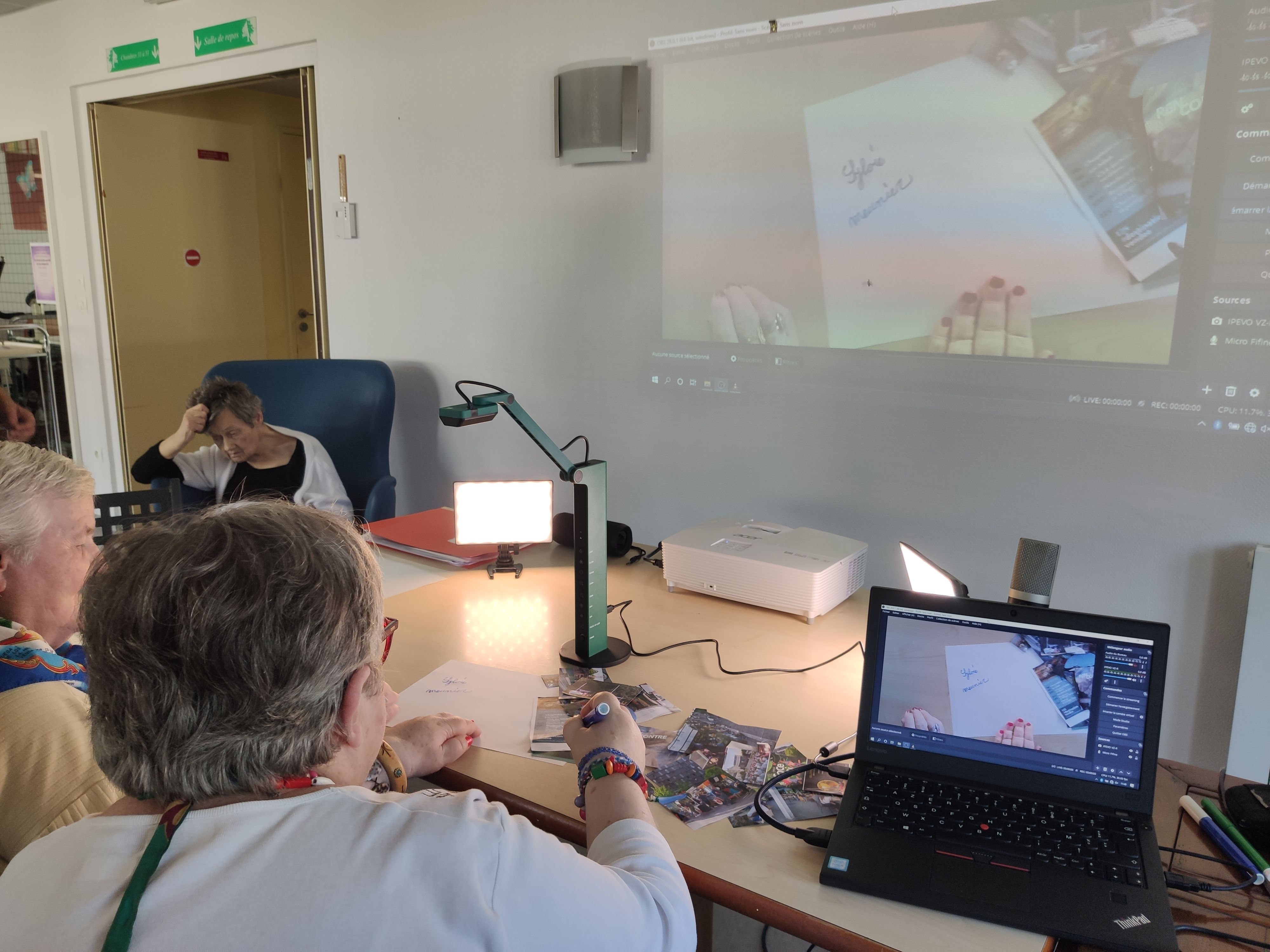
The loneliness of old age could be combated by the creation of objects, allowing the elderly to preserve their presence for themselves and others, thus restoring meaning to their social lives.
The Symptom of Age
The elderly must face a rather serious symptom: loneliness. The absence of social ties—or rather, their extreme scarcity—is partly due to the fact that their social network consists either of deceased individuals or those who have lost mobility and can no longer easily maintain social relationships with them. Today, digital tools could help, but they remain underutilized. Moreover, talking on the phone or via video calls all day does not constitute the most fulfilling social interactions.
The elderly thus suffer from isolation, which I call a symptom because it is like an external illness, yet perhaps also internal in some way—tied to their lifestyle, their way of being, from which the symptom arises: isolation, loneliness, and a sense of being disregarded by others.
The Missing Object
And indeed, what can we build, while we are in the “active phase of life,” with these very elderly individuals? Of course, we can exchange stories, gather testimonies, and learn from their experiences, but we can only do this once, twice, three times... It’s not enough. It remains relatively one-sided because these very elderly individuals can only offer us things from their life memories. But what can we give them in return, aside from our presence and the exchange we share? There is transmission, but what’s missing is a shared object of construction. It remains a dual relationship: I share my memories with you, and you are enriched; I share my presence, which connects you to life because, thanks to me, you are no longer alone.
What we do with other people, whether in personal or professional contexts, is create external objects—contributing to a professional project, going on outings together, etc.
True Empathy
Thus, what harms the very elderly is their loneliness, which is nearly impossible to resolve—unless we place them in the company of robots, which has proven somewhat effective and has been tested for several years. This will likely become even more common as these objects become more empathetic, even if we might attribute to them a false empathy.
In reality, empathy depends on what humans project onto the object. It’s the same with animals. A young animal, for example, interacts with us in its own way, but we use it to cultivate our own humanity, of which it is unaware. It is present in its animality, not in our humanity. There is thus a great deal of projection of our humanity that creates our sense of its empathy toward us. It will be almost exactly the same in our relationship with machines.
Presence in the Object: Personal, Social, and Desiring
I share here a reflection in the form of a proposal to improve the fate of old age. I propose the concept of presence to oneself in the object. What very elderly people who feel lonely lack is their presence in an object—whether painting, writing, singing, or any other creative object: knitting, driving, video games, etc. It is about investing oneself in the creation of an object external to oneself.
And for elderly individuals to engage in productive activities, they likely need to have prepared for it long before reaching very old age, as these activities require cognitive functions, activation of certain brain regions, and risk-taking. We venture to discover ourselves in our relationship to objects outside our bodily envelope. But even if this was not anticipated before entering old age, it can absolutely be cultivated, and new neural connections can emerge at any age—we’ve known this for quite some time now.
Thus, fostering autonomous creativity, rooted in personal desire for people of all ages—but especially the elderly—will have benefits in two complementary and indispensable aspects:
- On one hand, the fact that this person is present to themselves through the creation of external objects gives their life purpose: making something outside themselves that can be received by others. It is a mediating object for oneself and for others. The value of creating an external object is that the other person who appropriates it—reads, looks at, listens to, touches it—is completely free, not trapped in a dual relationship. This object, as a third element, allows both parties to be enriched by it.
- On the other hand, and this is very important, this external object enters a community of similar objects. For example, someone who embroiders will encounter the community of other embroiderers, whether directly in a local embroidery club or via social media—perhaps by sharing photos of their work and discovering others’.
Work: Always Socializing
Thus, this presence to oneself, thanks to the object that connects with other similar objects, also fosters social relationships—meaning, a sense of purpose. This is the question of work. We too often conflate work and employment. Once people retire, they feel useless because of this confusion. And we know very well that retired people can remain useful—by babysitting grandchildren, for example, or engaging in other activities, volunteering, etc. But all this requires energy, which not everyone has, depending on their physical abilities and lifestyle.
Therefore, when elderly people invest in creating external objects, they do so at their own pace, in their own singular way. There is no initial social pressure to engage in object-making. Presence to oneself via the object allows one to continue giving meaning to life, ensures these external objects gain meaning in relation to one another, and thus allows the very elderly to integrate into a meaningful social network—into work, into truly free and enriching activities for the social space and for others.
Creation: Taken Seriously
In my opinion, one of the great keys to addressing mental health in old age is personal creative work, which—via the created object—enables a relationship with the collective, thanks to this third function of the object. And note: I do not mean recreational practices dismissed as mere pastimes. I mean creative practices that are essential for oneself—objects that allow us to reveal ourselves first to ourselves.
One might object that not everyone has a creative soul and that this proposal cannot suit everyone. I strongly disagree, and my extensive experience across many domains and with many “audiences” proves it. Every person has things to express; every person gains immense personal benefits from their own expression; and every person can enrich others through their expression. No expression is without value. The only barrier is fear—something everyone experiences.
But once people are encouraged and take their expression seriously—meaning, once their expression meets the gaze of others—it enters reality. It is no longer “occupational therapy” to stave off boredom; these are objects that enrich others, quite simply.
This is easy to say, but it is a long journey because people lack self-confidence. Thus, guidance through creativity—developing one’s perspective, one’s subjectivity—is infinitely enriching, as people gain confidence and create things that truly enrich others.
The Meaning of Life
What gives life meaning? Being useful to others, because we are social beings. What do the elderly say causes them so much suffering? “I am useless,” because they no longer have children or grandchildren to care for—and even if they did, they lack the strength.
Thus, inventing these spaces, this confidence for the elderly, will change their lives—and also change the lives of many others, as countless people will be enriched by these creations.
Transcending the Amateur/Professional Divide
This requires completely rethinking the amateur/professional dichotomy, which is so problematic because it assumes a hierarchy in creations. It is a humanistic scandal, as it casts a veil of contempt over all non-professional productions. And this harms everyone without exception: those forbidden from expressing themselves (the vast majority, elderly or not) and all those who cannot receive what the elderly—and others—have to offer, whether amateur or professional.
Many examples illustrate this, but the most important thing, if one is facilitating such dynamics, is to resist a kind of well-intentioned miserabilism that would attribute incompetence or apparent debility to the elderly. Some might argue that certain individuals are truly beyond capacity and that only “occupational” activities are possible. This is absolutely false. They are “beyond capacity” due to damaged neural connections—but cultivating these connections can revive them. And the earlier we engage in this “cultivation of neural connections,” the more it reawakens the sense of life lived in presence to oneself, the object, and others. It is never too late.
Evaluating Creative Actions
In terms of evaluation, if we bring creations by the very elderly into contact with others—even if the elderly seem unaware of what is happening, or that others are enriched by their work—this is no reason to stop. It becomes a form of “art brut” that others can receive. For two reasons:
- First, we likely do not perceive everything these individuals experience internally. Even if we don’t see it, they may have received something from it. Our perceptions are limited to explicit signs.
- Second, even if the creators seem to gain nothing, others do receive something from these creations. Thus, in the end, in human exchange and collective construction, it will have contributed to others’ enrichment. So why deprive ourselves of this potential enrichment, even if it comes from seemingly unaware individuals?
In the Light of Nature
It’s like admiring a beautiful natural landscape. The landscape is not conscious of what it offers us. We decide to be enriched by it, and it can be profoundly moving. Why deny ourselves this enrichment? Our humanity is at stake in how we engage with things external to us—things that, a priori, do not interact with us. Yet we are still enriched, expanding our humanity, perceptions, and narratives about the world.
Thus, I advocate for a strong development of creativity—artistic or otherwise (no value judgments here)—for old age, in a real sense, not as mere occupation.
This requires deconstructing many preconceptions, but it will be immensely enriching for both beneficiaries and facilitators. It will challenge our views of social roles and even our self-perception as professionals. We might feel threatened, even in competition with the elderly—leading us, unconsciously, to diminish their contributions to retain our own power.
Implementation
Thus, encouraging creativity—always and for all—is, in my view, a key to mental health at any age, and society will emerge all the richer for it. But how can we take seriously someone we perceive as inferior in capacity, intelligence, speed, or efficiency? How can we imagine they are capable of creativity?
I myself have often led creative workshops for the very elderly, people with physical and mental disabilities, children, and all kinds of individuals. And every time, I observed extraordinary enrichment—for the participants as well as for myself. I have received as much, if not more, artistic value from these “anonymous” creations (by those who feel illegitimate) as from professional artists.
What I’m saying is this: once people are empowered to express themselves, all human beings have immense gifts to offer others. That is the power of creativity. We can be enriched by high culture, popular culture, or the culture of our neighbor—as long as we make space for it. Because if we see our neighbor only as someone to greet in the morning, we might miss all the ways they could enrich us and others—ways they themselves may not even realize.
Horizontal Mediation
This is why mediation is absolutely essential—but respectful, horizontal mediation, convinced it has as much to receive as to give. We can change the world, here and now, by creating respectful frameworks that empower people to express themselves. The path may be long, but it is vital to value every expression, even the most fragile.
What does it mean to “give value”? It means positioning oneself to receive what the other offers. Even something they are unaware of—a poem, the shaky way they hold a camera—we can receive something from it. Dare to embrace the most fragile expressions, let go of the fantasy of mastery, of an art whose value lies in technicality or aesthetic, narrative, or thematic criteria. This is how we remake humanity: by truly sharing our objects.
And to repeat: the key that unlocks all this is the presence of the mediator—their attention to the other, the legitimacy they grant simply by sincerely receiving what is offered. This is the key that will open everything. Presence in old age.

Presence as the fundamental grounding of our being in the world
Presence constitutes this fundamental grounding that connects us to ourselves and to the world, this quality of attention that transforms lived experience into inhabited consciousness. To be present is to resist the centrifugal forces that disperse us - the imminence that projects us into urgency, the denial that cuts us off from reality, the social injunctions that distance us from our interiority. Presence is neither withdrawal into oneself nor fusion with the exterior, but this creative tension between inner grounding and openness to the world. It is cultivated through paradoxical adaptation that requires sometimes absenting oneself to better find oneself again, through the complex geography of our inner states that vary according to contexts, through resonance with the waves that pass through us. Faced with drama that fractures, submission that empties existence, old age that isolates, presence becomes resistance and reconstruction. It is what allows us to transform the unexpected into opportunity, to maintain our integrity in turmoil, to create connection where solitude reigns. Cultivating one’s presence ultimately means offering oneself the present of the present moment, the source of all authentic transformation.
-

Vocal presence
A typology of voices at a distance and the kinds of presence they shape.
Making a phone call, leaving a voice message, joining a video call, listening to a podcast, watching a live stream, talking with a voice AI: six (…) -

What is Philosophy Today?
Crafting concepts from presence and lived life.
Every person carries a philosophy without knowing it, inherited from their culture. I try here to say what it is, for me, to do philosophy today, (…) -

Presence and memorisation
When silence becomes the founding act of knowledge.
A recent discovery in cognitive science reveals that ten seconds of silence after learning triples memory retention. This is not a mnemonic tip. (…) -

Presence and Comparison
Or how the quest for superiority diverts us from the essential.
I postulate that our obsession with comparison distances us from the only authentic way of existing: presence to oneself. This presence is not a (…) -

Presence and anxiety
A Dialectic of transformation.
For years, I have observed within myself the movements of anxiety, this tenacious companion that seemed to structure my relationship with the (…) -

Absence at the Blockage Point
Why our frozen identities prevent us from liberating ourselves.
We all carry impossibilities that define us. Every existence is traversed by aspirations that remain perpetually out of reach. And what if the (…) -

Presence and Isolation
On essential solitude as a condition of authentic thought.
Presence to oneself is born paradoxically from isolation. This fundamental solitude, far from being a withdrawal, constitutes the breeding ground (…) -

Presence and Drama
From absence as a stage to transformed presence.
How do we inhabit the drama that fractures us? Between salvific denial and transformative presence, I bear witness here to my path of identity (…) -

Presence and Tolerance
The art of accompanying without imposing, toward mutual emancipation.
How do we accompany those who seem frozen in their certainties? Authentic tolerance, allied with respectful presence, builds a space of trust (…) -

Social Presence and Physiological Health
What is the true elixir of youth?
Beyond diets, miracle remedies and “scientific progress,” the key to longevity lies in the depth of our connection to community. Lessons from the (…) -

Presence in the Unexpected
The art of grafting the unexpected.
Faced with the unexpected that thwarts the best-laid plans, should we resist or open ourselves? Perhaps the issue is not so much in this question. (…) -

Presence and adaptation
For an ethics of transformation.
Between active presence and constrained adaptation, cultivating an “adaptive presence”: an ethics of creative resistance in the face of (…) -

Leaving the house in the presence
Reflections on collective presence after lockdowns.
The lockdowns of 2020 and 2021 ultimately revealed our vital need to go out and share collective moments. This experience questions the meaning of (…) -

Presence and totality
When antagonisms reveal their synergy.
Presence, openness to the unexpected, seemingly opposes organized totality. Yet, an authentic presence to oneself and others can generate a living (…) -

Presence and value
To multiply human capacities.
Our presence in the world is guided by values whose roots are contingent and anecdotal. Becoming aware of this makes us more flexible in exploring (…) -

Adapting to presence
To be present is paradoxically to transform oneself, through absence from oneself.
To be more present, to oneself and to the world, one must adapt their presence—it is an act of will. And this leads to a paradox: being fully (…) -

Presence and sound waves
Our power to act on the waves that make us.
We exist in a vibrational universe. Our presence in the world is of a wave-like nature, and we can influence the quality of our presence through (…) -

Geography of presence
Life as a layered journey.
Our presence to ourselves varies depending on context. The concept of a “geography of presence” explains how our inner states transform, (…) -

Presence and earth
A short introduction to critical thinking on the eco-capitalist doxa.
We are present on Earth, nourished by it, yet we exploit it without coherence. Our so-called ecological awareness is accompanied by a blindness to (…) -

Presence and power of the spirit
For a politics of non-conformism.
The mind defines humanity and the uniqueness of each person, beyond the physiological. This singular essence allows us to enrich others while (…) -

Presence and suicide
Typology of presence before/after the radical choice of absence.
Suicide paradoxically transforms absence into an overwhelming presence. Grief involves symbolically constructing this absence to rediscover one’s (…) -

Presence and old age
For a neuro-social therapy.
The loneliness of old age could be combated by the creation of objects, allowing the elderly to preserve their presence for themselves and others, (…) -

Presence and submission
Temporal hypothesis of self-failure.
To be present to oneself is to offer oneself the present time, the source of integrity. Submission denies this presence, stealing our vital (…) -

Presence and time
Practical hypothesis of power over time.
We each have extremely varied experiences of time, depending on our general modality of presence in time, and our specific intentionalities at (…)


-

What is the place of human beings in the age of artificial intelligence? From function to being: a plea for rediscovered humanity.
AI surpasses our functions. Rather than a threat, what if this were an opportunity? There may be a chance to redefine ourselves not by what we do, (…) -

Observatory of cultural policies: “Images are like words for today’s young people” Video interview of Benoît Labourdette by the Observatory of cultural policies (5’, 2019).
Video interview with Benoît Labourdette: state of play of image practices and young people’s needs in terms of image education.Director: (…) -

Artificial Intelligence, a Tool for Emancipation in Mediation How conversational AI is opening up new possibilities for cultural and therapeutic mediation.
Since I began using conversational artificial intelligence in the context of cultural and therapeutic mediation in 2023, I have observed effects I (…) -

House of the image, Appointments of the image #6: “Intimacy, images, social networks. Existing and living together in the digital age” Trainings for image education
Training day and co-construction of educational tools to work on self-image, designed in collaboration between theMaison de l’image (Noémie Rubat (…) -

MPAA: Films for the 10th anniversary of the House of Amateur Artistic Practices Commissioning films and video content strategies
Five films to affirm the identity of a Parisian cultural institution, MPAA (House of Amateur Artistic Practices). House of Amateur Artistic (…)
