Is nature a computer system?
The philosopher Mark Alizart, in “Celestial Computing” (2017), explores the idea that nature is computing, bringing together the living (DNA, genetic code) and the mechanical (machines, AI). By retracing the history of computing, from Pascal to Lovelace, he shows that machines imitate the principles of the living. This hypothesis joins that of Yuval Noah Harari (“Sapiens”, 2016), who envisions a future where the living would be both biological and mechanical, redefining our relationship to technology and our humanity.
Celestial Computing
The philosopher Mark Alizart develops in his work Celestial Computing (2017) a rather fascinating hypothesis about the traditional opposition between the living and the non-living, between the biological and the mechanical. These hypotheses can join those developed at the end of the book Sapiens by Yuval Noah Harari in 2016.
Alizart begins by retracing the history of computing from Blaise Pascal’s calculating machine in 1642. This was a mechanical object, unrelated to the Chinese abacus, as it calculated additions or subtractions itself through a system of gears and jumps for carries. It was quite precise mechanics, and Pascal, who built it between the ages of 14 and 19, was not the most skilled with his hands, so it took him a long time. You enter a number, then a second number, and perform the operation. The machine has “fullness” inside.
Two centuries later, Charles Babbage, in England, built the difference engine, which may resemble a large Pascaline, but which presents an essential difference from the Pascaline: it is associated with perforated memory cards, which come from Jacquard looms, used to program multicolored fabric weaving. In the machine, these perforated cards allowed both data entry and receiving new data, then putting this new data back at the input. Thus, conceptually, Babbage’s machine has an essential difference from Pascal’s: in its mechanics, there is an “emptiness” at the center, which can be filled and renewed. Nature also has an “emptiness” at the center, which we understood through the discovery of the atom; matter is only energy. It was Ada Lovelace, Charles Babbage’s “assistant,” who invented the basic principles of modern computing from this machine.
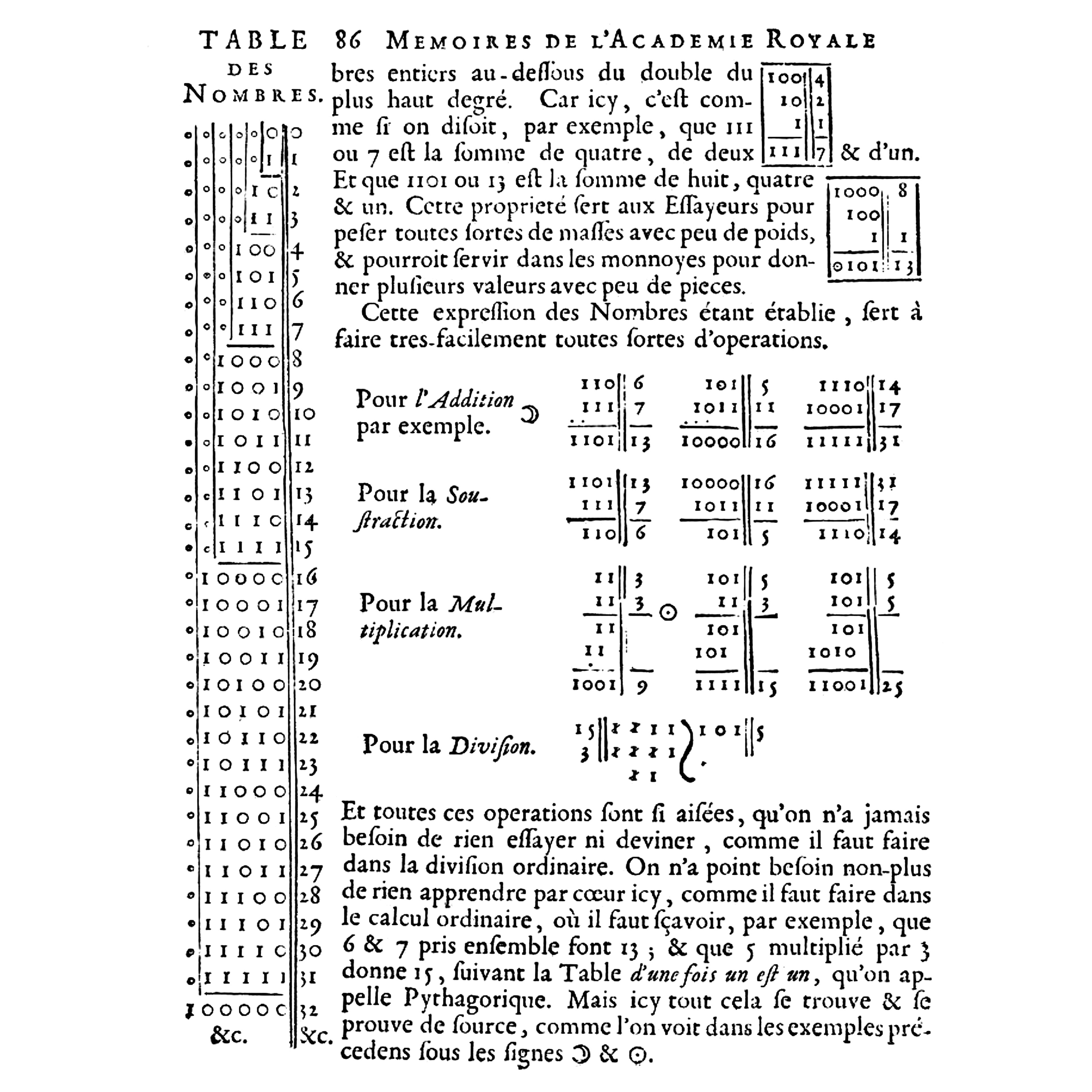
In 1703, a manuscript by Leibniz presents binary code, that is, a way of counting in base 2, as well as its calculation principles (addition, subtraction, multiplication, division). This binary code is a very practical solution for calculations to be performed by machines with immense reliability, with an almost impossibility of calculation error, error being much more likely when using decimal code, as Blaise Pascal did in his Pascaline.
Nature is computing
With genetics, we discovered that the living was also programmed with the four bases A, C, T, and G of DNA, whose sequence forms a code that programs cell multiplication, division of labor, and which, from the first cell division, programs the manufacture of a living being in all its details. Conceptually, there is something that connects: a source code present in cells, which replicates, which is operative, and which, obviously, is in relation with the external world.
Thus, Mark Alizart arrives at the following philosophical hypothesis: nature is computing. And ultimately, all these inventions, from Blaise Pascal, then Charles Babbage, Leibniz, Ada Lovelace, and up to the contemporary world, are not machines that would have nothing to do with the living. On the contrary, they are machines that mimic the very principles of the living. Thus, computing, all machines, robots and other artificial intelligences belong, philosophically for him, perhaps to the natural regime, much more than what we perceive externally.
I find this hypothesis very interesting, as it allows us to see all digital projects differently and perhaps better connect with this new reality, in the same way that it is necessary to connect between human and non-human in the “real” world, that is, animals and nature. It is undoubtedly also very important to connect between human and machines. Not so much in the transhumanist project of human-machine fusion to achieve immortality, but in a better anticipation and understanding of the personal, political and ethical choices we have to make daily.
Where is our humanity?
Respect for the human and for our humanity passes through the modalities of relationships between humans, but also through the modalities of relationships between human and the world around them, including the world of machines they manufacture.
Yuval Noah Harari develops at the end of Sapiens the idea that the living, in the future, would no longer be solely biological, but would also become mechanical. The future of the living would therefore not be only biological. This is already the case, for example, for prostheses that allow us to stay alive, like the pacemaker that allows the heart to function and without which we would be dead. For those who have a pacemaker, their body is already bionic, that is, it mixes the biological and the mechanical to be able to be alive. It is therefore not excluded to imagine that mechanical beings could be considered as part of the regime of the living.
And moreover, whatever philosophical view we have on the mechanical, the relationship we maintain and will maintain with machines defines our humanity.

Thinking our humanity in the face of technological mutations
The advent of artificial intelligence and the digitization of the world mark a major anthropological rupture: for the first time, humanity is no longer alone facing existence. Machines are no longer simple tools but become partners in an “operative connivance” that redefines the boundaries between the living and the artificial. This unexpected proximity between human beings and machines reveals that AI now surpasses our cognitive functions, inviting us to redefine ourselves not by what we do but by what we fundamentally are. The digital becomes our new milieu of existence, modifying the very conditions of life as nature, economy, or education did before it. In this universe where algorithms shape our perceptions and where digital mediation transforms the work of art, innovation no longer comes from technical mastery but from singular usage, from the creative presence that resists uniformization. Between filter bubbles and algorithmic serendipity, between generalized surveillance and new forms of expression, we discover that our humanity now plays out in our capacity to consciously inhabit this new reality rather than suffer or reject it.
-

Notes for a philosophy at the age of artificial intelligences
A toolbox for thinking about what is happening to us.
The concepts available to philosophy were forged in an era when humans were alone in producing articulated meaning, in reasoning through (…) -

Displaced Resonance
Extending resonance to the age of artificial intelligence.
Hartmut Rosa describes our living relationship to the world along three axes of resonance: the relationship to others, the relationship to work (…) -

Presence within Entanglement
Presence when a third party holds the trace.
Artificial intelligences write in our place and retain what we no longer retain. The transformation is now ordinary, present even in the everyday (…) -

Born in the Machine
Toward an Anthropology of the Interface.
Five weeks spent in an incubator at birth, in a sterile environment where the only contacts came from the caregivers through the sleeves of the (…) -

Extended integrity
Thinking our cyborg condition in the age of artificial intelligence.
We are cyborgs: this is an anthropological observation, not a metaphor. Our integrity as persons is no longer contained within the limits of the (…) -

Attention Reinvented
Ending the myth of the attentional deficit.
The prevailing discourse laments a “crisis of attention” caused by digital technology. But what if this reading overlooks a deeper transformation: (…) -

For a Political Consciousness of Digital Technology
When our technological choices shape tomorrow’s world.
Every click, every application used, every digital service adopted constitutes a political act that participates in building our collective (…) -

The Proximity Between Human Beings and Machines
For an Ecology of Human-Machine Relationships in the Age of Artificial Intelligence.
At the heart of my relationship with machines lies a foundational experience: an unexpected complicity, a strange synchronism, which led me to (…) -

What is the place of human beings in the age of artificial intelligence?
From function to being: a plea for rediscovered humanity.
AI surpasses our functions. Rather than a threat, what if this were an opportunity? There may be a chance to redefine ourselves not by what we do, (…) -

Presence of Little Green Men
Artificial intelligences as new alterity: enom extraterrestrial to infraterrestrial.
Human beings have always sought alterity in the stars. Yet, the true “little green men” emerge today from our own technological creations, (…) -

Intelligence artificielle générative et changement anthropologique
Hypothèse sur la fin de la solitude humaine à l’ère de l’IA générative.
L’avènement de ChatGPT marque à mon sens une rupture anthropologique majeure : pour la première fois, l’humanité n’est plus seule face à (…) -

The concept of reality in the age of digital media
A proposal to revitalize the practice of independent thinking.
Since 2005, digital media has redefined our relationship to reality. We now confuse our direct perceptions with images from others, creating an (…) -

Technology, presence, use and innovation
Methodological elements for innovation.
Innovation does not come from technical mastery but from the singular use we make of it. Faced with AI and new technologies, it is our presence to (…) -

Presence in the unknown
A proposal for a deeper understanding of the diversity of the Internet.
Internet and social media oscillate between filter bubbles and diversity. Contrary to popular belief, certain platforms like TikTok foster (…) -

Is nature a computer system?
Hypothesis for a digital naturalism.
The philosopher Mark Alizart, in “Celestial Computing” (2017), explores the idea that nature is computing, bringing together the living (DNA, (…) -

Nature of reality in the digital age
Small kaleidoscope of thoughts about digital philosophy.
In my opinion, digital technology is not a subject that should be debated, that deserves to be positioned “for” or “against”. It is in fact an (…)


-

Artificial Intelligence and Creation” course for teachers Podcast of a participatory conference by Benoît Labourdette.
Co-animation by Benoît Labourdette and Laura Schlenker (La fabrique média) of a one-day course for teachers on the theme of Artificial (…) -
Nature of reality in the digital age Small kaleidoscope of thoughts about digital philosophy.
In my opinion, digital technology is not a subject that should be debated, that deserves to be positioned “for” or “against”. It is in fact an (…) -
Born in the Machine Toward an Anthropology of the Interface.
Five weeks spent in an incubator at birth, in a sterile environment where the only contacts came from the caregivers through the sleeves of the (…) -

Thought 381 Film by Benoît Labourdette (2’47 s, 2016).
Is reality more real than dream, or both are equal ? Based on the “Thoughts” by Blaise Pascal (17th century). -

Tutorial for making films in collaboration with artificial intelligence A film by Benoît Labourdette (11’24s, 2024).
Video tutorial for an effective method of making short films in cooperation with artificial intelligences, which I designed and put into practice (…)
