The invisible art of material organization
In my digital cultural actions, I discovered that material organization transcends simple logistics to become a practical philosophy of mediation.
The materiality of the digital: a paradox to be tamed
My work in cultural animation leads me to transport and deploy a multitude of digital tools. Suitcases filled with small machines, potential tangles of cables, chargers, extension cords and various devices; this material reality of the digital is quite underestimated. Yet, as Bruno Latour reminds us in Enquête sur les modes d’existence (2012), « technique is never a simple means, it transforms the ends it is supposed to serve ».
This transformation begins with the organization of the material. Each properly coiled cable, each labeled box, each methodically arranged bag participates in the construction of a system that exceeds the sum of its parts. The material order I impose on these objects is not a constraint, but a liberation: it makes improvisation and adaptation in the field possible.
Philosopher Gilbert Simondon, in Du mode d’existence des objets techniques (1958), already emphasized the importance of understanding “technical concretization,” the process by which technical objects evolve toward an optimal form. In my case, this concretization involves meticulous attention to apparently insignificant details: choosing custom-cut gardening wire rather than plasticized metal wires that get tangled, the coiling technique that preserves cable flexibility, the spool always within reach to create new ties when needed, and to renew them so they’re always pleasant and quick to handle, for example.
Organization as a mediation amplifier
The material organization I’ve developed is not simply about technical management; it constitutes a fundamental element of mediation itself. Good organization allows, in identical time and space, the deployment of more devices, reaching more participants, enriching the proposed experience. As Michel de Certeau writes in L’invention du quotidien (1980), “space is a practiced place,” and this practice begins with how we organize our tools.
This organizational efficiency also has a non-negligible economic dimension. A well-designed system can be managed by fewer people than a chaotic setup that mobilizes additional energy to compensate for its disorder. The initial investment in time and thought to establish good practices, and its progressive updating, translates into substantial long-term savings, both in human resources and in material preservation.
I regularly observe, during collaborations, that these organizational skills are far from universally shared. Many people, not having received technical training, coil cables in a way that creates permanent twists, compromising their durability and ease of use, adding stress, and reducing concentration on what’s essential: cultural mediation, that is, the relationship with others. This observation echoes Richard Sennett’s reflection in Ce que sait la main : la culture de l’artisanat (2010): « Craft skill designates an elementary and enduring human impulse, the desire to do something well for its own sake ». This skill, traditionally transmitted in technical training, becomes essential for everyone in a context of democratization of digital tools.
The gardening wire technique: innovation through repurposing
My discovery of gardening wire as a binding solution represents what Claude Lévi-Strauss would call “bricolage” in the noble sense, the art of creating something new with the means at hand. This simple wire, cut to the desired length, advantageously replaces the metal ties sold specifically for this purpose. It allows quick tying and untying, without risk of tangling, and can be replaced instantly thanks to the spool I systematically carry. But to find the right gardening wire, easy to cut with scissors, flexible enough yet still rigid, and black in color, I had to test several dozen over the years, to finally find the one that suits me. This organization is a construction over time.
This approach illustrates what Tim Ingold calls in Faire : anthropologie, archéologie, art et architecture (2017) the “correspondence” between practitioner and materials. Gardening wire wasn’t intended for this use, but its adoption transforms the practice of organizing: from tedious chore, it becomes a fluid gesture integrated into the flow of activity, and the pleasure of building a pleasant future. At packing time, I no longer suffer the pressure of time that pushes to “stuff” the material anyhow into the bags. I take the time to reorganize on site, knowing that this invested time will be immediately profitable upon return to the office, making the next deployment more fluid and perhaps open to new possibilities. This also produces the pleasure of anticipating a fluid future, like a pleasant welcome for tomorrow’s self. And above all, it lays the foundation for easier availability of these tools for future actions, thus the possibility of adding new tools (which wouldn’t have been possible if everything had been more complicated, because poorly organized).
This discipline of immediate organization echoes the Japanese philosophy of kaizen, continuous improvement through small touches. Each session becomes an opportunity to refine the system, identify friction points, optimize processes. The material emerges from the activity not disorganized and fatigued, but ready for the next use, sometimes in better condition than upon arrival.
Organization as a condition for creative improvisation
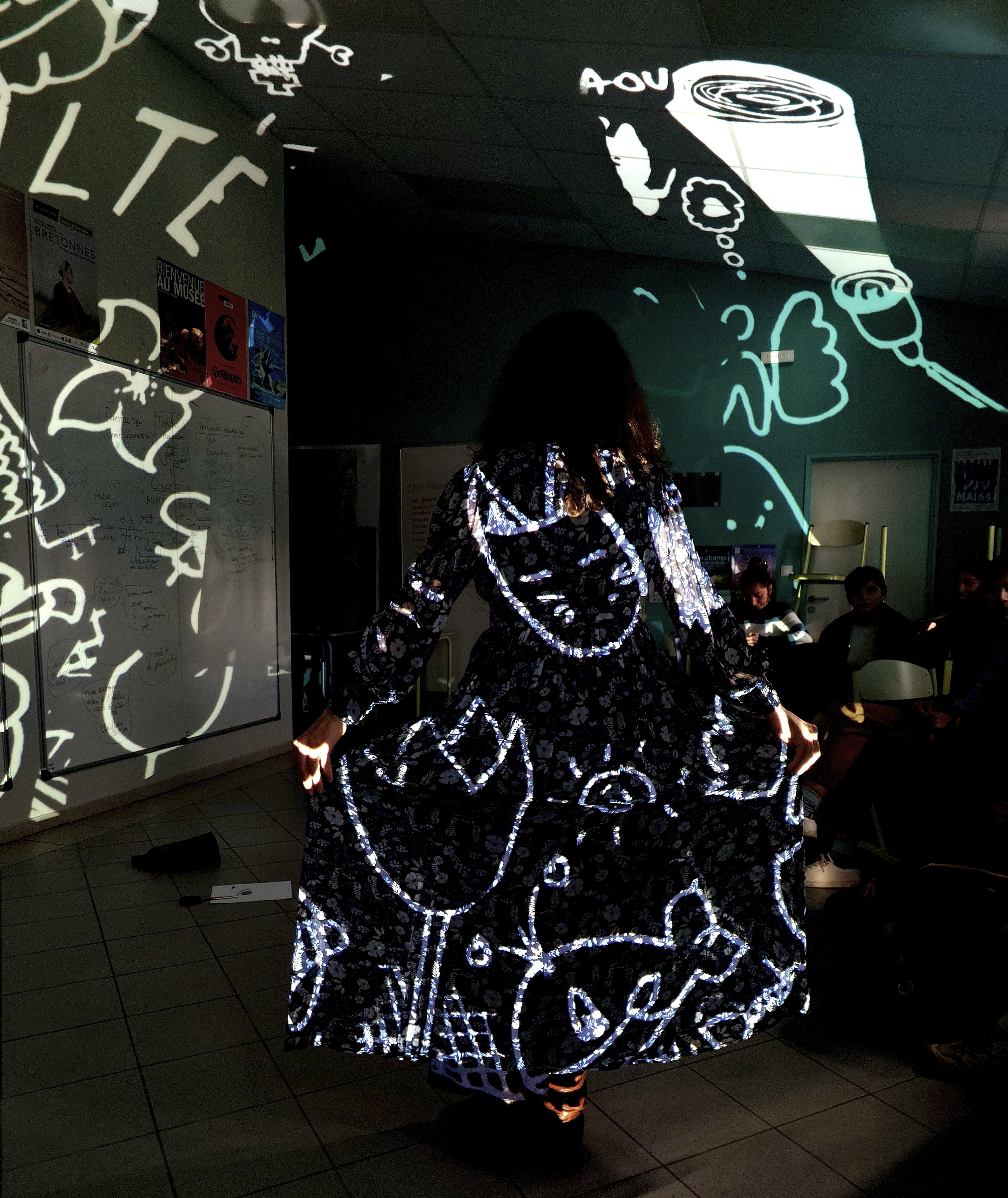
The launch project of the digital culture class in Lyon on VR perfectly illustrates how rigorous organization becomes the foundation of creativity. In a simple suitcase, I had gathered video mapping material, sound recording equipment and musical instruments. The uncertainty about the exact location of the intervention—I had requested a dark space without guarantee of obtaining it—could have dissuaded me from bringing this equipment. But the lightness enabled by my organizational system made this transport unproblematic.
This meticulous preparation reflects the notion of “organized serendipity” developed by Robert Merton: the ability to seize unforeseen opportunities through methodical preparation. The space proved suitable, and I was able to quickly deploy a collaborative artistic device that made an impression on the participants. For these digital culture classes, which have existed for over twenty years, it was the first time that a staged creative experience was offered from the launch session.
Material organization thus becomes what I would call an “invisible infrastructure” of cultural mediation. Invisible because participants perceive only the result, the fluidity of the experience, the richness of the offerings, the absence of technical downtime. But this invisibility is the fruit of considerable upstream work, constant attention to details, a practical philosophy that considers each technical object as an integral part of the mediation device.
Toward an ecology of technical organization
My organizational practice is part of a broader approach that I would qualify as ecological. Not only in the environmental sense—well-maintained material lasts longer, generates less waste—but also in the sense of an ecology of attention as defined by Yves Citton. The mental energy saved through good organization can be reinvested in the relationship with participants, in listening, in creative adaptation to situations, and in more open receptivity to innovations.
This approach requires going beyond the traditional dichotomy between conception and execution, between intellectual and manual work. As Matthew Crawford emphasizes in Éloge du carburateur (2009), thought is embodied in technical gestures, and conversely, technical gestures nourish reflection. The art of folding a cable correctly is not a subordinate skill but a form of embodied knowledge that fully participates in the success of the cultural project.
The democratization of digital tools transforms us all into occasional technicians, making these organizational skills increasingly relevant for varied profiles. My experience advocates for a broader transmission of this practical knowledge, beyond specialized technical training alone. Material organization, far from being a simple logistical prerequisite, constitutes an essential dimension of our capacity to create, share and transmit in the contemporary digital space.

You will find here methodologies that can be used directly to run cultural, creative, digital and audiovisual workshops.
-

The Ambient Sound Chorus
Having non-actors play the ambient sound of a scene live during the shoot, using simple musical instruments.
During a filmmaking workshop, when the shoot begins, how can we make sure everyone genuinely contributes, including those who are not acting or (…) -

The invisible art of material organization
When organizing materials becomes a philosophy of cultural mediation.
In my digital cultural actions, I discovered that material organization transcends simple logistics to become a practical philosophy of mediation. (…) -

The creative unconscious, a method for collective creation
When letting go becomes method. For a Taoist approach to audiovisual creation.
How can we explain that a group of people can produce a coherent cinematographic work in a short time without a script? A method that shows the (…) -

Participatory reverse photography workshop
A method for deconstructing relationships with images.
Pedagogical method that transforms the phone into a tool for collective creation to question our relationship with images, democratize the (…) -

Paths for projects for the prevention of violence through audio-visual practice
Pedagogical structure of a workshop.
Violence, and especially “gratuitous” violence, with no obvious explanation and operated by young people who are a priori not concerned, is a (…) -

Tutorials for doing video activities with your children
Podcast by Benoît Labourdette (1’37s, 2020).
Very simple tutorial (1 minute 30) to conduct two creative audiovisual activities with your children.During the confinement period in (…) -

Tutorials for making sequence-shot films
Podcast by Benoît Labourdette (17’30s, 2020).
Complete pedagogical method for making three types of films in sequence shot: collective film, animated film, memory at the window.During the (…) -

Book: “Image education 2.0”
Practical guide (free download).
“Image education 2.0” (under the direction of Benoît Labourdette), practical book of image education in the digital age, published by ACAP. Free (…) -

UPOPI : “What to do with a pocket camera?”
Teaching method : 7 sessions to make films simply with a phone or a camera... Read the articleWhat to do with a pocket camera ?Whether it’s (…) -

The Journal of animation : Action article “Making a film with a cell phone: creativity citizenship”
Manage a workshop with mobile phone.The Journal of animation monthly reference tool for facilitators of socio-cultural field, invited me in (…) -

CLEMI: Fact sheets video with mobile phone
Pedagogical and technical sheets for making video with mobile phone.CLEMI, institution of the Ministry of Education whose mission to teach (…)


-

Presence in the Unexpected The art of grafting the unexpected.
Faced with the unexpected that thwarts the best-laid plans, should we resist or open ourselves? Perhaps the issue is not so much in this question. (…) -
The creative unconscious, a method for collective creation When letting go becomes method. For a Taoist approach to audiovisual creation.
How can we explain that a group of people can produce a coherent cinematographic work in a short time without a script? A method that shows the (…) -

Multiverse Calligrams
-

Towards a distributed cultural sector Hypotheses on the commons and digital diversity.
What if digital cultures showed us how to build the commons through distribution rather than centralization? This hypothesis invites us to rethink (…) -

Education in the age of artificial intelligence Rethinking our practices for a changing world.
AI disrupts our relationship to knowledge, thus questioning the foundations of education. This transformation goes beyond the technical to touch (…)
