Participatory reverse photography workshop
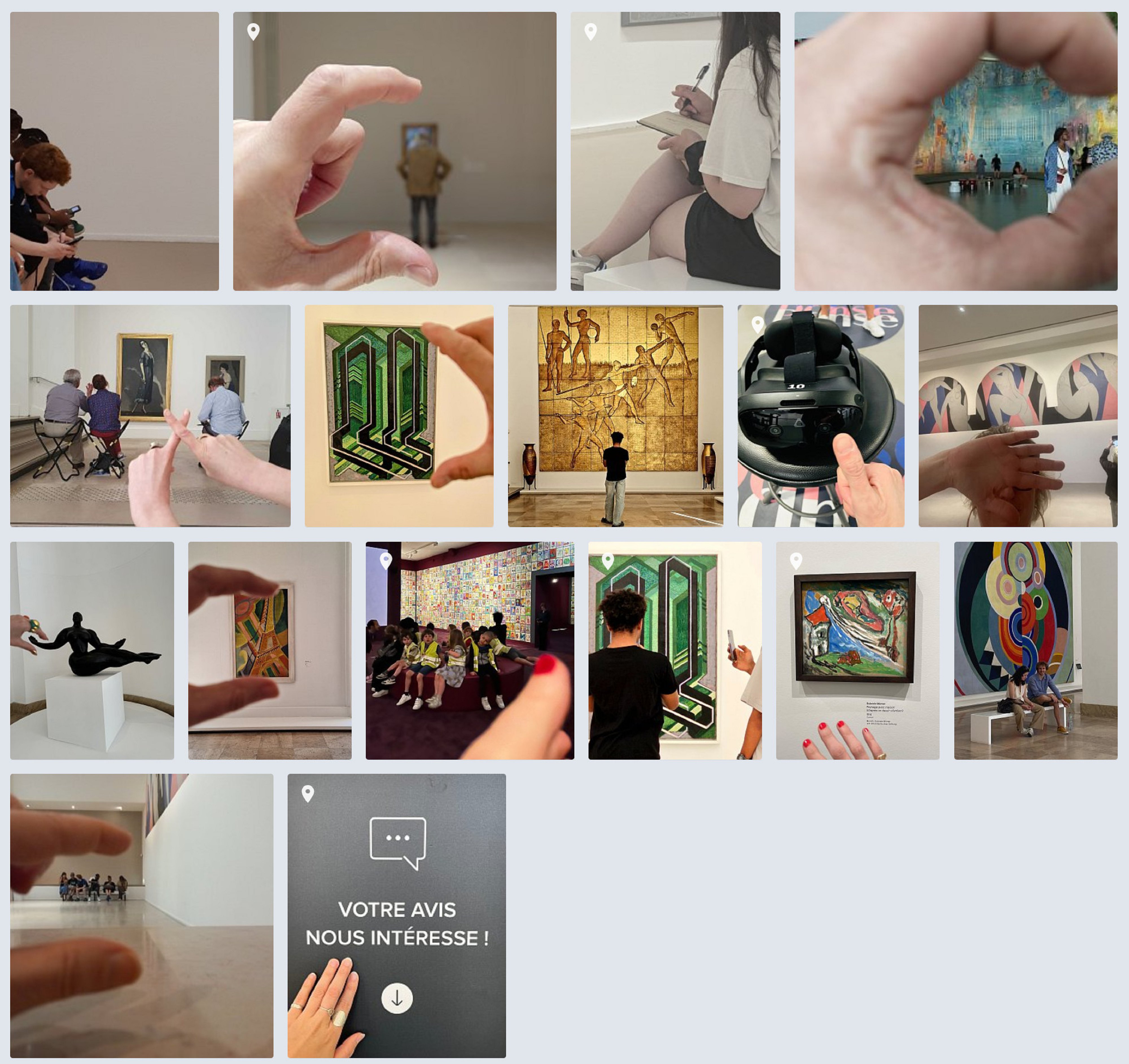
Pedagogical method that transforms the phone into a tool for collective creation to question our relationship with images, democratize the creative act, and build oneself in a benevolent social space.
An innovative pedagogical approach
The participatory photography workshop is a cultural action method that I have developed and put into practice very often, which transforms the mobile phone, an omnipresent object in our daily lives, into a true tool for collective creation and psychosocial, pedagogical, artistic or cultural reflection. I developed it in various professional training and cultural action contexts, ranging from youth protection educators to young people in social difficulty, groups of cultural venue directors, etc. This method allows us to democratize the creative act while questioning our relationship with images and the challenges of cultural democracy.
The workshop process
The workshop is built on a very precise protocol, but flexible enough to liberate creativity. We propose that participants each create a photo, then share it as a group. Initially, the facilitator proposes a common theme to participants, such as “culture and youth” for example, accompanied by a single formal constraint: each photograph must incorporate a hand, generally that of the photographer. This apparently simple instruction creates a visual thread that will connect all productions. It is fundamental to specify to participants that the image should not literally illustrate the proposed theme, but rather evoke it in a sensitive and intuitive way. Each photo will be identified only by the first name of its author, thus erasing professional or social hierarchies.
The actual creation phase lasts only fifteen minutes. Participants disperse in the available space, each working in complete autonomy with their own phone. This temporal constraint plays an essential role: it prevents over-thinking and favors the emergence of more instinctive creativity. During this short period of time, participants can take several shots, but must select only one. Thanks to a QR code provided by the facilitator that leads to a private web platform for photo sharing, everyone then uploads their photo to this shared space, immediately making accessible and visible the fruit of this both personal and collective creation. And those who have technical difficulties are helped by others.
The sharing moment constitutes the heart of the experience. In a darkened room, the photographs are projected in large format, thus creating a system that values each creation. A fundamental rule then structures the exchanges: the author of the projected photo does not have the right to speak. This prohibition, far from being a frustration, becomes the driving force of a remarkable collective dynamic, as other participants are invited to freely express what they perceive in the image, the emotions it arouses, the associations of ideas it provokes. The facilitator themselves participates in the exercise and submits their own photograph to the group’s gaze, thus establishing precious horizontality in relationships.
Theoretical and pedagogical foundations
This methodology rests on several profound pedagogical principles. The first concerns what I call the deconstruction of the “mastery fantasy.” The exercise reveals experientially that the creative act largely escapes its author. Through others’ views of their own images, participants discover dimensions, symbols, resonances that they had not consciously integrated. This awareness concretely illustrates the role of the unconscious, both personal and collective, in any artistic creation process.
The system also operates a radical reversal of traditional modes of presenting creative work. Instead of having to justify, explain or defend their production, creators find themselves in the position of discovering their own work through the prism of multiple gazes. This approach generates several strong pedagogical and psychological effects:
- It first values everyone’s creation independently of any prior artistic expertise, allowing museum directors as well as social educators to experience creative vulnerability in a benevolent framework.
- It then reveals the polysemic richness inherent in any image, demonstrating in a living way that a photograph never carries a single meaning but on the contrary opens onto a multiplicity of possible interpretations.
- The use of the mobile phone as a creation tool is not insignificant. This familiar object, which everyone masters technically, allows bypassing the intimidation that professional photographic equipment might cause. This technical accessibility constitutes a powerful democratic lever, making quality creation possible in complete autonomy. The speed of execution and sharing that this tool allows radically transforms the usual temporalities of collective creation, without sacrificing anything to the level of artistic requirement that irrigates this workshop. These are not “quickly made” photos, they are very invested photos, thanks to the initial instructions.
Multidimensional pedagogical interest
For professional audiences, the workshop offers much more than a simple introduction to photography. It develops a sensitive view of the world, a valuable skill in many professions beyond the artistic field. The experience of vulnerability that participants live, even those occupying high hierarchical positions, proves profoundly constructive. It allows them to understand from within the processes of artistic creation and reception, an experience particularly relevant for culture or education professionals.
On the level of image training, the workshop constitutes a true education of the gaze. Participants learn to see beyond evidence, to welcome the multiplicity of possible interpretations, to trust their creative intuition. This approach largely exceeds the acquisition of technical skills to touch on a deeper understanding of what it means to create and perceive.
The group dynamics generated by this system also deserve to be highlighted. The common constraint of a hand present in the image creates a visual link between all productions, generating a sense of belonging to a collective creation. The framework imposed by the workshop rules structurally establishes a posture of benevolence and mutual listening. The equality in risk-taking, including the facilitator, temporarily abolishes hierarchies and allows the emergence of authentic speech about creation.
Conditions for success and perspectives
Several conditions appear essential for the success of this workshop. The framework must be sufficiently secure to allow the expression of creative vulnerability. The prohibition made to the author to speak particularly protects from the temptation of defensive justification. The material valorization of creations, through their projection in large format in a dedicated space, confers symbolic importance to everyone’s productions. The constrained creation time plays a crucial role by short-circuiting over-reflection mechanisms to favor the emergence of intuition. Finally, the technical simplicity of the system, with the use of the QR code and shared space, guarantees fluidity that prevents technical obstacles from hindering the creative experience.
This methodology opens onto numerous possible transpositions. It can adapt to other mediums such as short video, sound capture or drawing, projected large thanks to digital technology. Application contexts can vary from school to associative settings, including therapeutic uses. Proposed themes can be adjusted according to the specific objectives of each training or cultural action. Longer formats can also be envisioned, transforming the punctual exercise into a long-term project.
A pedagogy of creative emancipation
The participatory photography workshop constitutes much more than a simple image training method. It represents a true pedagogy of creative emancipation that reveals to everyone their capacity not only to create, but also to enrich others’ gaze. By transforming an everyday tool into an artistic medium, by establishing rules that liberate rather than constrain, by creating conditions for authentic horizontality, this approach allows living a transformative experience. It demonstrates that art is not the privilege of a few but a fundamental human capacity that only asks to be revealed and shared. In our era saturated with images, this methodology offers a precious space to slow down, create consciously, and above all learn to truly look, together.
And finally, others’ gazes on my own production accompany me in legitimizing it, me who gave it no value. We don’t believe in the veracity of what others say about our creation, but since we ourselves react to others’ images, we know it’s true. Thus, others’ gazes have the effect of constructing ourselves, and also establish our legitimate place in the social space symbolized by this “exhibition.”

You will find here methodologies that can be used directly to run cultural, creative, digital and audiovisual workshops.
-

The Ambient Sound Chorus
Having non-actors play the ambient sound of a scene live during the shoot, using simple musical instruments.
During a filmmaking workshop, when the shoot begins, how can we make sure everyone genuinely contributes, including those who are not acting or (…) -

The invisible art of material organization
When organizing materials becomes a philosophy of cultural mediation.
In my digital cultural actions, I discovered that material organization transcends simple logistics to become a practical philosophy of mediation. (…) -

The creative unconscious, a method for collective creation
When letting go becomes method. For a Taoist approach to audiovisual creation.
How can we explain that a group of people can produce a coherent cinematographic work in a short time without a script? A method that shows the (…) -

Participatory reverse photography workshop
A method for deconstructing relationships with images.
Pedagogical method that transforms the phone into a tool for collective creation to question our relationship with images, democratize the (…) -

Paths for projects for the prevention of violence through audio-visual practice
Pedagogical structure of a workshop.
Violence, and especially “gratuitous” violence, with no obvious explanation and operated by young people who are a priori not concerned, is a (…) -

Tutorials for doing video activities with your children
Podcast by Benoît Labourdette (1’37s, 2020).
Very simple tutorial (1 minute 30) to conduct two creative audiovisual activities with your children.During the confinement period in (…) -

Tutorials for making sequence-shot films
Podcast by Benoît Labourdette (17’30s, 2020).
Complete pedagogical method for making three types of films in sequence shot: collective film, animated film, memory at the window.During the (…) -

Book: “Image education 2.0”
Practical guide (free download).
“Image education 2.0” (under the direction of Benoît Labourdette), practical book of image education in the digital age, published by ACAP. Free (…) -

UPOPI : “What to do with a pocket camera?”
Teaching method : 7 sessions to make films simply with a phone or a camera... Read the articleWhat to do with a pocket camera ?Whether it’s (…) -

The Journal of animation : Action article “Making a film with a cell phone: creativity citizenship”
Manage a workshop with mobile phone.The Journal of animation monthly reference tool for facilitators of socio-cultural field, invited me in (…) -

CLEMI: Fact sheets video with mobile phone
Pedagogical and technical sheets for making video with mobile phone.CLEMI, institution of the Ministry of Education whose mission to teach (…)


-

“Image carriers” Brittany - Training “portable cinema” Trainings for image education
At the invitation of the UFFEJ Britanny (Laurence Dabosville), I proposed a day of training for project managers “Smugglers images” of the (…) -

Work or mastery ? Methodology of the productive action.
How do we achieve the best possible result in the work, in the construction? In my opinion, contrary to popular belief, it is not the search for (…) -

“Artificial Intelligence: stop or yet?” - Workshop for the creation of an exhibition Master 2 Audiovisual and Digital Media - Grenoble Alpes University.
Facilitated a multimedia workshop to help a group of students take an in-depth look at the challenges of Artificial Intelligence through their own (…) -

Formalizing the informal Informality, essential to learning, resists structure while calling for it. How to tame it.
The absence of informal aspects in distance learning forces us to rethink its fundamental nature. This constraint becomes a laboratory for (…) -

ESAV Toulouse : Pocket Films Workshop Pocket Films Workshops for professionals
Twenty-six films made in three days.Since 2006, barely a year after the appearance of cameras in mobile phones, I teach at the School of Cinema (…)
