Workshop immersive techniques for creating an exhibition
Students in the Master 2 Audiovisual and Digital Media (AVMN) program at Grenoble University were asked to organize an exhibition on the theme of voluntary interruption of pregnancy (IVG). A methodological account of part of their journey in the process of creating this exhibition.
The framework
This master’s degree is not primarily focused on the expographic dimension, but we integrated it a few years ago, as the mediation of video (as well as sound, scenography, etc.) in physical spaces is now fully part of the audiovisual field.
Myself, Benoît Labourdette, and Romain Baujard, led a 3-day workshop at a key moment in their work process, at the invitation of Laurie Schmitt, the Master’s program’s pedagogical director.
Student needs
The students, divided into four teams for four parts of the exhibition, worked on their angle (four angles: the divide between for and against, the struggle on the visual side, social pressure against abortion, sorority). What we feel needs to be worked on at this stage is:
- the concreteness of content creation, commensurate with their means.
- personal involvement and commitment to the content itself.
- the exploration of available technical resources and the invention of devices.
- a general idea of the scenographic and immersive device.
Creation of visual material
I brought a large number of books on feminism and democratic struggles. I began by asking the students to create content from these books, using photos and their phones, which could be reused in the exhibition. It’s a subjective collection of what they find meaningful and sensitive. This collection is collective; it’s a “common pot” that’s created. So they have to pay particular attention to the framing of the photos. Most of these documents could not have been found on the Internet. So it’s directly a very qualified content that they create, it’s not an exercise. They upload the photos themselves via the “private cloud” I’ve set up (accessible below).


I find it quite “impressive” to immediately see the great value of this content, all the inspiration, very concrete, that their photographs can give to create an exhibition. And it enabled them to approach the subject in a way other than through Internet research.
Bibliography
Meanwhile, in another form of surveying, I take photos of the covers and back covers of the books I’ve brought along, to place in another “bibliography” folder. Most of these books were unfamiliar to the students, and this can be very useful. What you don’t write down, what you don’t keep a physical record of, is often forgotten. So I offer them this resource, a qualified bibliography on the theme of feminism.

Podcasts of book extracts
In order to bring them even closer to reading material that already fascinates some of them, I suggest that they create podcasts, individually, which are readings by each of them of extracts from books that have “spoken” to them. In this way, in a short space of time, we’ve also collected some fascinating audio content: (you can listen to them by browsing the “cloud” at the bottom of the article).

The podcast is recorded face-to-face, in front of a high-quality microphone (Fifine K670), connected via USB to a simple laptop. So, after each recording, I rename the audio file and immediately put it online. So all this content is well-indexed material that’s easy to find and exploit if need be. It’s not hosted in a dependency of a multinational, but on the server of my website.
Summary podcasts of the four projects
To reconnect them to their projects, after a break, I suggest they record four podcasts, one for each group, to synthesize their projects:

Character videos from books
Then, to step up a gear in terms of creativity, I suggest that they individually create a video based on a filmed book: a character (taken from the book) who speaks to us. So we create a documentary fiction, based on the books, their content and their visuals:

This exercise, like the others, I also do with them, to “set an example” of my own willingness to expose myself. In my opinion, one of the most important pedagogical challenges is to help them dare to be themselves, to discover themselves and others.
I’d also like to give them the chance to experience things in a way that makes them realize that, even with limited technical resources, if you put a lot of effort into the background work, you can create important, usable content.
Collective Sound Ambiences
An exhibition immerses us in a space. One of the aims of this workshop is to work on immersive techniques. Sound is the primary factor in creating a sense of immersion. I ask them to create, in teams, four sound ambiences, adapted to their part of the exhibition. To do this, they use the simple microphone on their phone.

When listening together (I brought along a quality Bluetooth speaker), you realize just how good the sound quality is. What’s more, their ambiences are already usable in their own right, which is a real step forward. They’ve put a lot of effort into it, and you can hear it.
Podcasts of testimonials on abortion
At the end of this very busy first day, I get them to work on their subjectivity at another level: each of them records a personal testimonial podcast on abortion, using their own personal emotions. An abortion close to home, or the effect an abortion story has had on us. Each person engages his or her subjectivity to the full, and records with his or her phone, in isolation, in a space that provides a sound ambience. Then, each person puts their podcast online. Of course, I do the same. These testimonies are very beautiful, some of them deeply moving. The moment of collective listening is a very beautiful and important moment.

The first day thus came to an end, after having created a great deal of usable photographic, sound and video content, with a moment of deep involvement. I hope that the students were able to appreciate how their personal point of view was undoubtedly the richest thing to share.
Video-mapping tests
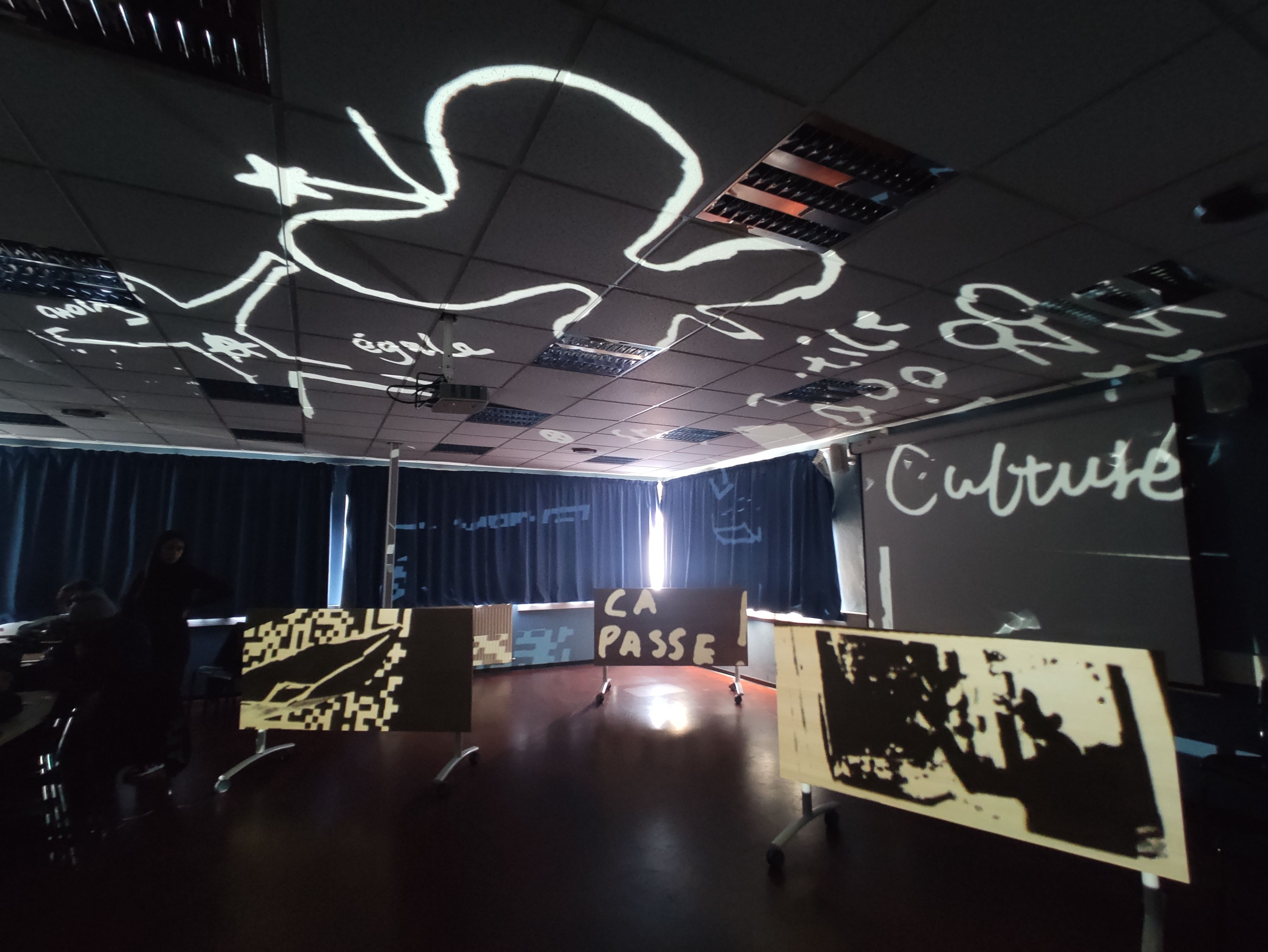
The next morning, I had them test the home-made video-mapping device I’d developed, using an IPEVO VZ-R title-bench camera combined with a short-throw projector. The camera is set to “negative” mode, so that texts, drawings or even animated images (thanks to telephones) appear in white on the walls as if by magic.

The purpose of this moment is purely to experiment, and to keep photographic traces of it, for inspiration. Some wonderful inventions come out of it, notably the “ox” effect created by animated images in negative.
Video editing with Capcut
To round off my talk, I suggest they get to grips with the free video editing software Capcut, which can be installed on both phones and computers. This tool, which is geared towards creativity, is highly ergonomic and enables them to produce truly unique audiovisual creations in a very short space of time. In just 15 minutes, each student makes a montage, which they upload to a private cloud:

We end my workshop by viewing these montages, each more inventive than the last. They realize just how much creativity is within their grasp, and just how quickly certain tools can be used to produce high-quality audiovisual objects.
Concrete experiments for the exhibition
The next day and a half is devoted, with Romain Baujard, to explorations with the equipment available at the university and in the large studio that will host the exhibition.


The practice of feminism seems to me to be an essential stake in the cultural actions, because the awareness of the systems of domination allows to go towards more equality, therefore to contribute to the democracy. The inequality between women and men is for me a cornerstone of the dominations that harm everyone.
But how to “put feminism into practice” concretely in public proposals? How can cultural actions, whatever their field of implementation (artistic, social, educational, professional...), arouse inner movements towards more respect of human rights? It is not a question of stating a normative feminist discourse, but of putting into practice an equality in the ways of acting. This is much more delicate and delicate to do than one might think, because it involves questioning one’s own unconscious functioning.
I share here some resources, partial, from my own pathways, practices and questionings: proposals and stories of cultural actions, working methods, methods of artistic creation and more conceptual or biographical reflections.
-

Domination on Display: An Ethnological Analysis of the 51st César Ceremony
Eight years after Blanche Gardin, six years after Adèle Haenel, nothing has changed. The system has even strengthened itself.
The César ceremony is a ritual. Not an artistic ritual, but a social one, whose analysis reveals the mechanisms of domination at work in the (…) -

Patriarchal feminism
When emancipation can reproduce patterns of domination.
Surprisingly, certain forms of struggle against patriarchy can unintentionally reinforce the very structures they seek to combat, particularly (…) -

On systems of domination in the film industry
The reasons for the violence are not what you might think.
The film industry is built on deeply entrenched systems of domination. These hierarchical mechanisms legitimize violence, including sexist (…) -

Workshop immersive techniques for creating an exhibition
An account of a method for constructing a point of view and an exhibition.
Students in the Master 2 Audiovisual and Digital Media (AVMN) program at Grenoble University were asked to organize an exhibition on the theme of (…) -

A definition of feminism
A thought movement in dialogues.
Here is my definition of feminism, from my place as a man: it is for me a movement of thought and action for equal rights between women and men, (…) -

Podcast: “For a democratic and feminist pedagogy”
Dialogue between Noémie Rubat du Mérac and Benoît Labourdette on June 25, 2022.
Overview of the fundamentals of the pedagogical actions conceived and carried out by Benoît Labourdette, linked to the deconstruction of systems (…) -

Collective film shot in a movie theater
Creative participation method.
Giving a voice in a creative way to the spectators of a movie theater, before the screening of a film.I put this proposal into practice in the (…) -

Equality is not won!
A collective film (3’12s, 2022).
An intergenerational film to become more aware, and more equipped, to defend equality. -

Fragments of lives
A collective movie (3’20s, 2022).
By sharing all our views, even the most intimate ones, we become stronger! -

Putting yourself in the other person’s shoes
A collective film supervised by Benoît Labourdette (2’40s, 2021).
Collective empathy exercise. -

Women’s voices
Immersive digital device, designed by Manon Gady and Maïa Hoog.
Immersion in feminist demonstrations, in the word of women.Device conceived and realized by Manon Gady and Maïa Hoog, students of the class of (…) -

Writing workshop in inclusive language
Literary game.
Literary writing game in inclusive language, which can be offered even for a few minutes, in all types of settings and for all ages.Inclusive (…) -

Feminist Contemplation
Participatory art installation.
Words projected on the walls transform a simple place into a space that invites an intimate thought of feminism.Installation realized in (…) -

The feminine neutral
Speaking method.
Count the number of people present, and if there is a majority of women, suggest the game of using the “feminine neuter”: “all of us” instead of (…) -

In front of our eyes
Collective film (3’10s, 2021).
Behind every object, the patriarchyIt is a chain, a sequence shot: each person films an object and gives it life, through the voice, putting (…) -

Gisèle Halimi Feminist Film Festival - Ville des Lilas: “Female gaze” workshop
Film creation workshop, to decode the images.
Male gaze ? Female gaze? What is the difference? How do images place us in positions of domination or submission? In the lobby of the Garde-Chasse (…) -

What kind of world do we want?
A film by Benoît Labourdette (0’54s, muet, 2020).
Bibliography in 2020 for the emancipation of women and men. -

Audiovisual workshops to combat gender stereotypes
Methods for audiovisual creativity.
Thought-provoking ideas and proposals for audiovisual workshop concepts for nuanced and useful actions, with the aim of building critical thinking (…) -

Sexuality #01
A film by Benoît Labourdette (2’28s, 2020).
Sexuality, that intimate space that we experience as natural and spontaneous, is in fact largely constructed by our culture. For more sexual (…) -

Domination
Un film de Benoît Labourdette (1’26s, muet, 2017).
Rebattre les cartes des systèmes de domination.


-

“Artificial Intelligence: stop or yet?” - Workshop for the creation of an exhibition Master 2 Audiovisual and Digital Media - Grenoble Alpes University.
Facilitated a multimedia workshop to help a group of students take an in-depth look at the challenges of Artificial Intelligence through their own (…) -
Feminist Contemplation Participatory art installation.
Words projected on the walls transform a simple place into a space that invites an intimate thought of feminism.Installation realized in (…) -
What kind of world do we want? A film by Benoît Labourdette (0’54s, muet, 2020).
Bibliography in 2020 for the emancipation of women and men. -
On systems of domination in the film industry The reasons for the violence are not what you might think.
The film industry is built on deeply entrenched systems of domination. These hierarchical mechanisms legitimize violence, including sexist (…) -

The specter of the other From anxious dehumanization to confident recognition.
How can the other, a subject of rights, become a threatening figure? A reflection born from a confrontation with reality, beyond the fantasies and (…)
