Receiving, or the difficulty of doing nothing
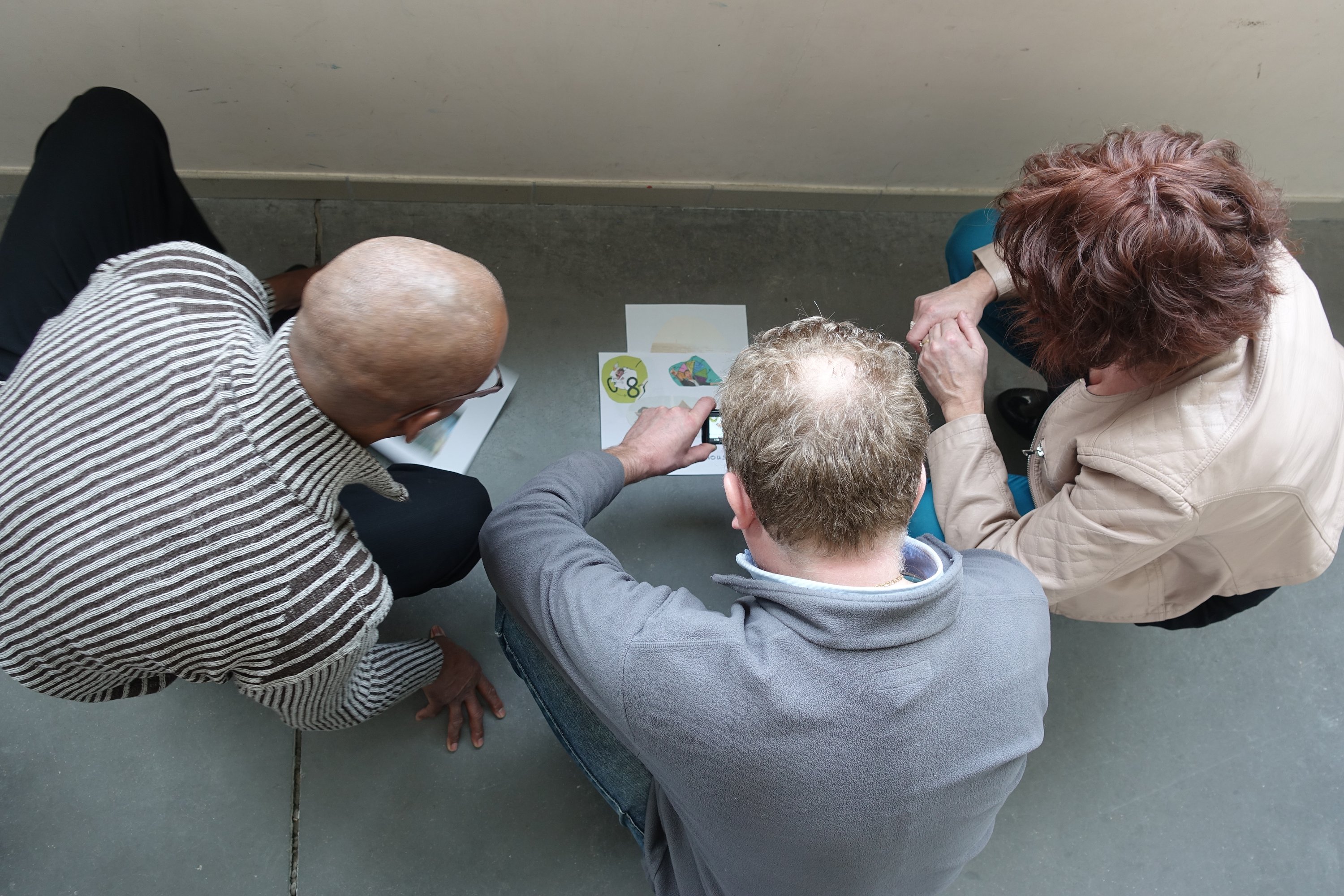
By the end of the day I am tired, with a physical tiredness, even though “I have done nothing,” because I have spent the day placing myself in a state of receiving. I said this sentence one day to students I was training, and it took me years to formulate. In mediation, receiving what others bring is the most demanding act.
The practitioner’s activism
Our professions value action. To be a professional is to do something: to organize a workshop, give instructions, accompany the participants, solve technical problems, manage time. The practitioner who does nothing isn’t working. That, at any rate, is what we have internalized.
This belief is a trap that pushes us to fill all available time with activity, never to leave any emptiness. By doing so, it closes us off to what comes from others. To receive what others bring, we need a free inner space; we need not to be in the middle of doing something else; we need to be available. Availability is the opposite of activism.
Donald Winnicott spoke of the capacity to be alone in the presence of another. This capacity, which a child develops by knowing that the mother is there even when she is doing nothing, is also what the mediator must cultivate. To be there, fully, without doing. To be available to what comes, without anticipating or directing it. From the outside this state of presence resembles passivity; it is a form of active attention.
We aren’t working right now!
I remember a workshop facilitator who was in training with me. We had sent some young people out to film on their own for forty-five minutes, so we had forty-five minutes to wait. We were waiting for them to come back. And she said to me, full of anxiety: “But we aren’t working right now! What are we doing? We aren’t doing anything!”
I explained to her that when the young people came back and we sat down to watch their films together, our role would be to receive. Perhaps it would not be what we had expected. Our work would be to give back to them what we had received from their films, what their films had done to us. To let go of our criteria of judgment, to give back what we had seen as precious, even if it was not what we had been waiting for.
To be in a state of receiving, that pause was needed. If we had spent those forty-five minutes in action, preparing what came next, tidying up, organizing, we would have been less open at the moment of return. That pause was a time of preparation for reception, time gained on the quality of our presence.
This quality of presence, at the moment when the participants come back and show us what they have made, is essential. Seen from the outside, it can appear superfluous: it is only a gaze, and a gaze changes nothing about the object it looks at. We have the impression that it is an addition, a commentary after the fact. But art is experience, as John Dewey reminds us in Art as Experience (1934). In creation, the moment of reception is part of the work; it completes the work as much as it reveals it.
When we have placed an order, when we have proposed a frame, asked people to film, to photograph, to write, our gaze on what they have produced is not external commentary. It is part of the creative act itself. The same does not hold for spontaneous individual creation, which follows a different logic, where the author is their own instance of validation. Here, we are the ones who commissioned the work, and our gaze is structuring.
If we do not exercise this gaze, if we do not give this moment the attention it deserves, we send people back to a terrible solitude. As though we had opened a door onto their expression, onto their sensibility put into shared space, and slammed it in their face. This violence is all the greater for following a movement of opening: we have invited the other person to take a risk, to show something of themselves, and we then fail to receive.
To be looked at is to exist. We know this in love relationships: someone who is not looked at loses confidence in themselves. We do not live in autarky; we are caught in a system of bonds. When we say that people must build their own self-confidence, that is true, but this building does not happen in isolation; it is structured by the bonds that hold us. Our role, at this precise moment, is to make a bond. This is what makes it so difficult to defend: we are making nothing, we offer a quality of presence that allows the other to exist.
This capacity to make a bond is internal; it is prepared and cultivated. When it is not there, the work we have patiently built can be undone in a few minutes.
The fatigue of receiving
It happens to me regularly, at the end of a day of workshops, to feel emptied. With an almost physical tiredness. And yet, when I look back at my day, I have the impression of not having done much that is visible. I have not fabricated anything, I have not edited any footage, I have not taught at the blackboard. I set up a space, gave a few instructions, then watched people work. After that, I looked, with them, at what they had made.
This tiredness is the proof that receiving is work, a work of transformation. When I receive what others have made, I open myself to something that does not come from me, that does not match my expectations, that may surprise me, disturb me, move me. I apply no filter, I take it in. This openness has a real energy cost.
The human brain represents about 2% of body mass but consumes nearly 20% of the body’s metabolic energy at rest. This consumption rises sharply when the brain is mobilized in sustained attention, which is the case when we receive what another person addresses to us. Several circuits work at once: working memory, which holds onto what has just been seen or heard; the prefrontal areas, which inhibit automatic judgments to make room for what is presenting itself; the networks tied to empathy and theory of mind, which allow us to represent what the other person is experiencing. Keeping these circuits active together, over time, has a real metabolic cost. The tiredness we feel at the end of the day has a precise biological reality.
The professionals of care know this, from the position that is theirs. Therapeutic listening is exhausting because it receives. One holds oneself in a state of availability to what the other brings, with their emotional charges and their silent inner work. Mediation through artistic creation mobilizes the same energy, in a different mode.
The time of looking
I have observed, over the years, that in most creative workshops a great deal of time is spent making and very little time looking at what has been made. Making takes up all the space. Looking at the productions is rushed at the end of the session, hurriedly, before everyone leaves. As though the time of making were the useful time, and the time of looking a supplement.
I propose the opposite. A quarter of an hour to make a photograph, an hour to look at it together. This imbalance restores the right proportion. Making is the moment when people produce something. Collective looking is the moment when this something acquires meaning, where the image becomes polysemic, charges itself with the readings of others, reveals itself to be richer than what its author had thought. It is the moment of symbolization.
This time of looking is also a time of mutual reception. Each person receives the gaze of others on their image and gives their gaze on those of others. This exchange does not pass through judgment, but through the sharing of what one sees, what one feels, what the image makes one think of. The heart of mediation lies there, in shared reception more than in making.
This gaze is costly for the mediator, but also for everyone present. Receiving what one has made oneself, and receiving what others have made, asks of each person an inner mobilization that nothing in our school or professional habits has taught us to provide. This is why these moments are difficult, and why participants sometimes have trouble remaining attentive. What we read as inattention is in fact the effect of an expenditure of energy that exceeds what we are accustomed to mobilize. Our role as mediators therefore includes an attention to the energy others are mobilizing in order to remain present, and to what we can ask of them without exceeding their capacity.
What mediators make by doing nothing
In our professions we have to give renewed value to the time of non-action: the time when we wait, when we watch others work without intervening, when we prepare ourselves to receive. This time is not dead time; it is time of inner preparation and openness.
What the mediator makes by doing nothing is availability, space for the other person, a quality of presence that authorizes the other to take a risk, because they know that someone is there to receive what they are about to do.
In a professional world that values productivity and measurable results, it is difficult to defend the fact that one is paid to wait, to look, to receive. And yet this is the heart of this profession, and what makes it demanding despite its apparent lightness.

Cultural mediation, as I conceive and practice it, is not primarily a set of techniques, but an ethics of relationship. It consists of creating the conditions for a singular experience for each person, with respect for their dignity and cultural identity. This section brings together methods I have developed through my interventions, as well as reflections on the contemporary challenges of mediation.
These methods share a few common principles. They place the person, not the artwork or knowledge, at the center of the process. They recognize that receiving is creating, and that each participant generates their own experience. They are rooted in the perspective of cultural rights and cultural democracy, that is, in a horizontal rather than top-down logic.
In practice, these methods often rely on creation: making a film with one’s phone, animating a paper cutout image, writing collectively. Creation is not an end in itself, but a means of bringing about an authentic experience, of allowing each person to reveal themselves to themselves and to others. Constraints of time, format or technique are not obstacles but frameworks that liberate expression.
I share these methods here not as recipes to be applied, but as invitations to experiment. Each context, each group, each person calls for adaptation. What matters is the quality of the relationship one establishes, the space of trust one creates, the place one gives to the other. The reflective articles that accompany these methods aim to nourish this permanent attention to what is at stake in the encounter between people around art and culture.
-

The bond that sets us free
Toward an ethics of the bond in mediation and support work.
To emancipate those whom we accompany, and to emancipate ourselves in the same gesture: this, in my view, lies at the heart of any practice of (…) -

Letting Go of One’s Criteria
What the practitioner must agree to lose for mediation to work.
In the cultural and therapeutic mediation workshops I lead, the challenge is to create the conditions for people, often unsure of their own (…) -

Receiving, or the difficulty of doing nothing
The mediator’s invisible time and the energy of welcoming.
By the end of the day I am tired, with a physical tiredness, even though “I have done nothing,” because I have spent the day placing myself in a (…) -

Work and Mastery (2)
Distinguishing work from mastery in mediation-based creation.
Work (as a process by which people are transformed through doing) and mastery (as the illusion of control over what one produces) are two distinct (…) -

The process, not the result
What needs to be told for mediation to be understood.
An artist is brought in, and results are expected to match the professional who has been paid. This expectation threatens every mediation (…) -

The framework that authorizes
For a reflection on space, time, and institution in therapeutic mediation.
When we speak of a frame, we often think of what contains and what forbids. This understanding is partial. In the analytic cure as in mediation (…) -

What the gaze of others does to our images
Reflections on symbolization, identity, and the unconscious in photography-based mediation.
When I invite a group of people to each take a photograph and then look at them together, with the rule that the author cannot speak while the (…) -

The Image as Evidence
What Machines Do to Us.
When an image is born of a machine, it attests. This property, which distinguishes photography from drawing and cinema from theatre, gives (…) -

Building, Not Valorizing
What the collective gaze does that valorization cannot.
In supported creation workshops, whether they fall within cultural action, arts education, or therapeutic mediation, people often speak of (…) -

Place as an Operative Concept for an Emancipatory Cultural Mediation
Taking one’s place is not about occupying a position, it’s about being able to move.
“What place for young people?” The question is wrongly framed. Place is not a position to occupy, it is the capacity to move within a relational (…) -

The Selfie, the Filter, and the Two Bodies
The image of self as therapeutic working material.
A young woman retouches her ID photo using artificial intelligence. The educator accompanying her tells her: “That’s not you. You’re already very (…) -

The object that disposes
What machines change in mediation.
When we choose a tool for mediation, we choose a device of relationships. The technical object carries within it a history, a politics, ways of (…) -

Trust as a Technical Act
How Inner Work and the Choice of Objects Build the Conditions for Emancipation.
The trust that a mediator gives to participants is something that gets built. It requires inner work on one’s own fears and a patient choice of (…) -

Not judging people’s digital practices
Non-judgment and non-hierarchization as conditions for mediation.
Judgment damages the very connection that mediation seeks to build. It goes hand in hand with a more subtle hierarchization, which places the (…) -

The Eye in the Hand
Why the same tool produces a radically different experience depending on the frame you give it.
We all have a camera in our pocket. We use it dozens of times a day, without thinking, for countless purposes. It has become so much a part of us (…) -

The contemporary functions of images: beyond memory
Towards an anthropology of image-as-speech and its consequences for mediation.
We think we know what an image is. We think it is a trace, a memory, a proof. But images have changed function without our fully realising it. For (…) -

Artificial Intelligence, a Tool for Emancipation in Mediation
How conversational AI is opening up new possibilities for cultural and therapeutic mediation.
Since I began using conversational artificial intelligence in the context of cultural and therapeutic mediation in 2023, I have observed effects I (…) -

The Fertile Margin
Reframe cultural and therapeutic practices within the current reality, where digital culture has become the dominant culture.
Publicly funded culture has become marginal in the face of digital practices. Rather than lamenting this, this article proposes to embrace that (…) -

Audiovisual Workshop in Therapeutic Mediation
Elements of a Course in the University Diploma in Arts and Therapeutic Mediations (Paris 7 – Université Paris Cité
How ordinary audiovisual tools — the phone, the camera — become therapeutic mediators: an account and analysis of a pedagogical practice in (…) -

Vision is a reconstruction
What the eye does not see, and why it changes everything about our relationship to images.
We believe we see the world as it is. We believe our eyes capture an objective image of what lies before us, the way a camera would capture a (…) -

Creation as the energy source of cultural mediation
Moving beyond hierarchies to unleash the power of making together.
Cultural mediation is going through deep questioning about its professional identity. Beyond the legitimate claims for status recognition, I wish (…) -

Creating with people
Methods of cultural mediation for shared creation.
This text brings together the principles that underpin my approach to cultural mediation. They are not rules. They are reference points, shaped by (…) -

Engagement in Time
What matters in cultural mediation is not the duration of actions, but the quality of shared time.
The duration of cultural actions is often considered a guarantee of quality. I defend here a different approach: what transforms people lies in (…) -

Definition of Cultural Mediation
An ethics of relationship in service of singular experience.
Cultural mediation is often reduced to a set of transmission techniques. Here I propose a definition that places the person at the center: an (…)


-

Artificial Intelligence as confidant: beyond the idealization of human relationships The critique of therapeutic uses of AI masks a denial of ordinary violence in human relationships.
The growing use of artificial intelligence as a confidant raises sometimes virulent criticism. It is denounced as a simulacrum, a dependency, an (…) -
Audiovisual Workshop in Therapeutic Mediation Elements of a Course in the University Diploma in Arts and Therapeutic Mediations (Paris 7 – Université Paris Cité
How ordinary audiovisual tools — the phone, the camera — become therapeutic mediators: an account and analysis of a pedagogical practice in (…) -
Creating with people Methods of cultural mediation for shared creation.
This text brings together the principles that underpin my approach to cultural mediation. They are not rules. They are reference points, shaped by (…) -

Professional meeting “Public participation”: presentation by Benoît Labourdette Interview of Benoît Labourdette by Jean-Yves de Lépinay (11’37s, 2020).
Sharing examples of audiovisual creation workshops conducted in the spirit of cultural rights: moving from “participation” to “interaction.” (…) -

“Territorial approach, participation, youth and digital technology”: interview of Benoît Labourdette by Serge Saada (52’, 2021) Observatory of cultural mediation in the social field.
As part of the Observatory of cultural mediation in the social field, Serge Saada interviewed Benoît Labourdette on the impact of the (…)
