Creating with people
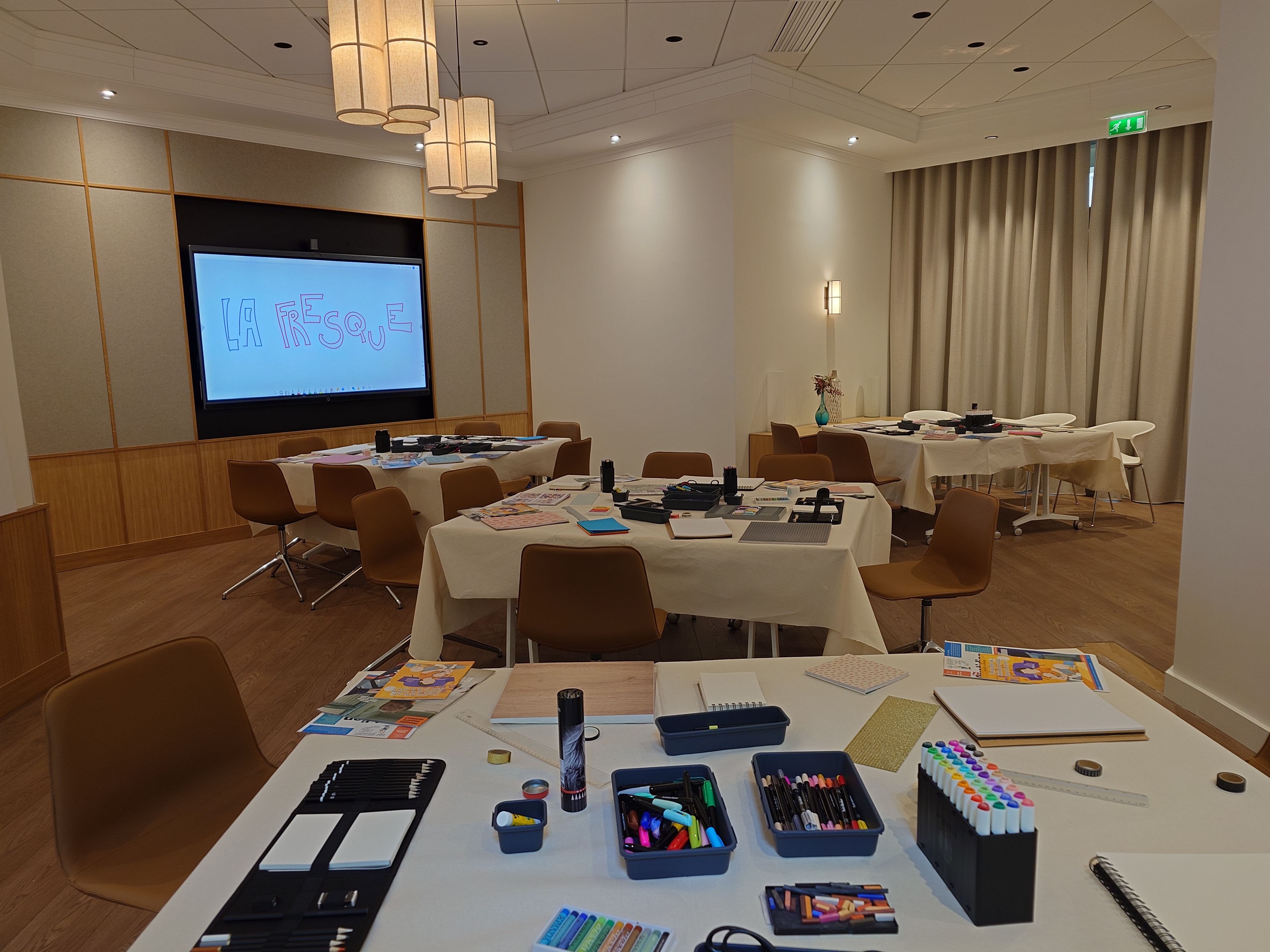
This text brings together the principles that underpin my approach to cultural mediation. They are not rules. They are reference points, shaped by twenty-five years of practice with very different audiences – autistic children, Roma teenagers, homeless people, elderly people, prisoners, families, schoolchildren, adults from all walks of life. Shaped also by failure, which has often taught me more than success. The other articles in this section each develop one aspect of this practice: the role of images, the place of artificial intelligence, the question of time, creation as a driving force. This one lays the foundation.
Mediation is an ethics, not a technique
Cultural mediation is most often thought of as a set of methods for transmitting knowledge. The underlying assumption is that there is a culture out there, foreign to us, and that through mediation we will discover it, understand it, be enriched by it. This view remains the most widespread in institutions. I believe it is wrong.
Cultural mediation is first and foremost a way of connecting with oneself, with others, with the world. A lived, engaged experience. What matters is not what people learn, but what they live through. And for them to live through something authentic, their dignity must be respected, their cultural identity acknowledged, and they must be given a real place within the framework.
This is what distinguishes cultural democratisation from cultural democracy. The first follows a top-down logic: there is a legitimate culture that must be transmitted to those who lack access to it. The second recognises the plurality of cultures and the capacity of every person to contribute to collective cultural life. It is no longer just about access, but about active participation. In my practice, I stand firmly on the side of cultural democracy.
In concrete terms, the lofty posture of the artist-expert who comes to impart knowledge to supposedly less cultivated people does not speak to me at all. I believe everyone has their own skills, their own experience, and that horizontal modes of interaction lead to richer projects for all involved. This does not mean compromising artistic rigour. But that rigour must go hand in hand with a rigour of connection. We make art, presumably, to share things. The terms of sharing seem to me as important as what is shared.
Acknowledging what resists
When a child refuses to take part, when a teenager tears up the sheet you have just printed for them, when an entire group sits with arms crossed, the most common reaction is to see a problem to be solved. We try to bring the person back into the framework. We guilt-trip, we moralise, we insist.
I have learned to do the opposite. Tearing up a sheet of paper is not waste – it is a gesture that says something. A child who refuses to sit down and cut out images is saying something about their relationship with the world, with school, with authority. And that something deserves to be heard.
In after-school workshops, for instance, some children, forced into an activity they did not choose, express their refusal in various ways. The temptation is strong to impose rules on them. But imposing rules they do not want risks making them resist even harder in order to be heard. Their refusal to be there is worthy of respect. And it is this recognition that may eventually open a door. Or not. Sometimes the connection does not happen, and that is how it is.
Those who disobey – I tend to look at them with a certain respect. They may have a little more freedom of mind than the others. It is hard to manage, of course. But it can also be the sign of a vitality that we need to know how to welcome.
The object as a third party
When you give someone an instruction, you are in what psychoanalysis calls a dual relationship. A dual relationship means a power dynamic. There is someone who asks and someone who carries out. It is built into the very workings of schools and most institutions. It produces submission or rebellion. Rarely creation.
The object changes everything. An object placed there, which you can pick up in your own way, creates a space of encounter that is not governed by an instruction. We gather around it. There are not necessarily directions to follow – there is simply something tangible that we are allowed to engage with. The object acts as a third party between people.
This is why I rely so heavily on objects in my work. Scissors and paper for collage, sturdy compact cameras, simple musical instruments, portable hand-held projectors, robust microphones plugged into very simple computers. Each object is a possible entry point into the activity. Each one is a door.
With autistic children at a day hospital, for example, I would set out different objects in a large room before each session. When the children came in, some objects spoke more to some than to others. They would take hold of them, and together we would see what we could build. These children, who are often unfiltered, for whom no instruction works in the conventional sense, taught me enormously. When nothing works, you have to reinvent everything. And it is in that reinvention that the most valuable discoveries are made.
Having several proposals in reserve
You often arrive on site with a fine idea, a session plan in mind. But the encounter with real people can make all of it obsolete within minutes.
In a photography workshop with reluctant children, you can suggest that the one who does not want to cut out images becomes the session’s reporter, handing them a small compact camera. You are still within the subject of images, but in a different activity. The role of “journalist” may appeal to someone whom collage leaves cold. Similarly, I often bring along very simple musical instruments. Children who do not want to take part in making images can go and make music in another space, and come back later to record a soundtrack for the others’ creations. The activities connect with one another.
The idea is not to multiply options in order to keep everyone busy. It is to respect the fact that the paths into creation are diverse. Some people need physical action, others need calm and precision. Some want to be at the centre, others prefer to watch from the periphery. All of these positions are legitimate.
When nothing goes as planned
The situations where frameworks fail are among the most formative. I often say, with a smile, that they are almost the situations that interest me most.
A few years ago, I was invited to run a filmmaking workshop with Roma teenagers near Bordeaux, on a travellers’ site. I had my usual setup, well tested: make a short film that tells a story, then screen it. Normally, it works every time. But here, none of these teenagers could read or write, and above all, the very idea of a film structured as a narrative meant nothing to them. The film as I conceived it was, at bottom, a text. And this textual conception of the world – these teenagers simply did not have it.
I could have tried to impose my framework. Instead, I asked them what they enjoyed. Playing boules, cockfighting, hedgehog hunting. I gave them four or five very simple little cameras and told them: play boules and film at the same time. Half an hour later, we projected the footage in the room. It was done “just like that”, with no aesthetic intention, but you could also see the other cameras, the other points of view. A multi-perspective representation of their daily life.
The room gradually filled up. The adults came in. For two days, it became what I called a “permanent cinema”. The teenagers would go out, film, come back, and there were always new images on screen – a permanent projection, fuelled by their autonomy. They had reclaimed the representation of their world, for themselves and for the adults in their community.
I would have preferred, at the time, for my original setup to work. But what emerged from that failure was infinitely richer than anything I could have designed.
Collage, a paradigm of flexibility
Among all the techniques I use, collage holds a special place. Scissors, glue, images to cut out, paper. That is all. And it is remarkably effective, in almost every context.
First, because collage frees up time. You do it when you want, you do not need a studio, a model, a booked slot. You can work at it for five minutes or for three hours. This temporal flexibility is decisive in contexts where people come and go, where you cannot rely on continuity. In a shelter for homeless people, after a visit to a museum exhibition, in an after-school workshop with very short time slots – collage adapts.
Second, collage makes people capable. It requires no prior technical skill. Everyone knows how to cut and glue. This elementary gesture makes it possible for anyone to enter a creative process. And from there, each person finds their own path. Some move towards elaborate compositions, others stay with simpler gestures. But everyone feels permitted to begin.
Finally, the scenography of collage is itself a mediation tool. Pairs of scissors laid on a table, magazines to cut up, coloured sheets. This setup, through its simplicity and visibility, invites without compelling. People build their own desire by seeing the materials and by seeing others at work. The scissors and the paper are the mediators, not us.
Action first, reflection after
One of the most important principles in my practice is to always start with action. Get people doing things before asking them to think. Film before talking about cinema. Cut out images before thinking about your script – the cut-out images will inspire it. Play an instrument before theorising about music.
This principle echoes Freinet pedagogy: learning takes place within a project that has a concrete purpose. Making a newspaper, a film, a sound piece, an exhibition. The technical tool, chosen so that it can be used autonomously, is the backbone of the setup. The teacher, or the mediator, becomes a companion. John Dewey, with his learning by doing, had already laid the groundwork for this approach: experience is not a supplement to theory – it is the very site of learning.
When I suggest making a stop-motion film from cut-out paper, the instruction is simple, concrete, immediately actionable. You cut, you move the pieces under the camera, you record at the same time. The others watch the film being made. The result is screened almost immediately, projected large, for everyone. This immediacy of feedback is a powerful lever.
Starting with action does not prevent reflection. But it nourishes it differently. You do not reflect in a vacuum – you reflect on the basis of what you have just lived through. And that lived experience, because it engages the body, the emotions, the relationship with others, anchors reflection in something concrete.
The trace, an inscription in the commons
Everything made in a creative workshop is meant to leave a trace. The films screened, the photos printed, the collages assembled, the music recorded. These traces are not souvenirs. They are inscriptions in a social space. When the films are put online on a server accessible to all, they become a shared heritage. When each person’s drawings are gathered in the same place, exhibited together, individual creation takes its place within a collective.
In almost all my workshops, I have made a habit of putting work online as it is produced. Each film, each photo, each sound piece is available to the participants and to their families. Some never access it, others share it widely. What matters is that the possibility exists. The trace is not imposed – it is offered.
I also document the creative processes, not just the results. Showing how things were made – the hesitations, the moments of grace, the difficulties. That is in itself a creative act. And it is a way of recognising that the journey has as much value as the outcome.
What mediation produces without our knowing
Beyond the films, photos and installations that participants make, we produce things we are not always aware of :
- We produce attitudes. The way we receive proposals, the way we value or dismiss attempts, the way we organise the flow of speech – all of this builds in participants a certain relationship with creativity, with error, with the judgement of others. A workshop can be a space where you dare to try, to get it wrong, to start again. It can also reproduce social hierarchies where only certain proposals are deemed worthy of interest.
- We produce representations of what art is. Depending on whether we offer an open or closed framework, depending on whether we reward obedience or initiative, we transmit implicit messages about what it means to create. The same tool can be emancipating or normalising, depending on the facilitator’s stance.
- And we produce connection. Not just between participants during the workshop, but between them and the world. When a Roma teenager sees themselves on screen for the first time in footage they shot themselves, something shifts in their relationship with representation. When an elderly person in a care home makes a stop-motion film and shows it to others, they reclaim an active place in cultural life.
That is what mediation is: creating the conditions for everyone to contribute to the commons, from who they are.

Cultural mediation, as I conceive and practice it, is not primarily a set of techniques, but an ethics of relationship. It consists of creating the conditions for a singular experience for each person, with respect for their dignity and cultural identity. This section brings together methods I have developed through my interventions, as well as reflections on the contemporary challenges of mediation.
These methods share a few common principles. They place the person, not the artwork or knowledge, at the center of the process. They recognize that receiving is creating, and that each participant generates their own experience. They are rooted in the perspective of cultural rights and cultural democracy, that is, in a horizontal rather than top-down logic.
In practice, these methods often rely on creation: making a film with one’s phone, animating a paper cutout image, writing collectively. Creation is not an end in itself, but a means of bringing about an authentic experience, of allowing each person to reveal themselves to themselves and to others. Constraints of time, format or technique are not obstacles but frameworks that liberate expression.
I share these methods here not as recipes to be applied, but as invitations to experiment. Each context, each group, each person calls for adaptation. What matters is the quality of the relationship one establishes, the space of trust one creates, the place one gives to the other. The reflective articles that accompany these methods aim to nourish this permanent attention to what is at stake in the encounter between people around art and culture.
-

The bond that sets us free
Toward an ethics of the bond in mediation and support work.
To emancipate those whom we accompany, and to emancipate ourselves in the same gesture: this, in my view, lies at the heart of any practice of (…) -

Letting Go of One’s Criteria
What the practitioner must agree to lose for mediation to work.
In the cultural and therapeutic mediation workshops I lead, the challenge is to create the conditions for people, often unsure of their own (…) -

Receiving, or the difficulty of doing nothing
The mediator’s invisible time and the energy of welcoming.
By the end of the day I am tired, with a physical tiredness, even though “I have done nothing,” because I have spent the day placing myself in a (…) -

Work and Mastery (2)
Distinguishing work from mastery in mediation-based creation.
Work (as a process by which people are transformed through doing) and mastery (as the illusion of control over what one produces) are two distinct (…) -

The process, not the result
What needs to be told for mediation to be understood.
An artist is brought in, and results are expected to match the professional who has been paid. This expectation threatens every mediation (…) -

The framework that authorizes
For a reflection on space, time, and institution in therapeutic mediation.
When we speak of a frame, we often think of what contains and what forbids. This understanding is partial. In the analytic cure as in mediation (…) -

What the gaze of others does to our images
Reflections on symbolization, identity, and the unconscious in photography-based mediation.
When I invite a group of people to each take a photograph and then look at them together, with the rule that the author cannot speak while the (…) -

The Image as Evidence
What Machines Do to Us.
When an image is born of a machine, it attests. This property, which distinguishes photography from drawing and cinema from theatre, gives (…) -

Building, Not Valorizing
What the collective gaze does that valorization cannot.
In supported creation workshops, whether they fall within cultural action, arts education, or therapeutic mediation, people often speak of (…) -

Place as an Operative Concept for an Emancipatory Cultural Mediation
Taking one’s place is not about occupying a position, it’s about being able to move.
“What place for young people?” The question is wrongly framed. Place is not a position to occupy, it is the capacity to move within a relational (…) -

The Selfie, the Filter, and the Two Bodies
The image of self as therapeutic working material.
A young woman retouches her ID photo using artificial intelligence. The educator accompanying her tells her: “That’s not you. You’re already very (…) -

The object that disposes
What machines change in mediation.
When we choose a tool for mediation, we choose a device of relationships. The technical object carries within it a history, a politics, ways of (…) -

Trust as a Technical Act
How Inner Work and the Choice of Objects Build the Conditions for Emancipation.
The trust that a mediator gives to participants is something that gets built. It requires inner work on one’s own fears and a patient choice of (…) -

Not judging people’s digital practices
Non-judgment and non-hierarchization as conditions for mediation.
Judgment damages the very connection that mediation seeks to build. It goes hand in hand with a more subtle hierarchization, which places the (…) -

The Eye in the Hand
Why the same tool produces a radically different experience depending on the frame you give it.
We all have a camera in our pocket. We use it dozens of times a day, without thinking, for countless purposes. It has become so much a part of us (…) -

The contemporary functions of images: beyond memory
Towards an anthropology of image-as-speech and its consequences for mediation.
We think we know what an image is. We think it is a trace, a memory, a proof. But images have changed function without our fully realising it. For (…) -

Artificial Intelligence, a Tool for Emancipation in Mediation
How conversational AI is opening up new possibilities for cultural and therapeutic mediation.
Since I began using conversational artificial intelligence in the context of cultural and therapeutic mediation in 2023, I have observed effects I (…) -

The Fertile Margin
Reframe cultural and therapeutic practices within the current reality, where digital culture has become the dominant culture.
Publicly funded culture has become marginal in the face of digital practices. Rather than lamenting this, this article proposes to embrace that (…) -

Audiovisual Workshop in Therapeutic Mediation
Elements of a Course in the University Diploma in Arts and Therapeutic Mediations (Paris 7 – Université Paris Cité
How ordinary audiovisual tools — the phone, the camera — become therapeutic mediators: an account and analysis of a pedagogical practice in (…) -

Vision is a reconstruction
What the eye does not see, and why it changes everything about our relationship to images.
We believe we see the world as it is. We believe our eyes capture an objective image of what lies before us, the way a camera would capture a (…) -

Creation as the energy source of cultural mediation
Moving beyond hierarchies to unleash the power of making together.
Cultural mediation is going through deep questioning about its professional identity. Beyond the legitimate claims for status recognition, I wish (…) -

Creating with people
Methods of cultural mediation for shared creation.
This text brings together the principles that underpin my approach to cultural mediation. They are not rules. They are reference points, shaped by (…) -

Engagement in Time
What matters in cultural mediation is not the duration of actions, but the quality of shared time.
The duration of cultural actions is often considered a guarantee of quality. I defend here a different approach: what transforms people lies in (…) -

Definition of Cultural Mediation
An ethics of relationship in service of singular experience.
Cultural mediation is often reduced to a set of transmission techniques. Here I propose a definition that places the person at the center: an (…)


-

“Territorial approach, participation, youth and digital technology”: interview of Benoît Labourdette by Serge Saada (52’, 2021) Observatory of cultural mediation in the social field.
As part of the Observatory of cultural mediation in the social field, Serge Saada interviewed Benoît Labourdette on the impact of the (…) -

Professional meeting “Public participation”: presentation by Benoît Labourdette Interview of Benoît Labourdette by Jean-Yves de Lépinay (11’37s, 2020).
Sharing examples of audiovisual creation workshops conducted in the spirit of cultural rights: moving from “participation” to “interaction.” (…) -

The marginality of cultural institutions Lucidity of a paradigm shift.
Traditional cultural institutions, once central, have become marginal in the face of digital practices that now dominate citizens’ attention. This (…) -

AI in Service of Democratic Transformation of Cultural Institutions Methodological proposal inspired by process management, adapted to cultural sector values.
Artificial intelligence is most often deployed to optimize production chains, for example through their digitization to create a digital twin in (…) -

For a Political Consciousness of Digital Technology When our technological choices shape tomorrow’s world.
Every click, every application used, every digital service adopted constitutes a political act that participates in building our collective (…)
