Mind mapping to build a script
One of the first difficulties in screenwriting is macroscopic construction, i.e. the overall sense of the narrative. Mind mapping is a practice that opens the door to macroscopic agility.
Forget Syd Field
There are, of course, the famous “three-act structure,” dear to Syd Field (see his famous book Screenplay), which aims to keep every story into a universal framework, but this approach does not work after the script was written. Before writing, while writing, if you start to lock his desire and creativity in a logical straitjacket, we will not go far. In the writing process, we must move forward, find, clear, search, and it is in this complexity there, the complexity of life, things that make sense to us, so are likely to have also a witness, may emerge.
The mind mapping
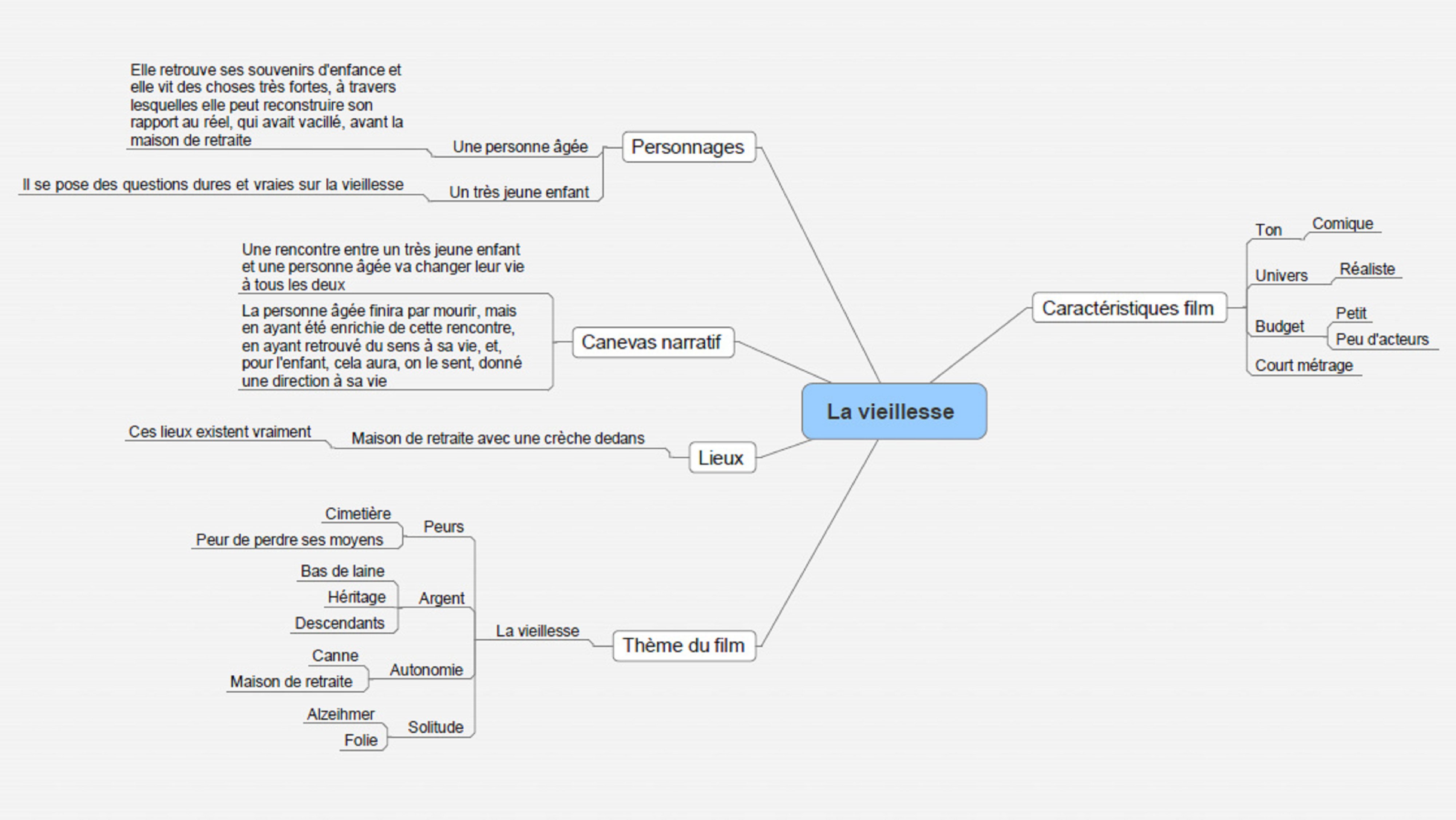
Mind mapping is a technique for storing, brainstorming, rapid organization of ideas. Software is used as Mindmanager (the best, but paid), or Freemind (free, slightly less ergonomic), or Xmind (free too, quite as good as Mindmanager), and “throws” literally the main idea of the film, preferably provisionally or theme which we want to work. I take an example, old age.

Then we “throw” the ideas that come to us, right now, by association, one after the other, around a central theme.

Within seconds, the ideas come. Then should the organizing, divided into groups clearer.

This could be a structure for writing a newspaper article about old age, but we have a film project. So, begin to divide things in this direction.

We see that the mind map changes direction, which distributes the As ideas in an environment that becomes that of a film project. Are added one at a time, in bulk, as it comes, ideas, then organize them. It goes fast, ideas flow, train each other, by this vision at all. The work of writing guides and mimics the movement of thought.
It was even suggested the concepts of budget, location scouting, etc.. ie the context of constraints, which suddenly becomes this in mind, and, instead of being an obstacle becomes an adjuvant to the writing process.
White page
We see that the technique of mind mapping is a great antidote to the blank page. By visual, the spontaneity that makes aspect is of great help to “unlock its ideas.”
The overall structure
This working tool can be very useful to build the overall structure of the film where the film he intended to bring the viewer and why. This is the type of question it is essential to ask all the time, so at the beginning of writing the middle or end. Work on his overall vision is really important, especially when writing in advance, we have the “nose to the grindstone” and it can happen that we get lost along the way. Collect his thoughts, making a mind map (in French: mind map) at regular intervals is a great help.
The mind map for all ?
The default mindmap occurs when starting to be a lot of information. There, it becomes difficult to handle, and can sometimes even block the vision of all because it is too much information around and get lost. This requires a mastery of computers for the folding-unfolding quickly and move it. Can cope with large mind map and benefit, but it takes a fairly long experience Mind Manager (for this Freemind really finds its limit). I do not think that the mind map is a tool that serves everything to write a script (although, technically, you could even write everything with it, which gives great ease to swap scenes, for example). By cons, at regular intervals, to get ideas and put them back, it is a valuable tool!

Tools and Techniques for Screenwriting and Film Project Development.
In our world where artificial intelligences create films directly from the desires of their authors expressed in very few words, in this world where 3.5-hour films in dark theaters coexist with 10-second videos on social networks—which of these require screenplays, why, and what is a screenplay?
Is a screenplay still useful in an era where everyone carries in their pocket audiovisual creation tools of nearly professional quality? What is the purpose of a screenplay?
For writers, directors, producers, and especially content creators, as they are most often called today, I believe that the screenplay, its methods of creation, its writing techniques, and its ways of telling stories, is an extremely powerful tool to help us create the most impactful audiovisual works possible—works that will best connect with their audiences today and tomorrow, across their respective distribution platforms, whether in movie theaters, on television screens, on SVOD platforms, on community video sites, or on new media built exclusively around collaborative video like TikTok.
This guide does not claim to be exhaustive, but it is based on concrete experiences—those I have lived and those I have facilitated. For over 30 years, I have supported thousands of people in making films of all genres, founded and directed several film festivals, created numerous innovative events around audiovisual media, and also served on creative funding committees. What I share here is therefore subjective and practical, drawn from my journey and my observations in practice.
-

The Principle of Consequences and Oppositions
How two words can transform the narrative power of a screenplay.
Replacing “then” with “therefore” or “but”: this might be the simplest and most powerful advice for bringing meaning and emotion to stories. The (…) -

Scientific research and scenario
Scientific rigor guarantees script quality.
Rigorous scientific research, whether it concerns the hard sciences or the humanities, anchors the screenplay in reality and generates singular (…) -

Writing on screen
Work on the relationship between text and image.
Let us explore and work on the potentialities of the text-image relationship in cinema. Present since the silent era with intertitles, the written (…) -

The non-fiction character
Reinventing narratives on social networks.
Social media influencers have created a new audiovisual genre: neither fiction nor documentary, but rather constructed characters that they (…) -

Making memories
Make the film sticky.
By creating scenes in a setting and then returning to it with other characters unaware of what happened there, the screenwriter generates intimacy (…) -

The trompe l’oeil technique
To make the film’s universe credible.
The trompe l’œil technique, used in the old special effects method of “matte painting,” can be transposed to screenwriting to expand the film’s (…) -

For a balanced consideration of characters
The art of creating physical sensations in the viewer.
The visual comparison of weights carried by different characters creates a physical sensation in the viewer. These burdens, whether material or (…) -

Subjectivized reality
The intelligence of tilting reality.
Subjectivized reality, a cinematic technique where the viewer experiences as real what is only the inner fantasy of a character, creates a (…) -

Use Chat GPT to structure your ideas
The proper use of machine reasoning.
Generative AIs excel at organizing information thanks to their logical reasoning capabilities. By submitting our ideas to them, even in a (…) -

Information retention
Manipulation or narrative tension?
Information withholding, a narrative technique that deliberately hides information known to the characters but not to the audience, creates (…) -

The investigation process
Why so many cops on screen?
The investigative approach fascinates and structures many narratives. Beyond police officers, convenient characters because they are legitimate to (…) -

Contactless application
To anchor emotions in the spectator’s body.
Narrative technique aimed at creating a physical and emotional connection between the viewer and the characters by evoking a shared sensory (…) -

The snake charmer’s trick
To build the rhythm of emotional breathing.
Temporarily neutralizing narrative tension with a “charm” that lulls the opponent allows for the creation of an emotional rhythm akin to (…) -

Finding inspiration in scenery
For films that are both realistic and ambitious.
Unlike pure imagination, writing directly in a real location allows you to draw from its unique details. The settings then become sources of (…) -

See a film or have it told to you?
Take into account the actual location of the film after viewing.
The screenwriter must consider not only the direct viewers, but also those who will be told about his work. These secondary stories, which have (…) -

Replacing characters
Touching the viewer’s subconscious.
Cinema has the power to transgress the notion of fixed identity in characters. Works like Lost Highway or The Matrix reveal that a character can (…) -

Playing with narrative reconstruction
Taking into account the viewer’s neural connections.
Narrative reconstruction is a cognitive process in which the viewer actively creates neural connections to make sense of a story. This playful and (…) -

The emotional elevator
Ethics and manipulation in screenplays.
The emotional elevator is a psychological manipulation technique that alternates between positive and negative moments to maintain control over (…) -

Are dialogues essential?
Method for (un)useful dialogues.
Should all dialogues in a film be essential? I believe that every dialogue, every word spoken by an actor in a film, just like every shot, must be (…) -

A film in the past
Details on film running times.
There are far fewer nuances in time in cinema than in literature. Cinema tells its stories mainly in the present tense, even if the past can (…) -

Going down the stairs in reverse
The art of reverse flashback.
The reverse flashback technique allows for exploring the origins of a situation by gradually moving backward into the past, enriching the (…) -

Motion blur
An animated film technique at the service of the screenplay.
The “motion blur” technique, essential in animation to create fluid, natural transitions, can be applied to screenwriting to make moments of (…) -

The trick of telepathy
For a rhizomic scenario.
The narrative trick of telepathy proposes to integrate unexplained transfers of information between characters into the scenario, creating a (…) -

Distant editing
A powerful formal concept at the service of the script.
The Armenian filmmaker Artavazd Pelechian, who has directed documentaries with a highly powerful and emotional form, such as « We », « The Seasons (…) -

Taking narrative capillarity into account
Consider your scenario in relation to other scenarios.
Contemporary audiovisual narratives are no longer perceived in isolation but as part of a network, creating a narrative capillarity where each (…) -

What is a story?
On narrative fractality.
A story is defined as the transformation of an initial situation into a final situation through a series of events. This change of state manifests (…) -

The Push Button
For moments of boost at key stages of the story.
In screenwriting, the “push button” is an action that triggers an irreversible mechanism, propelling the story into a point of no return, like a (…) -

The key in the lock
A tool for building narrative levels.
Like a key in a lock, each narrative element must perfectly adapt to the context of the story to move it forward. A new character, setting, or (…) -

What is the purpose of a screenplay?
A transient and unlocatable object.
A screenplay serves two functions: to convince and to organize. AI challenges this transitional format by enabling more flexible and interactive (…) -

Film Your Scripts Instead of Writing Them !
A Method for Writing and Creativity.
Faced with a blank page, ideas are hard to come by. I propose a method that involves filming guided improvisations with friends, to generate (…) -

The specifics of screenwriting
How to write a screenplay?
The role of the screenplay is to help people imagine a film and organize its production. It is for this reason that there are certain (…) -

The character identification process
Exploring the depths of fictional characters.
How is it that we identify with fictional characters? In some films, the main characters are deliberately insipid, while the secondary characters, (…) -

The webbed finger technique
To move stories forward in a powerful way.
The technique of webbed fingers in writing links each narrative element to two others, creating a collective force that pushes the story and its (…) -

The closing door theory
Play on the viewer’s frustration to create narrative tension.
The technique of suspense keeps the viewer on the edge of their seat by creating an information gap between them and the characters in the film. (…) -

The script’s little bike
For the rhythmic mechanics of writing.
A screenplay is a narrative mechanism, like a bicycle: the energy of the characters and the story move forward in time, guided by precise gears. A (…) -

The importance of nature in a scenario
For an organic dimension in our relationship with films.
How and why involving the natural elements in a script anchors the film in a deep relationship with the viewer. Our nature mobilizedWe are (…) -

The idea bank
A treasure chest for the scriptwriter.
Build a very simple, scalable and efficient tool to solve all types of problems in scenarios. What makes up storiesStories, mainly human ones, (…) -

The sieve technique
A solution for lack of inspiration.
The sifting technique helps to overcome lack of inspiration. By collecting ideas unfiltered, then “sifting” them, the ones that shine like gold (…) -

Anthropomorphism and scenario
Situating ourselves in the living world.
Anthropomorphism dominates cinema, attributing human traits to non-humans. Faced with the Anthropocene, it is crucial to move beyond this (…) -

Dreams, psychoanalysis and scenarios
To work with the audience’s subconscious.
Cinema and psychoanalysis, born together, explore the unconscious. The dream, at the heart of films, acts as a powerful narrative engine, blending (…) -

Scriptwriting and artificial intelligence: towards new subjects?
Anthropology of contemporary writing.
Since ChatGPT in 2022, generative AI has been transforming our ways of creating and thinking. These technologies, linked to artistic forms, are (…) -

Scenario and psychology
Overcoming the psychologization of characters.
Screenwriting often relies on the psychological depth of characters to evoke emotion and foster audience identification. But what if this (…) -

Viewer freedom
For an ethics of the relationship between film and viewer.
Screenwriting often relies on narrative mastery to control the viewer’s emotions. Yet this quest for control can conflict with an ethic of viewer (…) -

Alternating day and night
For organic scenarios.
As a filmmaker, I often wonder what makes a film organic and captivating. The alternation between day and night, a natural rhythm of our (…) -

Scenario and architecture
An essential underlying structure.
Cinema, often perceived as an art of image and sound, is deeply connected to architecture. Through spaces, movements, and scales, it shapes (…) -

Our emotions as the source of the scenario
Encouragement to take risks in writing.
A captivating screenplay draws from the author’s lived emotions. By exploring their own fears, joys, or sorrows, the writer creates authentic and (…) -

Serendipity and screenwriting
Disorganize the writing.
A screenplay, structured and the result of extensive work, is the visible part of an iceberg.Serendipity, the art of discovering the (…) -

Scenario ontology, part 1
Isn’t screenwriting the opposite of cinema?
Cinema, according to André Bazin, captures reality through mechanical recording, creating a fascinating trace of what has existed. In contrast, (…) -

The art of pitching
A method for building film projects.
“Pitching” is most often understood as the act of summarizing one’s project in a very concise manner, with the goal of convincing a partner to (…) -

What is a scenario?
Introduction to a philosophical vision of a technical and artistic object.
The screenplay, traditionally seen as a technical tool of cinema, is in reality a complex concept that deserves to be questioned in its essence. (…) -

The exhibition scene
Constraint or opportunity?
The exposition scene in a film or series is a key element that provides the audience with the necessary information to understand the story, (…) -

Mastering suspense
Using Alfred Hitchcock’s method.
The proper application of suspense techniques allows for the creation of a strong bond between the viewer and the film. I will present the method (…) -

Drawing for writing
Technique for freeing the brain.
Drawing to write: a key to unlocking writing. Drawing, often perceived as difficult, frees the mind and offers a new perspective. By sketching (…) -

The “truth” of a script
Creativity method.
Truth“is not realism or verisimilitude. The”truth“is a perception of the spectator, which can be very powerful: it is the sign of an anchoring of (…) -

Take sound into account when writing scripts
The materiality of cinema, right from the script stage.
’A scenario that gives, on reading, the sensation of the soundtrack of the film, will have a rare, extremely convincing evocative power. (…) -

The voice-over: friend or foe of the scenario?
Against preconceived ideas, for diversity of expression.
Voice-over is often discouraged in academic scriptwriting textbooks, which focus on the dramatic situation rather than on an interiority (…) -

Test your scenarios with your mobile phone
Why go without?
A very simple use of the mobile phone can speed up the scriptwriting work. PrototypesIn many fields prototypes are made, which can also be (…) -

“Scrivener” to write a script
An atypical and very powerful tool.
Scrivener is probably today the best software to write a script. Synthetic discovery of this tool. Why a specific software to write a screenplay? (…) -

Orally present his film to a commission
Being prepared and meeting expectations.
I am very regular member commission to award financial aid to film production. In my experience, what are the best practices and pitfalls? Why (…) -

Mind mapping to build a script
Tool-based practice of intellectual agility.
One of the first difficulties in screenwriting is macroscopic construction, i.e. the overall sense of the narrative. Mind mapping is a practice (…) -

Screenwriting software
Tools that format or emancipate us?
Script software standardizes page layout, automatically applies styles and numbering, and frees up time for creativity. From Final Draft to Celtx, (…) -

The writing of the screenplay in terms of the DVD
New technologies, new ways of writing.
The digital age is transforming the traditional screenplay into a more complex, modular object. In cinema as in institutional works or for social (…) -

How to write a screenplay ?
First leads.
Scriptwriting confronts all authors with a fundamental challenge: to organize creative chaos efficiently. Between spontaneity and structure, each (…) -

Writing the script of a documentary
Tracks for a balancing act.
Issues and approaches to documentary writing. Initially questions What is literature ? A look at the real ? A meeting between a filmmaker and a (…)


-

Memory and creativity The narrative fabric of our memories.
How does the creation of stories transform arbitrary sequences of numbers into lasting memories? An empirical exploration of the links between (…) -

Collaborative mind-mapping An instituting, evolving form of writing.
Collaborative mind mapping is a visual and tree-like note-taking method, projected in real-time during meetings or training sessions. This (…) -
“Scrivener” to write a script An atypical and very powerful tool.
Scrivener is probably today the best software to write a script. Synthetic discovery of this tool. Why a specific software to write a screenplay? (…) -

The meeting A film by Benoît Labourdette (5’16s, 2011).
A meeting, like a thousand other meetings. No, it is your meeting. -
The sieve technique A solution for lack of inspiration.
The sifting technique helps to overcome lack of inspiration. By collecting ideas unfiltered, then “sifting” them, the ones that shine like gold (…)
