Transmitting cultural rights: a question of coherence
How can we talk about cultural democracy within an authoritarian framework? How can we defend respect for each person’s culture while imposing a tightly scheduled programme? The transmission of cultural rights raises a radical question: that of coherence between what we say and how we say it. An account of a training day where the method became the message.
The paradox of transmission
There is something deeply paradoxical about the idea of “training people in cultural rights.” To train, etymologically, is to give form, to shape. It is an action that flows from those who know to those who do not yet know. Yet cultural rights tell us precisely the opposite: that every person carries a legitimate culture, that knowledge does not descend from above, that richness is born from the encounter between different cultures and not from imposing one culture over others.
How, then, can we transmit cultural rights without betraying them? How can we be simultaneously in a posture of transmission (since there are indeed legal, philosophical, and historical bodies of knowledge to share) and in a posture of respect for the cultural rights of those we are addressing?
This question, far from being theoretical, is a question of practice. It arises at every moment when facilitating a working day: in the arrangement of the space, in the way instructions are given, in the choice of what we show, in the room given to each person’s voice, and above all in the ability to abandon one’s own programme when the group needs something else. The pedagogical methods we use are the first message we send to people. Before we have even uttered the words “cultural rights,” we are either putting them into practice or contradicting them.
I recently had the opportunity to facilitate a day of awareness-raising on cultural rights for the team of a performing arts production office. Seven people, most of whom were discovering the subject for the first time. A single day. The account of this experience allows me to share a few methodological principles which, I believe, go beyond the scope of this particular day and touch on what makes the transmission of cultural rights so singular and so demanding.
Staging the space before saying a word
I arrived early. The day was taking place in the organisation’s own premises, that is, in an everyday workspace. This detail is not trivial. We work differently in a familiar place than in a neutral one. My first action was therefore to stage the space, to transform it enough so that people would feel, upon arriving, that something singular was about to happen, while still being at home.
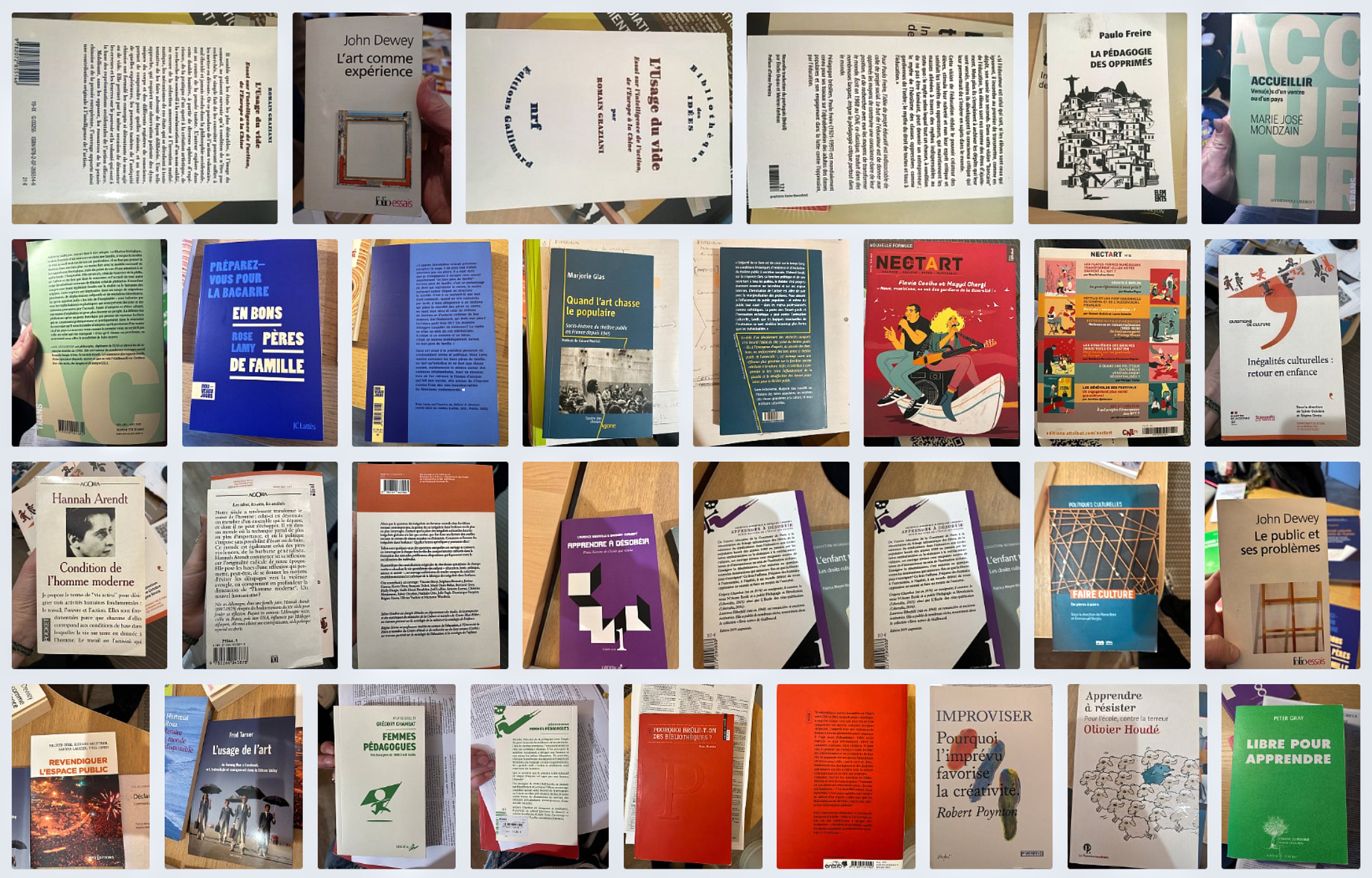
On the table, I had laid out about a hundred books. Not only works on cultural rights in the strict sense, but a deliberately eclectic bibliographic landscape: American pragmatist philosophy with John Dewey, progressive pedagogy with Célestin Freinet, anthropology, contemporary sociology, non-violent communication, feminist works, essays by Hartmut Rosa, Ivan Illich, Hannah Arendt, Romain Graziani, and others. Journals, articles.
The instruction given to people upon arrival, before even sitting down, was simple: choose two books, leaf through them, photograph what interests you, the cover, an excerpt, the back cover…
Why this entry through books? Because it immediately sends a message without needing to state it: each person will build their own path. There is no required route, no book one “should” read. Each person’s autonomy in their relationship to knowledge is recognised from the first minutes. Choosing a book is an intimate gesture: it says something about our curiosities, our intuitions, about what attracts us without always knowing why. It is already an exercise of cultural rights.
The diversity of the books offered carries another message: cultural rights are not a closed subject, a sealed body of work. They draw nourishment from philosophy, pedagogy, sociology, feminist thought, reflections on digital technology, and more. This disciplinary breadth is constitutive of the subject. Showing it from the very first gesture, rather than explaining it in a speech, is to make it tangible, real, and already operative in the enrichment received by participants through the discovery of these works, in their diversity, without formatting ideas or thought.
Identifying communities before theorising them
Communities are much discussed in cultural rights. The Fribourg Declaration makes them one of its eight pillars. But the word often remains abstract, even alarming for those who associate it with communitarianism. Rather than starting with a definition, it is possible to let people experience community directly.
The “sit-stand” exercise is disarmingly simple: you ask about ten questions, if the answer is yes you stand up, if not you stay seated. Who came by bicycle? Who likes coffee? Who is discovering cultural rights? Who is wearing second-hand clothing? Who has an artistic practice, professional or amateur?
It goes quickly, it makes people laugh, and it identifies communities. The community of coffee lovers. The community of those who have an artistic practice. The community of those who spend too much time on administrative paperwork. We discover that we share unexpected things, and that communities reconfigure with each question. This is not merely an “icebreaker,” it is a concrete enactment of what cultural rights mean by “community”: not an identity enclosure, but a multitude of shifting, interwoven affiliations.
In ten questions and three minutes, we have had a felt experience of something that would have required lengthy theoretical development to explain. And above all, we have learned things about each other. We now know that one person has already been trained in cultural rights, that another changed careers, that only a third of the group has an artistic practice. This information is precious for the rest of the day.
Personal elaboration rather than passive reception
After a more conventional phase of transmission (an introduction to the meaning of cultural rights, their history, the distinction between cultural democratisation and cultural democracy), the question arises: how can each person appropriate what has just been said? We know from neuroscience, and particularly from Olivier Houdé’s work on “cognitive resistance,” that genuine learning requires the creation of new synaptic connections. For this to occur, two conditions are necessary: that the person feels safe, and that they are in an active position.
A simple exercise consists of putting people in pairs, standing, moving through the space, and asking them to explain to the other person what cultural rights are and why they matter. One speaks, the other listens. No discussion, no debate: just listening. Then they switch.
The mechanism at work is well known: it is by explaining something to someone that we shape our own thinking. By verbalising, we structure what was still floating. We identify what we have understood and what remains unclear. The exercise works regardless of group size (you can do it with a hundred people) and it guarantees that everyone will have spoken, including the most reserved, who in a classic round-table might never have expressed themselves.
In the same spirit, inviting each person to produce a drawing, a diagram, or a short text synthesising their understanding of cultural rights, with felt-tip pens and coloured paper, is to offer another mode of elaboration. This is not a school exercise. You can draw a smiling face, a diagram with arrows, a single word. All of these productions, uploaded to a shared digital space and viewed collectively on a screen, form a kind of polyphonic landscape of the group’s understanding. The whole is worth more than the sum of its parts, and each person finds their contribution legitimised by its inscription within this ensemble.
Creation as a tool for understanding
One of the most significant moments of such a day is when a creative exercise is proposed. Not an “artistic” exercise in the sense that one would need to master a technique, but a simple, accessible creative gesture, connected to the subject.
The proposal was as follows: take a photograph, with your phone, in which a hand is visible, and which tells something about cultural rights. People could go out into the street, use objects from the office, explore the space. Then the photos were uploaded to a shared folder and viewed collectively, enlarged, in the darkened room.
The feedback instruction was unusual: the person who took the photo is not allowed to speak. It is the others who reflect back what they received, felt, and interpreted.
This reversal is at the heart of what cultural rights change in our relationship to creation and mediation. In a conventional setup, the author explains their intention, and the “audience” listens. Here, it is the opposite: the gaze of others enriches the work, charges it with meanings the author had not necessarily envisaged. Several things then happen.
First, we observe that each image elicits very different interpretations. There is no single meaning, no “correct reading.” This is a concrete enactment of the diversity of cultures: we do not see the same thing, and all these visions are legitimate.
Next, the person who created the image receives something unexpected. They took their photo quickly, they are not necessarily proud of it, they may find it unremarkable. And others see depth, resonances, beauty in it. This experience touches on what psychoanalysis calls symbolisation: something I place outside myself comes back to me enriched by the gaze of others, and participates in my construction. We are not in the realm of “valorisation” (which presupposes a hierarchy), but in a process of self-construction through encounter.
Finally, this arrangement overturns the quintessential school question: “what did the author mean?” Not only is this question often impossible to answer (since the act of creation mobilises intuition as much as intention) but it reduces the work to its conscious project alone. Welcoming the multiplicity of interpretations means recognising that creation exceeds its author, and that the person who receives is not an empty vessel but a subject carrying their own culture.
Knowing when to abandon the programme
This is perhaps the most difficult and most important principle. For this day, I had prepared a detailed, timed programme, with different sequences meant to follow one another. When the afternoon resumed, a conversation developed among the participants, about their trajectories, their doubts, their professional experiences, the connections they were making between cultural rights and their work. The conversation was rich, deep, personal. It did not correspond at all to the planned programme.
I could have “refocused,” recentred, brought the group “back on track.” This is what many facilitators do, out of concern for honouring the contract, for “holding” the programme. But this is precisely what cultural rights tell us: that people must be able to take their place, and that this place can transform the very framework of the encounter.
What was being exchanged in that moment overflowed the programme and brought it to life. People were making connections between cultural rights and their intimate experiences: their relationship to a performance that had marked them, the feeling of not feeling authorised in certain spaces, the evolution of their own criteria of judgement. They were discovering each other in an unusual depth. Letting this conversation unfold meant recognising that the objective (that each person find their own path in relation to cultural rights) was better served by this discussion than by the sequence I had planned.
I later shared this reflection with the group: what happened this afternoon was not planned, but that is precisely cultural rights in action. You took your place, and the day was transformed by it. This capacity of the facilitator to modify the programme without anxiety, to sense that what is happening is more important than what was planned, requires a form of trust: trust in the group, trust in the subject, and trust in the idea that transmission cannot be reduced to the transfer of content.
The framework as that which authorises
We often believe that a framework is what constrains, what forbids. Ask around: “what is a framework?” and you will hear about limits, rules, what you are not allowed to do. Yet the framework, from the perspective of cultural rights, is what authorises. A well-established framework makes expression, risk-taking, and encounter possible. It creates the conditions for trust.
In a training day, the framework is built through the accumulation of small gestures: the staging of the space, the diversity of the books offered, the instructions that recognise each person’s autonomy, the exercises that put everyone in a position to contribute, the feedback that welcomes the diversity of interpretations, and the ability to let go of the programme when the group needs it. Each of these gestures says the same thing: you are legitimate, your culture has value, and we are going to enrich one another.
This is not a naive or demagogic posture. There are indeed bodies of knowledge to transmit (the history of the Ministry of Culture and its colonial construction, the Fribourg Declaration, the distinction between the eight rights, case-study methods, the resources of the Culture 21 network or the Observatory of Cultural Policies). But this knowledge is only fully absorbed when the manner of transmitting it is itself respectful of people’s cultural rights. Otherwise, we produce information, but not appropriation.
What coherence makes possible
At the end of this day, the remark addressed to me touched precisely on this: “There is a coherence between what you say and what you do. Your facilitation methods and tools are in harmony with the subject you are addressing, and that is too rarely the case.”
This remark is not a compliment. It is an observation, and one that should concern us: if it is “too rarely the case,” then something is not working in the way cultural rights are usually transmitted. Perhaps it is because we still too often separate content from form, substance from gesture, knowledge from relationship. Perhaps it is because training sessions are still designed according to a top-down model (one person who knows speaking to people who are learning) even though they deal with a subject that blows up this model.
Cultural rights are not a theoretical body of work that can be poured into receptive minds. They are an ethics, a way of being in relationship, a permanent practice. Transmitting them means practising them. Not in an artificial or demonstrative way, but because one is convinced that it is the only way to allow each person to truly grasp them, by making their own path, from their own culture, in respect of their own dignity.
It is in this sense that cultural rights oblige us: not only to change what we say, but to change what we do and how we do it. The same demand applies to a one-day training session, to the programming of a cultural season, to the reception at a performance venue, to the management of a team, to the building of a partnership. Working methods are not secondary. They are the very place where cultural rights are enacted, or betrayed.


The “cultural rights”, which derive from the Universal Declaration of Human Rights, are a concept developed and defended by researchers, sociologists, philosophers, political leaders and actors of the cultural world. Present in a certain number of articles of law since 2001, the cultural rights aim at highlighting and formalizing, in order to be able to make them operative, the principles of a “cultural democracy”. To summarize it quickly, it is a question of each person being able to give value to his or her personal culture, in order to be able to exercise his or her citizenship: to express himself or herself, to defend his or her point of view, to create, to develop his or her practices, to have access to a cultural diversity, etc. Cultural rights operate in a much wider field than that of the strict cultural sector.
The notion of “cultural rights” is present in France in the laws NOTRe (2015) and LCAP (2016). It is carried by a delegation of the Ministry of Culture (General Delegation for transmission, territories, since January 1, 2021).
Paradoxically, cultural rights are difficult to implement in the cultural sector, which is traditionally rather attached to “cultural democratization”: one often defends the idea of the transmission to the public of works of art of the best possible quality, according to a principle of hierarchy of “cultural values”. Thus, the cultural rights can be lived by certain professionals of the culture as a dangerous dynamics for the Art, a tendency towards the amateur practices, which is not the case.
In my point of view, which is that of a practitioner/researcher in the cultural field, cultural rights are above all a practice, an exercise of democracy in the very methods of organization of the work, of the relation to the other and of the place of each one, the choices of programming, the methods of mediation and animation of workshops, the mode of territorial inscription of the cultural policy, etc.
I propose in this section concrete working methods for good practices of implementation of cultural rights, based on my field experiences, as well as a sharing of more theoretical reflections, in the framework of my own research on cultural rights.
I place myself in the filiation of thinkers like John Dewey. But cultural rights cannot be presented without mentioning Patrice Meyer-Bisch, Jean-Michel Lucas, Christelle Blouët, the “Fribourg Declaration”, etc.
-

Transmitting cultural rights: a question of coherence
What facilitation methods reveal about our relationship with people.
How can we talk about cultural democracy within an authoritarian framework? How can we defend respect for each person’s culture while imposing a (…) -

The political dimension of organisational frameworks
When forms contradict intentions: organising cultural democracy.
We talk about cultural democracy, horizontality, cultural rights. But the concrete frameworks we put in place often tell a very different story. (…) -

Will Heritage Still Be Part of Our Lives in 2045?
Digitising collections is not enough: the challenge is to enable their appropriation by citizens.
Cultural practices in 2045 will be as different from ours as ours are from those of 2005. At that time, YouTube did not exist, no one had a (…) -

The Representation of One’s Cultural Role
What the Association of French Mayors survey reveals about the cultural imaginary of local authorities.
What do we presuppose when we speak of “audiences distant from culture”? The AMF survey, read as an anthropological document, unveils the (…) -

Algorithms and Cultural Rights
How algorithms, far from confining us, implement cultural rights through democratic discoverability based on metadata.
Algorithms are regularly criticized as tools that supposedly lock us into “filter bubbles.” We must free ourselves from them, we are told. Yet (…) -

Domination at the Heart of Culture
How laudatory terms mask power relations in the cultural sector.
The praise we bestow upon “great artists” reveals, beneath its flattering appearances, a structure of domination. Behind admiration lies the (…) -

Making Room for Adolescents: Rethinking Our Approaches in Cultural Action
From democratisation to cultural democracy.
Cultural action and mediation with adolescents challenge the foundations of our practices: between framework and transgression, between physical (…) -

Symbolization as a tool for mobilization
When the collective and digital traces build cultural engagement.
Faced with an abundance of digital cultural practices, cultural venues struggle to mobilize “audiences.” I argue here that this difficulty does (…) -

Legitimate participation as the horizon of cultural events
From legitimacy to participate: how cultural rights transform our practices.
Cultural rights are often misunderstood. Their strength lies in their capacity to transform our practices: moving from a top-down programming (…) -

The Accelerated Eye
Manifesto for a new ecology of the gaze.
What if speed were not the enemy of culture, but the instrument of a new form of sensitive intelligence? A radical reappropriation of our right to (…) -

Authorizing Creation
For a radical democratization of the creative act.
How can artistic creation become a political act of collective emancipation? By carrying within itself, in its form and process, the authorization (…) -

Creative Freedom and Cultural Rights
A dialectic at the heart of cultural policies.
French cultural policy today finds itself at the crossroads of two fundamental principles, both enshrined in law: creative freedom and cultural (…) -

Cultural Rights in Light of Personal History
At the beginning of my journey as an engaged cultural actor.
The question of cultural rights has long shaped my commitment, well before the term came to light. Through my story, I attempt to show how a (…) -

Cooperative Narratives
Creating polyphonic narrative devices to transform academic knowledge into living and operative knowledge.
How can we overcome the limits of academic narrative to create truly shared knowledge? A concrete experience of collective writing devices that (…) -

The myth of recognition through cultural democratization
Rethinking artistic value beyond systems of domination.
Artistic recognition is less about talent than about a social game that some refuse to participate in. A reflection on alternative paths to (…) -

Cultural Rights and Digital Discoverability
For a cultural policy adapted to digital spaces.
Faced with the failure of many institutional digital cultural strategies, cultural rights and its corollary cultural democracy seem to me to be (…) -

Freedom and Cultural Rights
A renewed approach to democratic dignity, through the contribution of two new rights.
Cultural rights, seemingly guarantors of human dignity, are emptied of their meaning when they fail to forcefully articulate the question of (…) -

Cultural Rights and Digital Technology
Rethinking digital tools in service of cultural democracy.
How can digital technology become a lever for cultural emancipation rather than an instrument of dependence? I propose a digital implementation of (…) -

The specter of the other
From anxious dehumanization to confident recognition.
How can the other, a subject of rights, become a threatening figure? A reflection born from a confrontation with reality, beyond the fantasies and (…) -

Cultural data and cultural rights
For an inclusive heritage democracy in the digital age.
Citizen cultural data is tomorrow’s heritage. Their recognition and preservation constitute a major democratic challenge for building a (…) -

Corporate memory at the service of cultural rights
Rethinking the relationship between cultural venues and people.
Cultural institutions, through their failure to collect and care for data, forget those they welcome, denying their dignity. This amnesia (…) -

Cultural rights and preservation of digital heritage
Bernard Stiegler’s technical philosophy sheds political light.
Have you ever tried to find a video you loved on YouTube from ten years ago? A blog post that made an impression on you? Your friends’ photos on (…) -

Artistic Legitimization, Cultural Rights, and Construction of the Individual
Between horizontality and the need for recognition.
Artistic legitimization, between traditional hierarchies and new digital forms, questions individual and collective recognition. By intersecting (…) -

Cultural rights and the “fight” against the far right
How to rebuild democracy in our cultural spaces.
How the discourse of “fighting against the far right” stigmatizes voters, compromises democratic dialogue and becomes hate speech. It would be (…) -

Architecture of artistic venues and cultural rights
The impact of location on social roles.
The architecture of cultural venues shapes roles and often limits participation. An approach inspired by digital spaces would enable cultural (…) -

Strategy, design and technical implementation of the “Azimut” platform
The resource portal for artistic practices.
I am supporting and leading, on behalf of the MPAA, in its current phase, the strategy, design, and technical implementation of this platform, (…) -

Synthesis of the seminar: “What pedagogy by and for cultural rights?”
Organized by UFISC, Opale, Réseau Culture 21, Observatoire des politiques culturelles, Laboratoire des droits culturels and Ligue de l’enseignement (February 6, 2025).
Workshop to find out what stage the partners had reached in their work on the “cultural rights” certification referential project in the context (…) -

Conference: “EAC and cultural rights: convergences to be identified and implemented”
Dans le cadre des Rencontres territoriales “Artistic and cultural education & Territorial cultural projects” (Foix, February 5, 2025).
How can cultural rights be a tool for better implementation of artistic and cultural education projects? And how we can identify convergences (…) -

Cultural rights and professional postures
Tools for the concrete implementation of cultural rights.
Cultural rights, stemming from the Fribourg Declaration (2007), represent a major advancement for cultural democracy. However, their practical (…) -

“Cultural rights” creative writing seminar
Master Arts du Spectacle, université de Caen Normandie 2021-2022-2023-2024.
A practical seminar on digital writing, with the theme of cultural rights. Students approach writing in the contemporary sense of the term, (…) -

“On the ineffectiveness of our works in real life”.
Commentary on the text by Eva Doumbia & Kader Attia (2023).
In July 2023, visual artist Kader Attia and director Eva Doumba published a text (in Analyse Opinion Critique) in response to the youth “riots” (…) -

Artistic creation in a digital environment
Commentary on the report commissioned by DRAC Bretagne (August 2023).
A study on the subject of digital and artistic creation reveals, through its unquestioned biases, the unconscious desire not to move the lines of (…) -

Digital technology, a tool for mediation and cultural democracy
Webinar on Monday, October 9, 2023 from 10am to 1pm.
Restitution of the “Digital Workshops” project by Cultures du Cœur and Benoît Labourdette Production, offered as part of the Été culturel program (…) -

Itinéraire bis, the path of cultural rights
Action research conducted by the MPAA (Paris).
Accompaniment in the animation, production of traces and fabrication of the web platform resources of the research-action “Itinéraire bis, chemin (…) -

Raising awareness of cultural rights - Nantes métropole (September 30, 2022)
Co-design and co-hosting of a one-day event for Nantes’ cultural players.
Taking ownership of cultural rights concepts and approaches through cooperative creativityA small group of cultural players from Nantes, led (…) -

Analyze your project using the Fribourg Declaration
Working method
How to set in motion an approach open to cultural rights, that is to say, to put more democracy in the projects and the relationship with the (…) -

John Dewey : an inspirer of cultural rights?
Sharing my interest in an inspiring personality.
The notion of “cultural rights” is increasingly present in the debates within the cultural sector. They are seen by many as being at the heart of (…) -

Professional meeting “Public participation”: presentation by Benoît Labourdette
Interview of Benoît Labourdette by Jean-Yves de Lépinay (11’37s, 2020).
Sharing examples of audiovisual creation workshops conducted in the spirit of cultural rights: moving from “participation” to “interaction.” (…) -

“Cultural participation”: interview with Benoît Labourdette.
Interview with Benoît Labourdette (4’39s, 2020).
Video presentation of Benoît Labourdette’s approach to the democratic dimension of cultural action. -

Research-action “Image Education 2.1”
Collaborative action-research project led by Benoît Labourdette production in 2018 and 2019, to develop the synergy between teenage cinema (…)


-

Cultural Mediation as a Device for Symbolic Emancipation Methodological Principles for a Horizontal Approach to Collective Creation.
Lived experience radically transforms our relationship to thought. Cultural mediation does not consist of transmitting knowledge but of creating (…) -

Formalizing the informal Informality, essential to learning, resists structure while calling for it. How to tame it.
The absence of informal aspects in distance learning forces us to rethink its fundamental nature. This constraint becomes a laboratory for (…) -
The political dimension of organisational frameworks When forms contradict intentions: organising cultural democracy.
We talk about cultural democracy, horizontality, cultural rights. But the concrete frameworks we put in place often tell a very different story. (…) -
Synthesis of the seminar: “What pedagogy by and for cultural rights?” Organized by UFISC, Opale, Réseau Culture 21, Observatoire des politiques culturelles, Laboratoire des droits culturels and Ligue de l’enseignement (February 6, 2025).
Workshop to find out what stage the partners had reached in their work on the “cultural rights” certification referential project in the context (…) -
Cultural Rights and Digital Technology Rethinking digital tools in service of cultural democracy.
How can digital technology become a lever for cultural emancipation rather than an instrument of dependence? I propose a digital implementation of (…)
