Traveling projections: reinventing cinema in public space
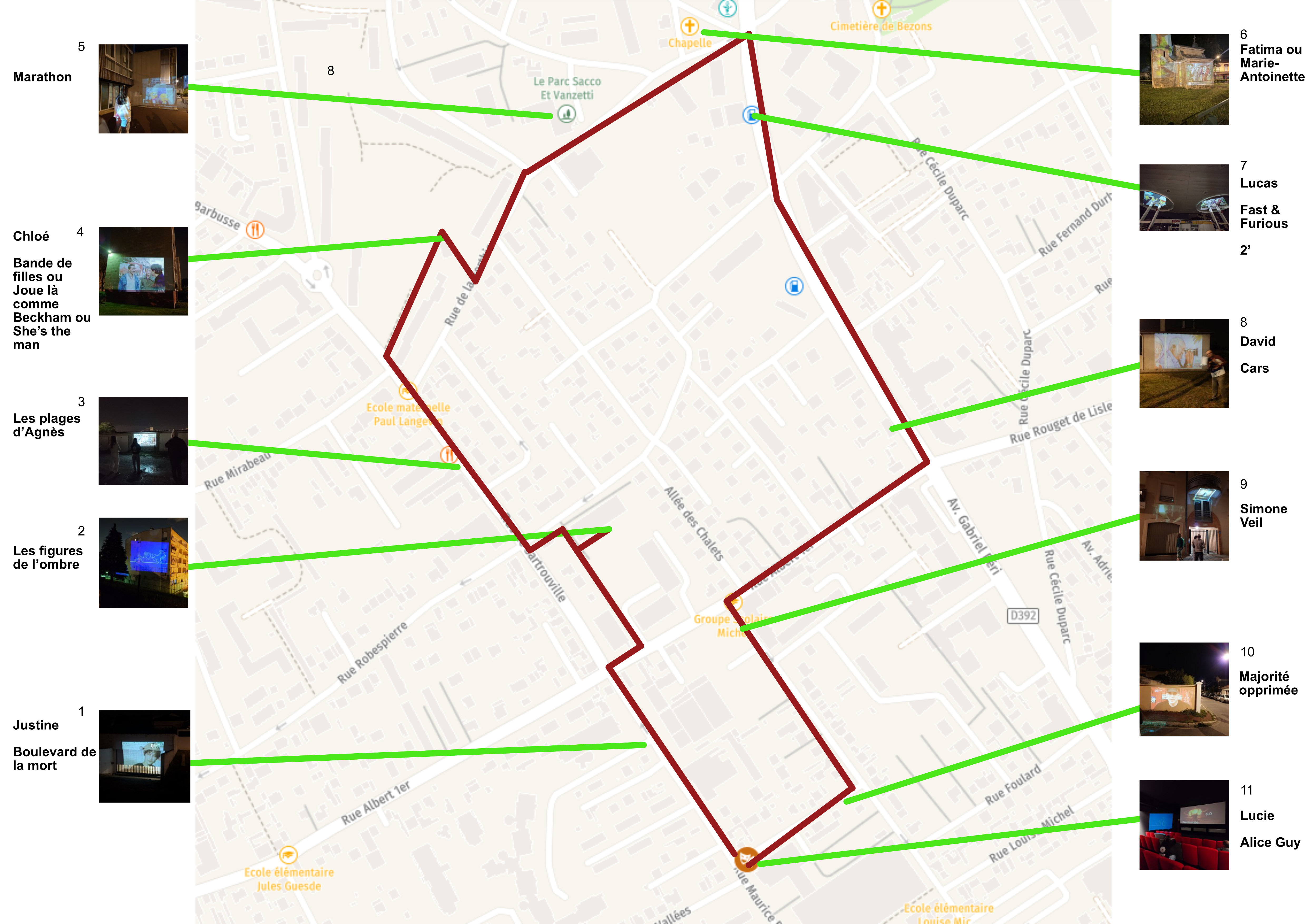
Traveling projections reinvent cinema by transforming public space into a place of sharing, where residents and passersby collectively experience the magic of images, outside traditional frameworks.
A democratic practice of distribution
Traveling projections represent an innovative form of cinematographic distribution that transforms public space into a place of collective expression. This practice, developed by Benoît Labourdette for about fifteen years (2011) thanks to the emergence of portable pico-projectors, allows residents to reclaim their urban environment by projecting films, sometimes of their own creation.
The essence of this approach lies in its profoundly democratic dimension: it is the residents themselves who organize and conduct these projections in their living spaces. Unlike traditional distribution systems, here the power over images is literally in the hands of participants who hold the projector and decide where and what to project.
A simple and mobile technical device
The technical operation relies on autonomous pico-projectors, true “light cameras” that directly contain the files to be projected, without requiring a computer. Only a portable speaker is necessary to broadcast sound. This technical simplicity allows great freedom of movement and improvisation.
The projections, if outdoors, take place exclusively at night and can take over any surface: walls, floors, ceilings, sculptures, or even people. Participants move through neighborhoods, creating unprecedented visual paths that transform urban architecture into ephemeral cinema screens.
A collaborative and thoughtful process
The preparation of these projections follows a precise methodology that involves several stages:
- A preliminary mapping of locations with daytime visits to imagine possibilities
- A nighttime revisit to test projections
- A collective sharing of scouting via QR code system
- An iterative process of refinement and questioning about the meaning of images
This collaborative approach allows going beyond mere technical projection to create events that make sense in their specific context. Mediation is crucial: it’s not about projecting any image anywhere, but creating a meaningful encounter between the work, the territory and its inhabitants.
The magic of rediscovered collective experience
The most striking phenomenon of these projections is their ability to instantly create collective experience. In a world where image consumption has become mostly individual via personal screens, projection in public space recreates the shared experience of cinema. Passersby stop, intrigued by this unexpected luminous apparition, cars slow down, an audience forms spontaneously.
This collective dimension recalls the fairground origins of cinema, where projection was above all a popular and participatory spectacle. The fascination exerted by these projected images stems from their very nature: light reflected by the real world, they create a unique encounter between the imaginary and the real, between the ephemeral and the tangible.
A cultural and political issue
Beyond the technical and spectacular aspect, traveling projections carry a strong cultural and political stake. They allow questioning the place of images in public space, creating moments of collective reflection on societal issues. The example of projecting Simone Veil’s speech for the law authorizing abortion in a collective housing neighborhood illustrates this dimension: the image takes on particular force through its contextualization in the residents’ lived space.
This practice is part of a broader approach to cultural democracy, creating bridges between traditional movie theaters and new forms of distribution. It allows reaching audiences who do not necessarily frequent institutional cultural venues and reinvesting the street as a space for expression and sharing.
Traveling projections thus represent much more than a simple technical innovation: they constitute a true reinvention of the collective relationship to images, restoring to cinematographic projection its magical and unifying dimension in our world saturated with individual screens.

Films in a neighborhood... Since 2011, we’ve been offering traveling screenings of short films in a neighborhood or building. These screenings, which require no prior installation, are carried out using a “pico-projector” (a portable video projector that appeared in 2010). This is “mobile projection”, on the walls of a city or neighborhood. Exploiting this still-new technology for moments of encounter between artworks, places and people.
These screenings provide audiences with an exceptional experience, rediscovering the magic of projection and giving everyday places a totally unexpected dimension. These itinerant screenings are very playful propositions, offering spectators beautiful, original and creative cinema experiences.
This proposal can be approached in the form of a workshop: a group of spectators builds the screening and runs it. They prepare a program of films, designed to be screened on the walls of their neighborhood, at night, in public. The choice of films or excerpts, then the choice of locations to show these films, the speeches, the meaning of this meeting, the way the neighborhood was invested, the way the screening was prepared in collaboration with the residents, the rehearsal time, notably technical, reinforce everyone’s involvement.
Travelling screenings took place at: Festival Via Pro Mons, Festival d’Avignon, École Normale Supérieure, Festival des scénaristes, Agglomération d’Évry, Maison des métallos, Festival Travelling Rennes, Passeurs d’images Île-de-France, Musée de l’Homme, ALCA Bordeaux, Festival War on Screen, Les Lilas, Saint-Denis, Fontenay-sous-Bois, Mitry-Mory, Saint-Michel sur Orge, Ivry-sur-Seine...
-

War on Screen Film Festival 2025
When high school students take to the city walls to raise awareness about the ecological emergency.
An evening where eight teams of teenagers transformed the streets into giant screens to share their concerns about the state of the planet, armed (…) -

Traveling projections: reinventing cinema in public space
A new form of cinematographic distribution.
Traveling projections reinvent cinema by transforming public space into a place of sharing, where residents and passersby collectively experience (…) -

Nuit Blanche at Vitry-sur-Seine
Participatory touring screening/performance/animated film.
During Nuit Blanche 2025 in Vitry-sur-Seine, the itinerant projection workshop transformed a multidisciplinary day into a collective and (…) -

Ciné balade in Ivry-sur-Seine
Travelling workshop-projection, July 21, 2023 at 10pm.
A new way to experience cinema and Ivry differently.This summer, become a programmer!The principle : Le Luxy invites you to attend three (…) -

Traveling screening in Fontenay-sous-Bois
As part of the Cultural Summer in Île-de-France program organized by Passeurs d’images.
An accelerated history of cinema, on the walls of the town of Fontenay-sous-Bois, starting in the theater and ending in the cinema, with an (…) -

Travelling screening in Saint-Denis
As part of the Cultural Summer in Île-de-France program organized by Passeurs d’images.
An improvised itinerant screening, prepared in the afternoon with customers of the bookshop La P’tite Denise, and designed with the complicity of (…) -

War On Screen Film Festival 2021
Mobile projection workshop.
A group of high school cinema students, with the support of Benoît Labourdette, organized a traveling screening as part of the 2021 edition of the (…) -

Traveling screening in Mitry Mory
As part of the Cultural Summer in Île-de-France program organized by Passeurs d’images.
Itinerant projection conceived and animated over several days of rehearsal by members of the Mitry-Mory 3rd Age Club, with the accompaniment of (…) -

Travelling screening in Saint-Michel-sur-Orge
As part of the Cultural Summer in Île-de-France program organized by Passeurs d’images.
In Saint-Michel-sur-Orge, at the Marcel Carné cinema, a group of local residents chose archival films of the town’s construction (collected by (…) -

Travelling projection workshop in Les Lilas
Ville des Lilas - Association Un Lieu Pour Respirer.
As part of the Journées du Patrimoine, an intergenerational workshop-projection with local residents, to reappropriate the neighborhood by (…) -

Projection itinérante à Montreuil-sous-Bois
Dans le cadre de l’été culturel en Île-de-France organisé par Passeurs d’images.
Projection itinérante improvisée avec les enfants du quartier de la Boissière à Montreuil-sous-Bois. Le terrain de jeu Jules Verne est le lieu (…) -

“By my window”
Travelling screening as part of the Valence Script Festival.
Travelling projection in the old town of Valence of a selection of films “By my window”.The International Festival of Valence - Scriptwriters (…) -

Night screening in the Fontbarlettes district (Valencia)
Travelling projection workshop.
Workshop for the organization of an itinerant projection for young people from the Fontbarlettes neighbourhood in Valencia (House for All). The (…) -

Moving screenings to reweave the link between the theatres and their spectators
Post-confinement cultural action project.
Itinerant projections on city walls, in the neighbourhood around a cinema, to experience again the happiness of shared projection, without any (…) -

ALCA and FRAC Aquitaine: Encountering audiences and a neighbourhood: co-constructing and experimenting an itinerant screening
Documentary on training, directed by Théo Rulin (3’18s, 2020).
Professional training through the concrete implementation of a cultural action rooted in the challenges of a territory, over two days (February (…) -

2019 Scriptwriters’ Festival: travelling screening
On the theme of musical cinema, a night walk in Valencia, to discover new and surprising works on the city walls. And then, on some films, viewers (…) -

Screenwriters’ Festival 2018
Itinerant projection at night in Valencia, as part of the International Festival of Screenwriters, on the theme of the evolution of audiovisual (…) -

Museum of Man : “Expanded” visit
“Expanded” visit of the exhibition “We and the others, from prejudices to racism”, Museum of Man, Paris. On 25 June 2017 at 11 am. Unique tour. A (…) -

Port Zones Film Festival : pocket films workshop and travelling projection
Workshop for the production of films for teenagers, then organization by young people of the itinerant screening of these films, within the (…) -

Call for air Arras
Benoît Labourdette’s movies in a travelling projection program in Arras (France).In the context of the manifestation of contemporary art “Call (…) -

Travelling Rennes Film Festival 2016
Participatory workshop projection at Travelling Rennes Film Festival 2016People sign up, and in an afternoon, everyone chooses a film, or a (…) -

Aubervilliers and La Courneuve : Films are on the walls !
The films are on the walls : cinema-walks in Seine Saint Denis (France). Sunday, October 25 and Saturday, October 31, 2015 at 18h. At dusk, guests (…) -

Travelling Rennes Film Festival 2015
Course nightly screenings, in a workshop within the Travelling Film Festival 2015 Rennes.Registrants have spent the afternoon with me, to (…) -

MA Scène nationale Montbéliard: “Joseph”, a travelling film by Joseph Morder
A film designed to be screened on the city walls on a travelling basis.Yannick Marzin, director of the Scène nationale de Montbéliard, proposed (…) -

2014 Screenwriters Festival
A history of Italian cinema, in a route of traveling screenings in the city of Valencia, in the 2014 screenwriters Festival.The theme of (…) -

Maison des métallos : film night courses
The maison des métallos, cultural institution in the city of Paris, greeted me as part of the event “Fine speakers” for a mobile cinema projection (…) -

Agglomeration of Evry: travelling projection workshop for children
Workshop for design and animation of travelling screenings for children, organised in the framework of the plastic Art workshops of the (…) -

École Normale Supérieure - Filming the words
Itinerant projection of short films in the buildings of the École Normale Supérieure (Paris).In the context of the dynamics of participatory (…) -

Avignon Festival - Night Route “Fast Movies”
A course at night to discover movies projected on the walls, doors, floors, bas reliefs, windows... in the streets of Avignon.The films shot (…)


-
Ciné balade in Ivry-sur-Seine Travelling workshop-projection, July 21, 2023 at 10pm.
A new way to experience cinema and Ivry differently.This summer, become a programmer!The principle : Le Luxy invites you to attend three (…) -
Maison des métallos : film night courses Moving screenings
The maison des métallos, cultural institution in the city of Paris, greeted me as part of the event “Fine speakers” for a mobile cinema projection (…) -
Aubervilliers and La Courneuve : Films are on the walls ! Moving screenings
The films are on the walls : cinema-walks in Seine Saint Denis (France). Sunday, October 25 and Saturday, October 31, 2015 at 18h. At dusk, guests (…) -
Travelling Rennes Film Festival 2015 Moving screenings
Course nightly screenings, in a workshop within the Travelling Film Festival 2015 Rennes.Registrants have spent the afternoon with me, to (…) -
Call for air Arras Moving screenings
Benoît Labourdette’s movies in a travelling projection program in Arras (France).In the context of the manifestation of contemporary art “Call (…)
