« Mental Health and Cinema »
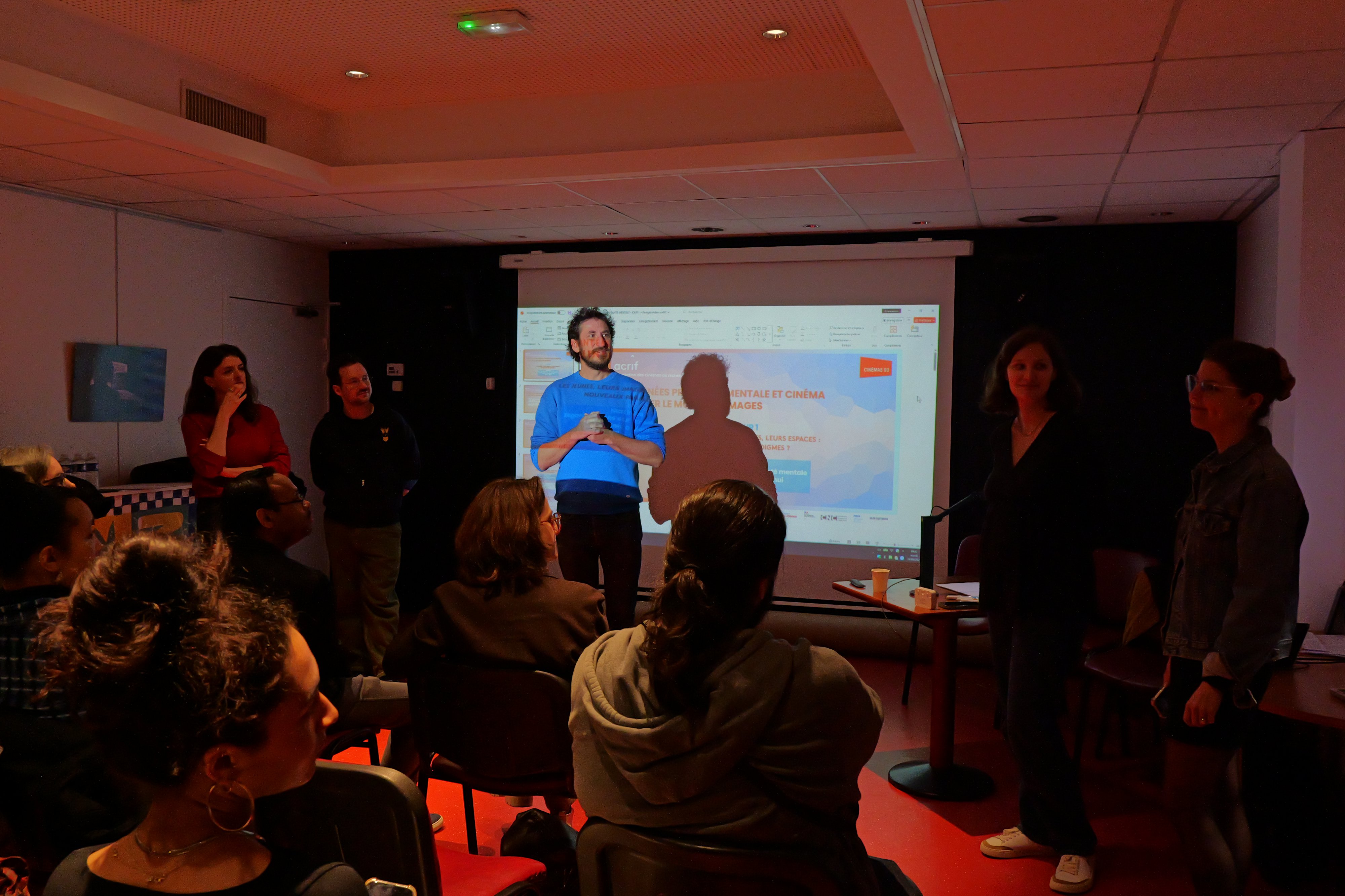
Synthesis of a day of professional gatherings at the Le Trianon cinema in Romainville, bringing together the perspectives of professionals from the cultural sector, cinema, social work and care around young people’s mental health.
The day in context
A project carried by ACRIF and Passeurs d’images Île-de-France
These gatherings are part of the coordination mission for Passeurs d’images Île-de-France led by ACRIF (Association des cinémas de recherche d’Île-de-France), which brings together 70 affiliated cinemas and conducts mediation work with diverse audiences, primarily outside school hours. They brought together around sixty professionals in the workshop room of the Le Trianon cinema in Romainville, Seine-Saint-Denis.
The idea for these gatherings came from an initiative by Claudie Le Bissonnais, former national coordinator of Passeurs d’images, who had laid the groundwork before retiring. Diane Olivier (Passeurs d’images coordinator, ACRIF) and Maxime Bouillon (cinema mediator, ACRIF) took over, and we co-designed the programme and content of the first day together. The second day, on 15 April 2026, was co-organised by ACRIF with Cinémas 93.
A deliberately interdisciplinary audience
The ambition of the day was to bring together people who don’t usually cross paths. Cultural mediators and cinema staff, educators and social workers, local health contract coordinators, psychologists and facilitators: questions of young people’s mental health are not settled within a single professional field. And cinema, as a common space for images, narratives and shared emotion, offers a ground on which people from very different backgrounds can speak to one another.
Associated articles
Several texts accompany this synthesis:
- The project presentation and the full programme of the two days.
- « Mental health, young people, images : what are we talking about ? », the full text of my introduction, with the foundational definitions we drew on.
- The photography workshop, the images made by participants and the readings they prompted.
Morning, first part: setting a shared framework
I chose to begin with half an hour of definitions. Mental health, young people, images: three words we use often, with very different meanings depending on where we speak from. If we don’t agree on what they cover, the conversation happens but goes nowhere. What follows is a synthesis of the points I insisted on; a separately published article offers a longer development.
The stand-up questions, with non-stigmatisation in the background
Before getting into the definitions, I proposed the stand-up questions: a series of questions asked aloud, where each person stands up if the answer is yes. In a few minutes, the room saw itself, its professional families, its cultural practices, without anyone having had to introduce themselves. There was also something deliberate but unsaid: several of the participants in the short film we would watch in the afternoon, people living with psychological conditions, were there from the morning, without any label, simply as participants on the same footing as everyone else. Meeting people before hearing their story changes what the encounter produces.
Mental health: three spaces, not only the pathologies
When we hear “mental health”, we spontaneously think of pathologies. This is reductive. Santé publique France distinguishes three spaces: positive mental health (flourishing, the capacity to act), reactive psychological distress (linked to grief, a breakup, violence experienced, having a real impact without necessarily being lasting), and psychiatric disorders which require medical care. This last space is what we hear most often in everyday language, whereas it is only one third of the picture. Institutions, too, can be unwell, a question rarely asked in the cultural field.
Psychosocial skills: ours first
Psychosocial skills (CPS), defined by the WHO in 1993 and updated by Santé publique France in 2022 into three families (cognitive, emotional, social), concern us directly, us, professionals, before they concern the people we support. If our own capacity to regulate our emotions or to understand what is happening in a group is lacking, there are concrete consequences for participants. This is a point often glossed over. I add a useful distinction: empathy (understanding without living in the other’s place), sympathy (emotional fusion), compassion (an affective response that pushes one to act). What concerns us professionally is empathy: understanding without losing oneself.
Images: functions rather than hierarchies
There is no hierarchy between amateur images and professional images. The semiotician Roger Odin showed this in his work on private cinema: these images are not inferior, they have different functions. In our practices with young people, we often start from the a priori that what they do with their phones is worth less than what we show them at the cinema: a condescending stance, which closes the dialogue. I distinguish three functions of images for our practices: symbolising (putting something at a distance from oneself, which in turn constitutes us; I prefer “construction” to “valorisation”, which presupposes a prior devaluation), sharing (being recognised in the gaze of others), acting (making images, like looking at them, is a practice that is learned). And as Camille Peugny has documented, “young people” do not form a homogeneous category.
Image education and media and information literacy: two distinct things
Some consider that no distinction should be made between image education (EAI) and media and information literacy (EMI). I think on the contrary that there is real use in distinguishing them. EMI is centred on journalistic practices and on critical thinking about media content; EAI is centred on creation and symbolisation, and works on process rather than on judgement. I also have a critical relationship to how EMI is often conducted, because it is frequently conducted by journalists who are both judge and party: for a truly critical media education, we would need more sociologists, anthropologists, psychologists.
Morning, second part: crossed perspectives on young people’s mental health
A deterioration that predates Covid
Catherine Embersin, socio-demographer at the Regional Health Observatory of Île-de-France, came with figures. What she showed first is that the deterioration of young people’s mental health does not date from Covid. It was measurable between 2014 and 2018, through indicators of depressive risk, recurring somatic complaints, suicide attempts. Covid accelerated something that was already underway. This point shifts the analysis: if the deterioration predates the Covid crisis, it is the underlying structures that need to be questioned.
Early warning signals
Among the most striking data: hospitalisations for suicide attempts have increased very significantly among 10-14 year olds, and psychological suffering appears earlier and earlier. Seine-Saint-Denis concentrates some of the most unfavourable indicators in Île-de-France: 28% unemployment among 18-24 year olds, a high proportion of single-parent families, and waiting lists in care structures counted in years.
The carer’s bias
Olivier Duris, clinical psychologist, began by naming something honest: the carer’s bias. He only sees young people who are doing badly, because the others don’t come for consultation. This reminder helps us not to overplay reality. Catherine’s figures put things back in proportion: a large majority of young people perceive themselves as being in good health. Suffering is real and on the rise, but it does not entirely define youth, far from it.
Social networks: turning the question around
Olivier Duris proposed a shift on the question of social networks. We often hear that they are responsible for rising anxiety. But he turned the question around: if young people occupy digital spaces more and more, it is perhaps because they have less and less access to physical spaces. Community centres are closing, skateparks are disappearing, adolescents in groups at a shopping centre are moved on. Networks respond to a need for socialising that society has stopped organising otherwise. For us, cultural professionals, this shift has a direct implication: creating spaces of encounter, collective practice and shared expression is not peripheral to the question of mental health.
The reality on the ground in Seine-Saint-Denis
Olivier Duris also described the concrete situation of specialist services in the 93, and what he said was difficult to hear: eight-year waiting lists for places in IME (medical-educational institutes), CMP (medical-psychological centres) that have stopped registering new patients, 14-year-olds for whom there is nowhere to go. We must keep this in mind when we speak of cultural practices as a lever for mental health. We must be aware of the context in which we work.
Morning, third part: images as a lever
What images do before words
After the break, Olivier Duris stayed on with me for the last sequence of the morning, centred on what images can do specifically in support work. The first point he made: images do something before speech intervenes. They generate emotions, they activate something in the body. It is precisely this first, pre-verbal moment that is interesting in mediation. Bion described how the parent translates the confused sensations of the baby into something thinkable. The image can play this role: it receives something still opaque for a person and sends it back in a form that begins to make sense. But this doesn’t happen on its own: it requires mediation, a conversation, someone to receive what the image has stirred.
Structuring fear, destructuring fear
He distinguished structuring fear from destructuring fear. Structuring fear is the one the image stages in a framed way: one works on something without being overwhelmed, and it resolves. Destructuring fear is the one that remains in suspense, that returns in the form of avoidance or diffuse anxiety. The difference does not lie in the content of the image, it lies in what happens afterwards. The discussion time after a screening is therefore fully part of the therapeutic setting.
What image-making allows in addition
On image-making, he identified something that seems to him specific compared to other mediations: the combination of a narrative dimension (an image tells something, chooses what it shows) and an exposure dimension (making an image is showing something of oneself, even very indirectly). It is this double dimension that makes image-making relevant when direct speech is difficult. For instance, anorexic patients who find it easier to film themselves to say something to their parents than to say it face to face. Autistic young people for whom the image serves as an intermediary in a relation that would otherwise be too intense. The image functions as a third party.
Not hierarchising images
He warned against the hierarchisation of images: we valorise the films we’re going to show to young people, we devalorise what they watch. If we want to create a relation, it begins with curiosity for what speaks to the other. The same holds in clinical practice: the mediation tool works all the better when the mediator invests it with pleasure, and when this investment is perceived by the person being supported.
Afternoon, first part: the photography workshop
The setup
The afternoon began with the photography workshop I had announced in the morning. Nine groups, fifteen minutes in the streets of Romainville, one staged photograph per group. The instruction was intentionally open: the theme is that of the day, but the photograph doesn’t have to illustrate it. It can approach it obliquely, go around it, move away from it. The groups were autonomous: there was an instruction, and then each person did as they wanted.
The images I discovered on their return were all different. One group had photographed overflowing yellow bins with two silhouettes photographing a tag in the background. Another had flipped its phone and taken three people full-length, upside down, as if suspended. Yet another had reconstituted a face with three phones held by different hands, superimposed over the real face of a person. These were not illustrations of a subject. These were images that had something to say, and said it otherwise than with words.
The reversed gaze protocol
The restitution followed a protocol I have been using for a long time: the people who took the photograph are not allowed to speak when it is projected. Others say what they see in it. This reversal always disorientates a little at first. And then something happens: people see things the authors had not put in. The authors discover their own image through the gaze of others, and it is far richer than what they would have said themselves. When you explain what you intended to do, you reduce. When others look, they open up.
This is a very concrete experience of something we often say in the abstract: an image does not belong entirely to the one who made it. As soon as it is seen, it also belongs to those who look at it. And these multiple gazes do not relativise it: they enrich it. A detailed account of the workshop, with the photos and the exchanges they prompted, is available in the dedicated article. And it is an experience of gaze, that constructs. And looking, knowing what one feels and sharing it, is far from easy.
What this teaches about restitution
At the end of the workshop, I said a few words on the question of restitution in arts practice projects. It is often treated as a moment of valorisation: we show the film, we applaud, we leave. But this logic presupposes that there is something to judge, and this judgement can weaken even when it is well-meaning. What interests me more is restituting the process as much as the result: what stages one went through, what was constructed along the way. This presupposes having documented it along the way, which means that someone in the group takes notes or photographs while things are happening. This is a decision to be made beforehand.
Afternoon, second part: the film and the exchanges
The project: the Séraphine residence in Rouen
The project presented by Anne-Sophie Charpy, coordinator of Passeurs d’images Normandie, had been built around the Séraphine residence in Rouen, an inclusive housing facility accommodating people with stabilised psychological suffering. A mediator from the Rouen libraries had been running monthly writing workshops for several years. The texts that came out were introspective, often traversed by the experience of psychological disability, and Adèle Colange, the residence’s coordinator, felt it was a shame that they did not find another form. Hence a project combining writing and image, funded by a Culture, Health, Medico-Social call for projects from the Rouen metropolitan area, with the filmmaker Amaury Voslion.
Making a film with people, not for people
Amaury Voslion described a way of working based on the same principle as the photography workshop: you don’t start out with a pre-established script. You start with the people. In two hours of first session, from a list of words each person had written, five sketches of skits had emerged. The structure of the film came from Océane, one of the participants, who had the vision of the whole from the writing workshops onwards: a filmed discussion group, traversed by fiction skits.
This is a point that runs against a received idea in participatory projects: with fragile audiences, one would need a very carefully marked frame, with little room for improvisation. The experience of this project says the opposite. It was precisely when the participants had the freedom to propose, modify and decide that something got moving. It was a genuine co-direction.
The form of the film: an artistic and ethical choice
The film articulates two modes: a filmed discussion group in which several participants bear witness to their experience of psychological disability, and fiction skits that punctuate and illuminate these testimonies. The fiction is not there to make things lighter. It is there to make accessible truths that the documentary form alone could not carry as well. One of the skits represents schizophrenia through a device close to science fiction, drawn directly from a participant’s testimony. This is not a way of circumventing something: it is a way of allowing the one who shared their experience to do so without being reduced to their symptoms.
The discussion after the screening
Several of the film’s participants described the psychiatric diagnosis as a relief, the end of a wandering, the possibility of finally putting a word on something that had been there for a long time. Jérémy used the term “coming out”, and the word was apt. Several of them had themselves had preconceptions about mental illness before being affected by it. This movement, where someone says “I, too, before, thought it was for others”, has a force that no prepared awareness-raising discourse has.
And for a filmmaker who had created a photograph with one of the participants an hour earlier without knowing who she was, the screening produced something strong. She had first met a person. The story came afterwards.
What this project shows
An artistic creation can be a space of destigmatisation more effective than a discourse on the necessity of not stigmatising. Because one meets people before meeting their diagnoses. And because when the two come together, it is they who choose how and when this happens. The regular screening of this film is now part of the project for the participants, not as an obligation but as a choice. Océane said it: what she had not imagined at the time of filming was that something they had made for themselves would become a tool for others.
What all this changes for how we work
The drift of missions is real, and it calls to be named
Cultural professionals increasingly find themselves facing situations of psychological distress without being trained for it, because specialist structures are saturated and vulnerable young people arrive in all kinds of spaces. Naming this is already something. Finding partners, knowing how to orient, not believing oneself to be solely responsible for what exceeds one’s role: these are professional skills that can be learned.
Professionals’ psychosocial skills come before those of the audiences
If one is not oneself capable of regulating one’s emotions in a difficult situation, of recognising one’s own biases, of not projecting one’s difficulties onto the people one supports, the practices one puts in place may produce the opposite of what is hoped for. Work on young people’s psychosocial skills begins with work on our own. This is a principle I try to hold, and this day confirmed it.
The horizontal relationship is not an ideal, it is a method
What gave strength to the Rouen project is not primarily the artistic quality of the film. It is the quality of the relationship in which it was made. Making a film with people involves real practical decisions: not arriving with a pre-established script, letting the group decide, not correcting productions to make them more presentable. This has a cost in time. It also produces things no other approach produces.
The gaze on the other’s images changes what one does with one’s own
The photography workshop showed something simple but difficult to internalise: we don’t know what we’ve made before others have looked at it. The image one judges worthless is sometimes the one in which others see the most. When we explain what we intended to do, we reduce. When others look, they open up. This movement needs a group, a time, and a frame that authorises gazes to be voiced.
Living cinema exists
The screening of the film from the Séraphine residence, with its participants present in the room, reminded us of something we know but forget: a film changes according to who looks at it, in what context, with whom. And when those who made it are there, something particular happens that has no exact name but that one recognises when one lives it. Cinema venues have something irreplaceable, not because they offer a better image or sound, but because they organise a collective experience that does not occur otherwise.
Event co-organizers
Partners

Drawing on Benoît Labourdette’s 30 years of experience in the field of cultural innovation and his research and methodological work, the Benoît Labourdette production agency supports cultural policies in their need for innovation, better encounters with populations, use of digital tools and cooperation, definition of mediation strategies, and support for artistic teams, technicians and elected representatives. Our method is always based on collective intelligence, cooperation and empowerment of people and structures. We work with cities and other local authorities, national networks, institutions and associations.
-

Creating to think
A French-Finnish meeting at L’Alhambra in Marseille on 4 May 2026, as part of the Erasmus+ Visual Thinkers project.
On 4 May 2026, I facilitated a professional meeting at L’Alhambra in Marseille, organised by the Image Clé association as part of the European (…) -

The Book Archipelago
A proposal to elected representatives: making plural bookshops the backbone of territorial cultural policies.
Faced with the tensions running through the bookshop sector today, it is time to put an end to the sanctuary myth. Rather than seeking an (…) -

The photography workshop: creating, showing, looking together
Reflections on a hands-on workshop facilitated by Benoît Labourdette at the professional conference “Cinema, images and young people’s mental health”, held on 14 April 2026 in Romainville, France.
A workshop in nine small groups, fifteen minutes to produce a photograph, then a moment of collective viewing in which the authors remain silent (…) -

« Mental Health and Cinema »
Synthesis of the day “Young people, their images, their spaces: new paradigms” (14 April 2026)
Synthesis of a day of professional gatherings at the Le Trianon cinema in Romainville, bringing together the perspectives of professionals from (…) -

Mental health, young people, images: what are we talking about?
Text of Benoît Labourdette’s opening talk at the professional meetings held on 14 April 2026.
Before entering into projects, we need to pin down the words. Mental health, young people, images: three notions we often use together without (…) -

Transmitting cultural rights: a question of coherence
What facilitation methods reveal about our relationship with people.
How can we talk about cultural democracy within an authoritarian framework? How can we defend respect for each person’s culture while imposing a (…) -

Mental Health and Cinema - Experiencing the World Through Images
Two professional conferences in Romainville (April 14 and 15, 2026).
On April 14 and 15, 2026, ACRIF, as part of its coordination mission for Passeurs d’images in Île-de-France, is organizing two days of (…) -

Collaborative assessment of screen literacy education in Nouvelle-Aquitaine
Collective intelligence methodology, digital platform, and collaborative publication for ALCA (2026).
ALCA, Agence Livre, Cinéma et Audiovisuel en Nouvelle-Aquitaine, entrusted me with the methodological support for a collaborative assessment of (…) -

Media Literacy: Should We Judge or Guide?
Reflections based on the National Meeting of Regional Centers for Media Literacy (Rouen, March 16–17, 2026).
On 16 and 17 March 2026, Normandie Images organised in Rouen the national meeting of France’s regional image education centres (pôles régionaux (…) -

The Meaning of Mediation Methods in Arts and Cultural Education
When practice reveals what theory ignores.
Artists and professionals involved in arts education develop singular methods that most often remain implicit. I wish to lift the veil on the (…) -

Cultural Mediation as a Device for Symbolic Emancipation
Methodological Principles for a Horizontal Approach to Collective Creation.
Lived experience radically transforms our relationship to thought. Cultural mediation does not consist of transmitting knowledge but of creating (…) -

Evaluating Arts and Cultural Education from the Artist’s Perspective
Review of a course given at INSEAC: conceptual and methodological tools for cultural professionals.
On January 15, 2026, as part of the CNAM module EAC104 “Building tools to evaluate ACE projects: qualitative and quantitative survey methodologies (…) -

Developing Psychosocial Skills Through Artistic Practices
Methodological principles for an experiential approach.
Psychosocial skills (PSS) are now at the heart of public health, education, and child protection policies. The 2023-2027 intersectoral roadmap, (…) -

When thirty-five professionals discover their psychosocial skills through creative experience
A look back at the interprofessional seminar of January 12, 2026, in Limoges: a day where theory gave way to lived experience.
At the DRAC Nouvelle-Aquitaine, educators, teachers, caregivers, and cultural actors experienced together what it truly means to develop (…) -

Image Education and Citizenship: When Youth Professionals Rethink Their Practices
{{Reflections on the “Out-of-School Time” professional day that I co-designed with ALCA and the Gironde Departmental Council.}}
On December 2, 2025, around a hundred youth, animation, and culture professionals gathered at the MECA auditorium in Bordeaux to explore together (…) -

Art and Culture in the Service of Psychosocial Skills
Account of a founding seminar for professionals of the Judicial Protection of Youth in Limousin.
On November 27, 2025, the Limousin Regional Directorate of PJJ brought together its teams for a half-day of collective reflection on psychosocial (…) -

Youth and culture: for a radical change in posture
Giving young people the power to create, not just consume culture.
How can cultural institutions break out of their chronic failure with young people? By abandoning condescension to embrace a genuine cultural (…) -

Reinventing youth reception in cinemas
Remote training for cinema operators in Lot-et-Garonne.
How can we transform our cinemas into spaces for authentic encounters with 15-25 year-olds? This question guided an intense training session with (…) -

“Participatory creation as a laboratory for democracy?”
4th edition of the biennial festival of participatory creation - Les Rencontres de la Poudrerie - Théâtre des habitants - May 16 & 17, 2025.
Les Rencontres de la Poudrerie are a moment for reflection and co-construction, at the intersection of art forms and the practice of social life. (…) -

Pour une robustesse coopérative des projets culturels
Réflexion sur les modalités de coopération territoriale et d’évaluation.
Pour que les projets culturels puissent trouver pleinement leur sens social et devenir plus robustes face aux attaques politiques qui les jugent « (…) -

Design of a professional day on “Artistic and digital practices for young people”
Act’art, artistic and cultural action in Seine-et-Marne.
As part of its mission to promote collective intelligence by facilitating local think tanks, Act’art asked Benoît Labourdette to design, (…) -

OPC Media: “What if we changed our posture?”
How can we learn to consider the richness of teenage digital practices and avoid giving in to preconceived ideas?
How can we learn to consider the richness of teenagers’ digital practices and not give in to preconceived ideas? For Benoît Labourdette, if we (…) -

Itinéraire bis, the path of cultural rights
Action research conducted by the MPAA (Paris).
Accompaniment in the animation, production of traces and fabrication of the web platform resources of the research-action “Itinéraire bis, chemin (…) -

Helping young people and professionals to speak out: “Cultures and youth policies” national meeting
Observatory of Cultural Policies / Villeurbanne (TNP, May 11 & 12, 2023).
As part of the Rencontres nationales “Cultures et politiques de la jeunesse” (“Cultures and youth policies”), which brought the year of the French (…) -

"Culture, youth and digital: designing new modalities for cultural and educational projects
Sharing of methodological tracks and professional training.
Deconstructing preconceived ideas about digital transformation and developing projects adapted to young people.The cultural offer is sometimes (…) -

“Media College” platform for Périfééries
Creation of a digital collective intelligence tool.
To meet a need for creative, intellectual emulation and the production of ideas for one of the axes of the Saint-Denis (93) city’s bid for the (…) -

Giant digital brainstorming
Design and implementation of a digital collective intelligence tool.
Method of activating a vast contribution for the axes of a cultural project. The needIn the solidarity I had with the city of Saint-Denis’ bid (…) -

The Périfééries project’s heritage council of influence
Facilitating collective intelligence in a short space of time.
As part of Saint-Denis’s bid to become European Capital of Culture 2028, I led a collective intelligence session to collect proposals on the (…) -

Reinventing cultural projects with youth?
Proposal of questions.
While public cultural action aims to reach people in their great diversity, it is clear that it is often difficult to mobilize youth. However, (…)


-
Mental Health and Cinema - Experiencing the World Through Images
Two professional conferences in Romainville (April 14 and 15, 2026).
On April 14 and 15, 2026, ACRIF, as part of its coordination mission for Passeurs d’images in Île-de-France, is organizing two days of (…) -
Mental health, young people, images: what are we talking about?
Text of Benoît Labourdette’s opening talk at the professional meetings held on 14 April 2026.
Before entering into projects, we need to pin down the words. Mental health, young people, images: three notions we often use together without (…) -
The photography workshop: creating, showing, looking together
Reflections on a hands-on workshop facilitated by Benoît Labourdette at the professional conference “Cinema, images and young people’s mental health”, held on 14 April 2026 in Romainville, France.
A workshop in nine small groups, fifteen minutes to produce a photograph, then a moment of collective viewing in which the authors remain silent (…) -

Ciné balade in Ivry-sur-Seine Travelling workshop-projection, July 21, 2023 at 10pm.
A new way to experience cinema and Ivry differently.This summer, become a programmer!The principle : Le Luxy invites you to attend three (…) -

Closed for technical problems A film by Benoît Labourdette (7’05s, 2015).
The bankruptcy of a movie theater, and the words that accompany indifference.
