Cultural Mediation as a Device for Symbolic Emancipation
Lived experience radically transforms our relationship to thought. Cultural mediation does not consist of transmitting knowledge but of creating the conditions for shared symbolization. I propose a conceptualization of the methodological principles underlying the “inverted participatory photographic workshop,” a device I developed and have practiced for many years in various contexts.
The inverted participatory photographic workshop: presentation of the device
Before entering into theoretical conceptualization, it is necessary to concretely present the device that serves as the support for this reflection. The inverted participatory photographic workshop is a method of cultural action that I have developed in various professional training and cultural action contexts: youth protection educators, directors of cultural venues, librarians, students, psychologists, artists, cultural professionals, young people in social difficulty, health professionals, etc.
The process is as follows. The facilitator proposes a common theme to the participants, accompanied by a unique formal constraint: each photograph must integrate a hand into the image, generally that of the photographer. This instruction creates a visual “red thread” that links all the productions. It is fundamental to specify that the image must not literally illustrate the proposed theme, but rather evoke it in a sensitive and intuitive way. Each photo will be identified only by the first name of its author, thus erasing professional or social hierarchies. Photography can also be carried out in small groups, without the hand constraint. What matters is that the photo has an intention, driven by a common theme. For example: “Psychosocial skills,” “Social networks,” “Media literacy,” “Artificial intelligence,” etc. What counts is that the subject treated by the photo is the subject that was previously worked on by the group in person. However, the photos will not be explanatory; they will be artistic, evocative, spontaneous…
The creation phase itself lasts only fifteen minutes. Participants disperse within the available space, each working in total autonomy with their own telephone. This time constraint plays an essential role: it prevents over-thinking and encourages the emergence of more instinctive creativity. Thanks to a QR code provided by the facilitator leading to a private web platform for photo sharing, everyone then autonomously uploads their photo to this shared space.
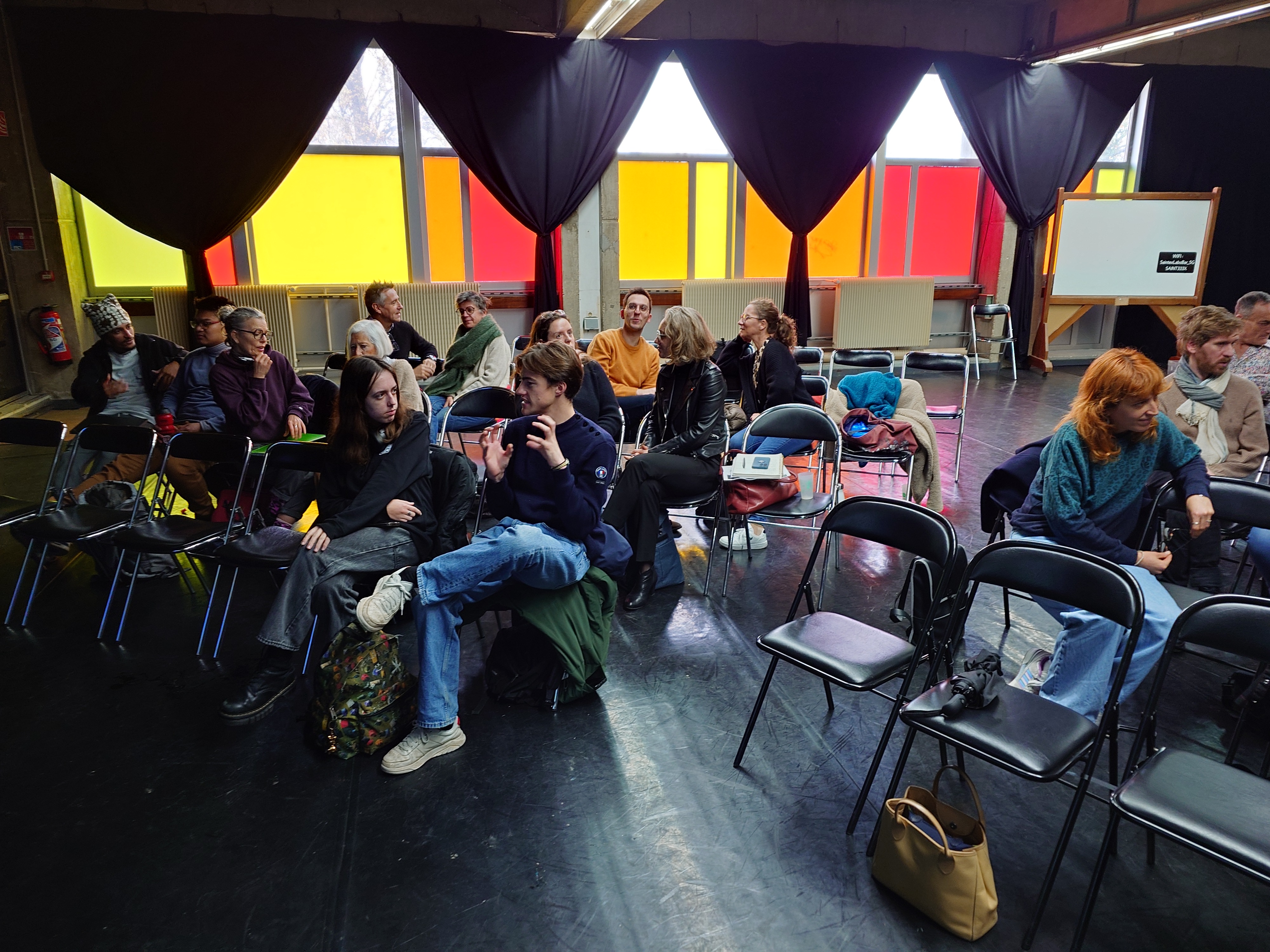
The moment of sharing constitutes the heart of the experience. In a darkened room, the photographs are projected in large format, stopping on each one to discuss it. A fundamental rule then structures the exchanges: the author of the projected photo is not allowed to speak. This prohibition becomes the engine of a remarkable collective dynamic: the other participants are invited to freely express what they perceive in the image, the emotions it arouses, and the associations of ideas it provokes. The facilitator also participates in the exercise and submits their own photograph to the group’s gaze, thereby establishing horizontality in the relationships.
It is this device, which I have implemented dozens of times over a long period, that serves as the field of observation and reflection for the conceptualization that follows.
Lived experience as a condition for thought
I am convinced that one does not reflect in the same way after having lived something as one does without living it. This conviction structures my entire practice in the fields of cultural mediation, training, cultural action, and artistic creation. When I propose a workshop, I do not primarily seek to convey a message or transmit technical skills. I seek to create the conditions for an experience that will modify the relationship participants have with the creative act itself.
This approach fits into what Bernard Stiegler calls “grammatization” in The Automatic Society (Fayard, 2015)—that is, the technical processes of discretization and spatialization of temporal flows that allow for their transmission and transformation. But where Stiegler is interested in the technical devices themselves, my practice aims to reveal how these devices can become instruments of symbolic emancipation. The mobile phone, an omnipresent object often perceived as alienating, is transformed into a tool for collective creation when the framework of its use is modified.
Lived experience is not a simple illustration or a practical application of theoretical concepts. It constitutes the primary material from which authentic thought can emerge. Patrice Meyer-Bisch, in his work on cultural rights, notably in Cultural Rights and Practices (L’Harmattan, 2016), insists on the fact that culture is not primarily a set of objects but a relational process. It is precisely this relational process that cultural mediation seeks to activate, by creating the conditions for an encounter between people, objects, places, and imaginaries.
Constrained time as a revealer of intuition
The choice to impose a very short time for creation—about fifteen minutes—is not a technical constraint but a fundamental methodological principle. This brevity prevents over-thinking and favors the emergence of more instinctive creativity. When I ask participants to create a staged photo on a given theme, I know that the limited time will short-circuit their usual mechanisms of intellectual justification.
This principle echoes the observations of Gilles Deleuze and Félix Guattari on artistic creation in What is Philosophy? (Columbia University Press, 1994): art has no opinion; it undoes the triple organization of perceptions, affections, and opinions to substitute a monument composed of percepts, affects, and blocks of sensations. Constrained time specifically prevents the formation of preconceived opinions about what the image “should” be. It allows participants to access what Deleuze calls “percepts”—that is, perceptions that exceed the person experiencing them.
In my practice, I regularly observe that participants produce images that are much richer, more ambiguous, and polysemic when they do not have the time to “do it right.” This paradoxical dimension is essential: artistic quality does not emerge from technical mastery or deep reflection, but from the ability to let something happen that goes beyond us. This is what I call the deconstruction of the “fantasy of mastery.” The exercise reveals experientially that the creative act largely eludes its author. It involves putting people in a modified state of consciousness—a form of trance—through the compression of time.
The prohibition of speaking as a device for decentering
The rule stating that the author of the projected photo is not allowed to speak constitutes the heart of the methodology. This prohibition, far from being a frustration, becomes the motor of collective dynamics and the construction of the whole. It operates a radical reversal of traditional modalities for presenting creative work. Instead of having to justify, explain, or defend their production, the creators find themselves in the position of discovering their own work through the prism of multiple perspectives.
Serge Tisseron, in Dreaming, Fantasizing, Virtualizing (Dunod, 2012), emphasizes that identity is constructed in the gap between what we think we are and what others perceive of us. It is precisely this gap that the workshop device makes visible and productive. By forcing the creator to remain silent, I create the conditions for them to discover the symbolic resonances of their own production—resonances they had not consciously integrated. Through the eyes of others, participants discover dimensions, symbols, and meanings in their own images that they had not anticipated.
This discovery is not simply cognitive. It touches upon something in the order of symbolic recognition. Participants often feel a form of anxiety when their photo is projected. They would like to apologize for what they have done. This fragility is not a flaw of the device; it is its starting point. Because it is precisely in this vulnerability that something in the order of symbolic legitimation can occur. The gazes of others do not come to judge the production according to pre-established aesthetic criteria. They come to reveal the value of what has been created—a value that the creator could not attribute to themselves.
The polysemy of images as an anthropological principle
The device vividly reveals that a photograph never carries a single meaning but instead opens up a multiplicity of possible interpretations. This dimension is not a simple semiological observation; it constitutes a fundamental anthropological principle. The image cannot be reduced to the intention of its author; it also belongs to those who look at it.
Roland Barthes, in Camera Lucida (Hill and Wang, 1981), distinguished the studium (the general cultural interest of a photograph) from the punctum (the detail that “stings,” that pierces the spectator). What the photographic workshop reveals is that the punctum is radically singular: each viewer will be touched by different elements and construct different meanings. And these meanings are not errors of interpretation; they constitute the very life of the image. When participants comment on a photo by seeing symbolic dimensions that the author had not thought of, they are not mistaken; they are actualizing the latent potentialities of the image.
This polysemy is not an obstacle to communication; it is its very condition. Dominique Cardon, in Digital Culture (Presses de Sciences Po, 2019), shows how digital platforms have multiplied spaces for the interpretation and reappropriation of images. But what my practice as a mediator seeks to reveal is that this multiplicity of perspectives is not a novelty linked to digital technology; it is constitutive of the very functioning of the image. The workshop merely makes visible and conscious this process that operates implicitly all the time. It is important to make it present and explicit because we forget it far too often; we are brought back much too frequently to “explanation,” “justification,” and the “author’s intention,” which is actually only a tiny part that often blocks what is essential in terms of lived experience, journey, and learning.
The place as the primary interlocutor
In the instructions I give to participants, I always insist on the importance of the place. I suggest they do not think beforehand about what they are going to do, but rather leave quickly, wander around, and see if there is a place that inspires them. This suggestion is based on the idea that the place where a photo is taken is of great importance and that it is often the place itself that, once you are there, will provide ideas. Conversely, if we think too much beforehand, we will look for a place that corresponds to our ideas, and this closes off our openness to what the world can inspire in us.
This approach is radically opposed to a conception of creation as the projection of a prior intention onto the world. I explicitly tell participants: “If we think in the abstract, we then find ourselves wanting to look for a place that corresponds to what we imagined in our heads, and we are always disappointed.” This disappointment reveals the gap between the mental image and the real image, between what Gaston Bachelard called “imagination” and “reverie” in The Poetics of Reverie (Orion Press, 1960). Imagination projects, reverie welcomes. It is this posture of welcoming that I seek to encourage.
The place is not a simple set or background. It is an “actant” in its own right, to use Bruno Latour’s terminology in Reassembling the Social (Oxford University Press, 2005). It possesses its own affordances, its own suggestions. A staircase invites certain types of compositions, a sidewalk invites others, and a church in the background opens up still other possibilities. By suggesting that participants discover a place rather than starting from an abstract idea, I invite them to enter into a dialogic relationship with the environment.
This approach also has a political dimension. It suggests that creation does not consist of imposing one’s vision on the world but of composing with what is already there. It is a form of creative modesty that seems particularly relevant in the context of what Yves Citton calls an “ecology of attention” in his work of the same name (Seuil, 2014). Rather than seeking to produce radical novelty, the goal is to reveal the latent potentialities of the “already-there,” to bring forth what was possible but invisible.
Legitimacy as a collective construction
One of the most important dimensions of the device concerns the question of legitimacy. I observe it every time: participants do not feel legitimate in what they have done. This fragility affects museum directors and social educators, cultural professionals and people in situations of precariousness in the same way. Creative vulnerability is universal; it knows no social hierarchy.
It is precisely because the device puts everyone in the same position of vulnerability that it can operate a transformation. Nancy Fraser, in What is Social Justice? (La Découverte, 2011), distinguishes three forms of social justice: economic redistribution, cultural recognition, and political representation. What the photographic workshop activates is specifically the dimension of cultural recognition. Not a recognition granted from the outside by a cultural authority, but a recognition that emerges horizontally, in the exchange of gazes.
When I say to participants: “Through the gaze of others, they reflect back to us a value of what we have done. And this is what others bring to us. We cannot give value to ourselves,” I am formulating a fundamental anthropological principle. Symbolic value is never self-attributed; it is always constructed in the relationship. This is what Axel Honneth calls the “Struggle for Recognition” in his book of the same title (Polity Press, 1995). But within the framework of this workshop, this struggle takes a pacified, ritualized form. The rules of the game create the conditions for a mutual recognition that does not pass through competition or the hierarchization of productions.
The legitimation that takes place is not definitive. It is not settled in one go, resulting in everyone having total self-confidence. It is a progressive journey, a “symbolization” in the psychoanalytic sense. Lacan said in his text “The Function and Field of Speech and Language in Psychoanalysis” (reprinted in Écrits, Norton, 2006) that the symbolic is what “kills the thing.” By symbolizing the creative experience, by passing it through the language of others, we effectively transform something in the order of raw lived experience into something appropriable and transmissible. Participants discover that their creation exists, that it has importance, and that it has touched others. This discovery founds their legitimate place in the social space symbolized by this collective “exhibition.”
Digital technology as infrastructure of collective memory
The use of digital technology in the workshop is not merely utilitarian. It activates questions of heritage, collective memory, and sovereignty. When I use a QR code that leads to a private platform—in a corner of my website that I maintain and will leave online—rather than to Google Photos or Instagram, I am implicitly asking the question: who owns the traces of our collective creation?
Bernard Stiegler extensively developed the idea that digital technologies constitute “tertiary retentions”—that is, externalized supports of collective memory, notably in Technics and Time, Vol 3 (Stanford University Press, 2010). These retentions are not neutral; they organize what can be memorized and how. By choosing to host the workshop photos on my own server rather than on commercial platforms, I am making a political gesture. I am telling the participants: “This is a heritage; it is in a corner of my server. I am not going to take it down. It will stay.” This permanence is important. It signifies that what was created will not disappear into the incessant flow of social networks.
Shared digital heritage creates a concrete bond. I observe that in workshops with adolescents, being able to return to the created images, show them to others, and comment on them remotely generates dynamics of appropriation and pride. A child who participated in an activity can talk about it to their family with words, but these words are often not enough to convey the experience. On the other hand, if the family can see what was done, they too can build their desire to participate, to come to the opening (as in this project at the Musée de la Grande Guerre de Meaux), and to get involved. Digital technology does not replace the physical relationship; it extends its effects in time and space.
This dimension of digital technology as a memory infrastructure aligns with Milad Doueihi’s work on “digital culture” as an anthropology of a civilization in Digital Cultures (Polity Press, 2011). Digital technology is not content to be a tool; it profoundly modifies our ways of inhabiting the world, building links, and inscribing ourselves in a collective history. Contemporary cultural mediation cannot ignore this dimension. It must work with digital tools not as pedagogical gadgets but as constitutive elements of our symbolic environment.
Horizontality as an ethical and political principle
One of the most important aspects of this methodology concerns the posture of the facilitator. I always participate in the exercise and submit my own photograph to the group’s gaze. This participation is not a simple pedagogical strategy to put people at ease. It constitutes a fundamental ethical and political principle: horizontality.
Paulo Freire, in Pedagogy of the Oppressed (Seabury Press, 1970), developed the idea of a “dialogical education” as opposed to “banking education.” In banking education, the teacher deposits knowledge into the heads of students assumed to be empty. In dialogical education, learning happens through exchange, in the mutual recognition of each person’s knowledge. This is exactly what the photographic workshop device seeks to implement. By putting myself in a position of creative vulnerability, by accepting that my production be commented on without me being able to defend it, I establish an equality in risk-taking.
This horizontality temporarily abolishes social and professional hierarchies. In a mixed group that includes directors of cultural venues, youth protection educators, professional artists, and young people in social difficulty, everyone is brought back to the same fundamental position: that of a vulnerable creator seeking recognition. Photos are identified only by the first names of their authors, thus erasing professional status. This equalization is not demagogic; it does not deny the differentiated skills of each person. It simply postulates that in the creative act itself, faced with the uncertainty of reception, we are all equally exposed.
Horizontality does not prevent mediation. I remain the one who designs the device, who sets the rules, and who facilitates the feedback session. But these rules are designed precisely to limit my power of prescription. Seeing the photos, I often think to myself that I would never have thought it possible to take that kind of photo in that kind of setting. As a result, I realize that I myself am pushed to step out of my own framework and to learn things about my own practice. This position of permanent learning for the mediator is not a displayed humble posture; it is a structural reality of the device.
Autonomy as a condition for authentic creation
The complete autonomy of the participants during the creation phase is essential. The fact that there is full and entire autonomy constitutes a fundamental methodological principle for me. There are photos that would not exist if I had been there as an intervener who “holds the hand,” because they consider that they know best, or that they are “the photographer.”
This autonomy aligns with what Jacques Rancière calls “emancipation” in The Ignorant Schoolmaster (Stanford University Press, 1991). For Rancière, intellectual emancipation does not consist of transmitting knowledge but of recognizing the equality of intelligences. The emancipatory master is not the one who explains, but the one who creates the conditions for the student to discover their own capacity to understand. Similarly, the emancipatory cultural mediator is not the one who shows how to take a good photo, but the one who creates the conditions for participants to discover their own creative capacity.
This autonomy also has an important practical dimension. Those who have technical difficulties get help from others. This spontaneous mutual aid is part of the device. It reveals that skills are distributed within the group and that everyone can contribute something. The use of the mobile phone—a tool that everyone masters technically at their own level—allows for bypassing the intimidation that professional photographic equipment might cause. This technical accessibility constitutes a powerful democratic lever. It makes quality creation possible in total autonomy. For the uploading of photographs, which can be very simple for some and very difficult for others, I also tell them to help each other; I do not intervene.
Autonomy does not mean the absence of a framework. On the contrary, it unfolds within very precise constraints: a common theme, a formal constraint (integrating a hand into the image), a limited time, and a defined sharing mode. These constraints do not limit creative freedom; they make it possible. This is the productive paradox of all artistic creation: it is in the acceptance of constraints that true freedom can be exercised. Georges Perec demonstrated this magnificently with the Oulipo, notably in A Void (Harvill Press, 1994). Formal constraints, far from hindering invention, stimulate it by short-circuiting habits and automatisms.
A pedagogy of constructive vulnerability
The device relies on the acceptance of a temporary vulnerability. This vulnerability is not a defect to be corrected but a necessary condition for learning. Brené Brown, in her research on vulnerability published in Daring Greatly (Gotham Books, 2012), shows that vulnerability is the birthplace of innovation, creativity, and change. What this photographic workshop stages is precisely this productive dimension of vulnerability.
When participants discover their photos projected in large format in a darkened room, they experience a moment of exposure in the strong sense of the term. They are exposed to the gaze of others, stripped bare in their creative attempt. This exposure could be experienced as violence if it were not framed by protective rules. The author’s prohibition from speaking is not just a pedagogical device; it is also a protection. It prevents the defensive justification that would be a way of escaping vulnerability. At the same time, it guarantees that the group’s comments will not be judgments but interpretations, associations, and resonances.
This shared vulnerability creates the conditions for structural benevolence. This is not a moral benevolence requested of participants as a personal quality. It is a benevolence that flows from the device itself: since everyone has gone through or will go through the same ordeal, and since the facilitator themselves submits to the same rule, a form of collective empathy emerges naturally. This empathy is not sentimental; it is cognitive and symbolic. It allows one to understand from the inside what it means to create and to receive, to produce and to be perceived.
The pedagogy of constructive vulnerability that I advocate is radically opposed to pedagogies of mastery. It does not aim to train experts capable of producing technically perfect images according to academic criteria. It aims to reveal the creative capacity that exists in everyone—this capacity that only asks to be recognized and legitimized. It is a pedagogy of revelation rather than transmission, a pedagogy that trusts what is already there rather than seeking to fill supposed gaps.
Cultural mediation and cultural rights
This entire methodology is part of a conception of cultural rights as developed by the Fribourg Group and notably by Patrice Meyer-Bisch. Cultural rights do not consist of giving access to “legitimate” culture, but of recognizing existing cultural practices and creating the conditions for their development. As formulated in the Fribourg Declaration on Cultural Rights (2007): “Everyone has the right to choose and to have their cultural identity respected in the diversity of its modes of expression.”
The photographic workshop does not start from the premise that there are people who know nothing about photographic art and need to be educated. It starts from the premise that everyone already has a sensitive relationship with images, nourished by their personal history, social environment, and cultural references. What the device proposes is to reveal and value this sensitive relationship, to make it visible and shareable. It is not about raising people toward a “superior” culture, but about recognizing the legitimacy of their own cultural expressions.
This approach is radically distinct from traditional cultural democratization, which essentially aimed to make high culture accessible to the greatest number. Instead, it falls under what is now called “cultural democracy,” which recognizes the plurality of cultural expressions and their equal dignity. Even Olivier Donnat, in his surveys on Cultural Practices of the French in the Digital Age (La Découverte, 2009), has postulated that amateur practices and popular cultures constitute forms of cultural participation in their own right.
Cultural mediation, in this perspective, is not a service activity that brings culture to those who lack it. It is a relational engineering that creates devices allowing everyone to exercise their cultural rights: the right to create, the right to be recognized in one’s cultural expressions, the right to participate in the cultural life of one’s community. The photographic workshop is one of these devices. It does not teach photography; it creates the conditions for everyone to discover and legitimize their own capacity to produce meaningful images.
Toward a generalizable methodology
The principles I have experimented with in this photographic workshop are transferable to other mediums and other contexts. What matters is not the photographic technique per se, but the structure of the device: constrained time, a common theme, a unifying formal constraint, complete autonomy in creation, a prohibition on the author speaking during feedback, the participation of the facilitator, a valorizing projection of productions, and a shared digital heritage.
These elements can be adapted to short video, sound recording, digital drawing, or collective writing. What is important is to maintain the productive tension between constraint and freedom, between vulnerability and recognition, between individual creation and collective symbolization. Jean-Pierre Esquenazi showed in Sociology of Works (Armand Colin, 2009) how “interpretive communities” constitute the true living space of cultural works. The photographic workshop artificially creates, for the duration of a session, an interpretive community that allows each creation to be received, commented on, and enriched.
The methodology is also applicable in very diverse contexts: professional training, popular education, social work, artistic and cultural education, school animation, or interventions in hospitals or prisons. In each of these contexts, it allows for revealing participants’ creative capacities, strengthening bonds within the group, and producing valuable traces of collective activity. It also offers a concrete support for addressing complex questions: the polysemy of images and media literacy, the construction of symbolic legitimacy and self-esteem, and the role of the unconscious in artistic creation.
What makes this methodology generalizable is that it does not rely on specific technical skills of the facilitator but on a posture and the design of a device. Any cultural mediator, educator, teacher, or social worker can appropriate these principles and adapt them to their own context of intervention. The essential thing is to maintain coherence between the different elements of the device and not to yield to the temptation of a “take-over” that would defuse the dynamic of autonomy and horizontal recognition.
Art as a fundamental human capacity
The inverted participatory photographic workshop represents much more than a method for image training. It constitutes a true pedagogy of creative emancipation that reveals to everyone their capacity not only to create, but also to enrich the gaze of others. By transforming an everyday tool into an artistic medium, by establishing rules that liberate rather than constrain, and by creating the conditions for authentic horizontality, this approach allows for a transformative experience.
It demonstrates that art is not the preserve of a few but a fundamental human capacity waiting to be revealed and shared. This statement is not ideological or voluntaristic; it is based on years of experimentation with extremely diverse audiences. Every time, I observe the same thing: people who did not think they were creative discover that they can produce rich, ambiguous, and touching images. People who felt illegitimate discover that their creation has value for others. People who thought of art as a reserved domain discover that they can participate in collective cultural production.
In our age saturated with images, this methodology offers a precious space to slow down, create consciously, and above all, learn to truly look together. It allows for the realization that images are only staging, always only interpretation. This realization, experienced playfully rather than theoretically, constitutes a fundamental lesson for navigating what Guy Debord called the Society of the Spectacle (Buchet-Chastel, 1967). It offers concrete tools to develop a critical gaze without falling into cynicism, to participate in cultural production without being alienated by market or spectacular logics.
The gazes of others on my own production help me to legitimize it—I, who gave it no value. One does not totally believe in the veracity of what others say about one’s creation, but because one reacts to the images of others, one knows it is true. Thus, the gazes of others have the effect of building ourselves, and also found our legitimate place in the social space symbolized by this “exhibition.” It is this mutual construction, this reciprocal recognition, and this shared symbolization that constitute the heart of cultural mediation as I conceive and practice it.

Drawing on Benoît Labourdette’s 30 years of experience in the field of cultural innovation and his research and methodological work, the Benoît Labourdette production agency supports cultural policies in their need for innovation, better encounters with populations, use of digital tools and cooperation, definition of mediation strategies, and support for artistic teams, technicians and elected representatives. Our method is always based on collective intelligence, cooperation and empowerment of people and structures. We work with cities and other local authorities, national networks, institutions and associations.
-

Creating to think
A French-Finnish meeting at L’Alhambra in Marseille on 4 May 2026, as part of the Erasmus+ Visual Thinkers project.
On 4 May 2026, I facilitated a professional meeting at L’Alhambra in Marseille, organised by the Image Clé association as part of the European (…) -

The Book Archipelago
A proposal to elected representatives: making plural bookshops the backbone of territorial cultural policies.
Faced with the tensions running through the bookshop sector today, it is time to put an end to the sanctuary myth. Rather than seeking an (…) -

The photography workshop: creating, showing, looking together
Reflections on a hands-on workshop facilitated by Benoît Labourdette at the professional conference “Cinema, images and young people’s mental health”, held on 14 April 2026 in Romainville, France.
A workshop in nine small groups, fifteen minutes to produce a photograph, then a moment of collective viewing in which the authors remain silent (…) -

« Mental Health and Cinema »
Synthesis of the day “Young people, their images, their spaces: new paradigms” (14 April 2026)
Synthesis of a day of professional gatherings at the Le Trianon cinema in Romainville, bringing together the perspectives of professionals from (…) -

Mental health, young people, images: what are we talking about?
Text of Benoît Labourdette’s opening talk at the professional meetings held on 14 April 2026.
Before entering into projects, we need to pin down the words. Mental health, young people, images: three notions we often use together without (…) -

Transmitting cultural rights: a question of coherence
What facilitation methods reveal about our relationship with people.
How can we talk about cultural democracy within an authoritarian framework? How can we defend respect for each person’s culture while imposing a (…) -

Mental Health and Cinema - Experiencing the World Through Images
Two professional conferences in Romainville (April 14 and 15, 2026).
On April 14 and 15, 2026, ACRIF, as part of its coordination mission for Passeurs d’images in Île-de-France, is organizing two days of (…) -

Collaborative assessment of screen literacy education in Nouvelle-Aquitaine
Collective intelligence methodology, digital platform, and collaborative publication for ALCA (2026).
ALCA, Agence Livre, Cinéma et Audiovisuel en Nouvelle-Aquitaine, entrusted me with the methodological support for a collaborative assessment of (…) -

Media Literacy: Should We Judge or Guide?
Reflections based on the National Meeting of Regional Centers for Media Literacy (Rouen, March 16–17, 2026).
On 16 and 17 March 2026, Normandie Images organised in Rouen the national meeting of France’s regional image education centres (pôles régionaux (…) -

The Meaning of Mediation Methods in Arts and Cultural Education
When practice reveals what theory ignores.
Artists and professionals involved in arts education develop singular methods that most often remain implicit. I wish to lift the veil on the (…) -

Cultural Mediation as a Device for Symbolic Emancipation
Methodological Principles for a Horizontal Approach to Collective Creation.
Lived experience radically transforms our relationship to thought. Cultural mediation does not consist of transmitting knowledge but of creating (…) -

Evaluating Arts and Cultural Education from the Artist’s Perspective
Review of a course given at INSEAC: conceptual and methodological tools for cultural professionals.
On January 15, 2026, as part of the CNAM module EAC104 “Building tools to evaluate ACE projects: qualitative and quantitative survey methodologies (…) -

Developing Psychosocial Skills Through Artistic Practices
Methodological principles for an experiential approach.
Psychosocial skills (PSS) are now at the heart of public health, education, and child protection policies. The 2023-2027 intersectoral roadmap, (…) -

When thirty-five professionals discover their psychosocial skills through creative experience
A look back at the interprofessional seminar of January 12, 2026, in Limoges: a day where theory gave way to lived experience.
At the DRAC Nouvelle-Aquitaine, educators, teachers, caregivers, and cultural actors experienced together what it truly means to develop (…) -

Image Education and Citizenship: When Youth Professionals Rethink Their Practices
{{Reflections on the “Out-of-School Time” professional day that I co-designed with ALCA and the Gironde Departmental Council.}}
On December 2, 2025, around a hundred youth, animation, and culture professionals gathered at the MECA auditorium in Bordeaux to explore together (…) -

Art and Culture in the Service of Psychosocial Skills
Account of a founding seminar for professionals of the Judicial Protection of Youth in Limousin.
On November 27, 2025, the Limousin Regional Directorate of PJJ brought together its teams for a half-day of collective reflection on psychosocial (…) -

Youth and culture: for a radical change in posture
Giving young people the power to create, not just consume culture.
How can cultural institutions break out of their chronic failure with young people? By abandoning condescension to embrace a genuine cultural (…) -

Reinventing youth reception in cinemas
Remote training for cinema operators in Lot-et-Garonne.
How can we transform our cinemas into spaces for authentic encounters with 15-25 year-olds? This question guided an intense training session with (…) -

“Participatory creation as a laboratory for democracy?”
4th edition of the biennial festival of participatory creation - Les Rencontres de la Poudrerie - Théâtre des habitants - May 16 & 17, 2025.
Les Rencontres de la Poudrerie are a moment for reflection and co-construction, at the intersection of art forms and the practice of social life. (…) -

Pour une robustesse coopérative des projets culturels
Réflexion sur les modalités de coopération territoriale et d’évaluation.
Pour que les projets culturels puissent trouver pleinement leur sens social et devenir plus robustes face aux attaques politiques qui les jugent « (…) -

Design of a professional day on “Artistic and digital practices for young people”
Act’art, artistic and cultural action in Seine-et-Marne.
As part of its mission to promote collective intelligence by facilitating local think tanks, Act’art asked Benoît Labourdette to design, (…) -

OPC Media: “What if we changed our posture?”
How can we learn to consider the richness of teenage digital practices and avoid giving in to preconceived ideas?
How can we learn to consider the richness of teenagers’ digital practices and not give in to preconceived ideas? For Benoît Labourdette, if we (…) -

Itinéraire bis, the path of cultural rights
Action research conducted by the MPAA (Paris).
Accompaniment in the animation, production of traces and fabrication of the web platform resources of the research-action “Itinéraire bis, chemin (…) -

Helping young people and professionals to speak out: “Cultures and youth policies” national meeting
Observatory of Cultural Policies / Villeurbanne (TNP, May 11 & 12, 2023).
As part of the Rencontres nationales “Cultures et politiques de la jeunesse” (“Cultures and youth policies”), which brought the year of the French (…) -

"Culture, youth and digital: designing new modalities for cultural and educational projects
Sharing of methodological tracks and professional training.
Deconstructing preconceived ideas about digital transformation and developing projects adapted to young people.The cultural offer is sometimes (…) -

“Media College” platform for Périfééries
Creation of a digital collective intelligence tool.
To meet a need for creative, intellectual emulation and the production of ideas for one of the axes of the Saint-Denis (93) city’s bid for the (…) -

Giant digital brainstorming
Design and implementation of a digital collective intelligence tool.
Method of activating a vast contribution for the axes of a cultural project. The needIn the solidarity I had with the city of Saint-Denis’ bid (…) -

The Périfééries project’s heritage council of influence
Facilitating collective intelligence in a short space of time.
As part of Saint-Denis’s bid to become European Capital of Culture 2028, I led a collective intelligence session to collect proposals on the (…) -

Reinventing cultural projects with youth?
Proposal of questions.
While public cultural action aims to reach people in their great diversity, it is clear that it is often difficult to mobilize youth. However, (…)


-
Transmitting cultural rights: a question of coherence What facilitation methods reveal about our relationship with people.
How can we talk about cultural democracy within an authoritarian framework? How can we defend respect for each person’s culture while imposing a (…) -

Formalizing the informal Informality, essential to learning, resists structure while calling for it. How to tame it.
The absence of informal aspects in distance learning forces us to rethink its fundamental nature. This constraint becomes a laboratory for (…) -

For an ecology of dispensability Rethinking authority and transmission.
Faced with the vertical management that dominates and alienates, another path exists: that of an authority that aims for its own dispensability, (…) -

Art bleeds Calligrams
-

Definition of Cultural Mediation An ethics of relationship in service of singular experience.
Cultural mediation is often reduced to a set of transmission techniques. Here I propose a definition that places the person at the center: an (…)
