Art and Culture in the Service of Psychosocial Skills
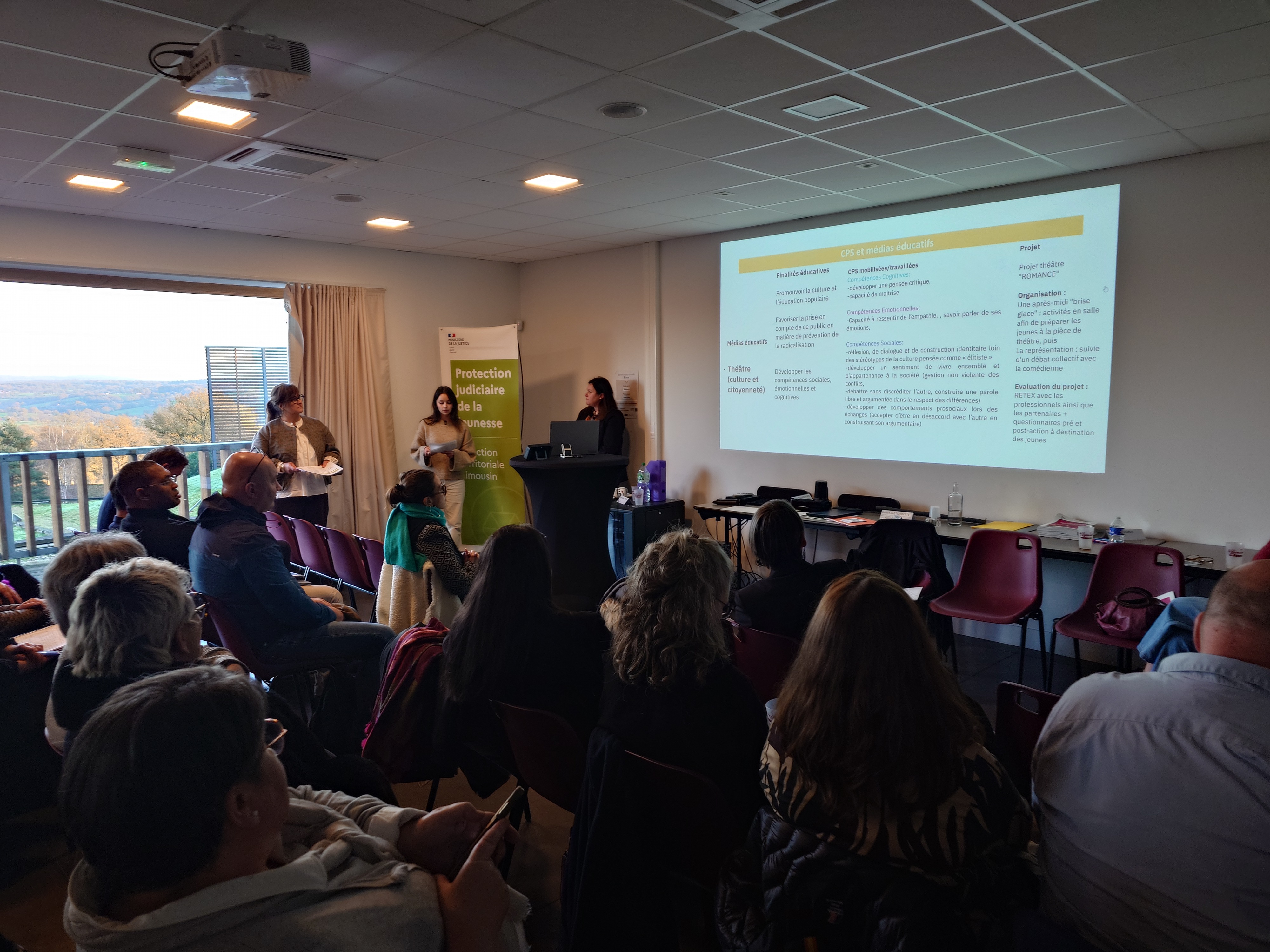
On November 27, 2025, the Limousin Regional Directorate of PJJ brought together its teams for a half-day of collective reflection on psychosocial skills, the first step in a three-year initiative.
An institutional framework with ambitious goals
In Limoges, on this Thursday in November, some sixty professionals from the Judicial Protection of Youth gathered for an afternoon marking the launch of a structuring project. The initiative falls within the framework of the Culture-Justice partnership, jointly led by the Limousin Regional PJJ Directorate and the DRAC Nouvelle-Aquitaine, with support from Promotion Santé Nouvelle-Aquitaine. This work is grounded in current public policies, particularly since the interministerial instruction of August 19, 2022, establishing a national strategy for developing psychosocial skills in children and young people.
Psychosocial skills, as defined by the World Health Organization as early as 1993, refer to all the abilities that enable an individual to meet the demands of everyday life. Santé publique France updated them in 2022 according to three broad categories:
- cognitive skills (self-awareness, critical thinking, decision-making),
- emotional skills (identification and regulation of emotions, stress management),
- social skills (communication, empathy, conflict resolution).
For young people under PJJ supervision, often marked by histories of disruption, these abilities constitute both an area of vulnerability and a lever for intervention.
The project led by the Limousin regional directorate stands out through its distinctive positioning: placing art and culture at the heart of psychosocial skills development. This approach deliberately differs from the sometimes dominant normative approaches in media education, favoring instead a humanistic and creative vision. The working hypothesis is based on the capacity of artistic experience to engage the sensory, the emotional, and critical thinking, thereby creating spaces for expression and recognition conducive to personal development.
A co-construction born from professional encounters
The genesis of this seminar dates back to a year of reflection and exchanges. During a day of cultural project presentations in Bordeaux in 2024, Samera Zemani, technical advisor in health promotion at the Limousin DTPJJ, and Benoît Labourdette, filmmaker and educator, began a dialogue that would gradually take shape. This encounter was enriched by the impetus of David Redon, justice-culture liaison at DRAC Nouvelle-Aquitaine, who had for several years been eager to intersect the question of psychosocial skills with cultural mediation.
Benoît Labourdette brings to this project an expertise forged over more than twenty-five years of engagement with PJJ audiences. A filmmaker by training, he was president of the national coordination of Passeurs d’images, an emblematic national program for visual education. His approach articulates artistic creation, participatory pedagogy, and attention to processes of self-construction. Drawing on this background, he ensured the co-design of this day with the regional directorate team, bringing together Samera Zemani, Nora Bennouna (secularism-citizenship liaison), David Nguyen (regional technical advisor), and Amandine Guyon from Promotion Santé Nouvelle-Aquitaine.
The collaboration with Dr. Marie-Noëlle Clément, child psychiatrist and founding member of the 3-6-9-12+ Association, helped anchor the discussion in scientific rigor. Working alongside Serge Tisseron for many years on questions of empathy and child development, she directs the day hospital at CEREP in Paris, where she supports children with severe psychiatric disorders. Her presentation provided the theoretical foundations essential to understanding the psychological mechanisms at play in work on psychosocial skills.
Empathy as the foundation of psychosocial development
Dr. Marie-Noëlle Clément opened her presentation by introducing the framework of her work. Her participation in the federation of Petits Laboratoires d’Empathie (Small Empathy Laboratories), founded by Serge Tisseron, allows her to develop several recognized programs, including the “Game of Three Figures,” an evidence-based program used in bullying prevention in schools. She also mentioned her involvement with the association “3-6-9-12+, Taming Screens and Growing Up,” which works on preventing risks related to excessive screen use, an issue directly linked to the development of empathy in children.
Her remarks helped illuminate the connections between the different components of psychosocial skills. Emotional regulation, the identification of emotions, and the ability to put oneself in another’s place without losing oneself are skills that develop from early childhood, in a favorable and secure environment. Young people under PJJ supervision often show deficiencies in this development, linked to life paths marked by disruptions, abuse, or neglect. Dr. Clément emphasized the importance of sometimes revisiting very early stages of development with adolescents, through activities that allow them to identify and name emotions.
She also addressed the question of guilt and awareness of one’s actions, a particularly sensitive subject in the context of juvenile justice. Some young people find themselves unable to perceive the impact of their actions on others, which is precisely the terrain for working on psychosocial skills. Exchanges with the professionals present made it possible to articulate these theoretical contributions with field realities, particularly on the question of developmental “windows” and the possibility of reopening them even later in life. Research in developmental psychology has demonstrated the effectiveness of psychosocial skills development programs across several dimensions: improvement of psychological well-being, reduction of risk behaviors, and decrease in violent and addictive behaviors (Psychosocial Skills: A Framework for Deployment with Children and Young People, Santé publique France, 2022).
A creative workshop to experience emotions firsthand
Following the theoretical presentation, Benoît Labourdette offered participants a participatory creation workshop, the pivotal moment of the afternoon. The exercise consisted of forming groups of five to six people and creating together, in less than ten minutes, a creative photograph on the theme of psychosocial skills. A deliberately open but technically precise instruction, leaving room for interpretation and collective creativity. The photograph could be abstract, symbolic, show faces or only hands, use elements found in the immediate environment.
This proposal is part of an approach where art is not considered a mere illustrative support but as an experience in its own right. As Benoît Labourdette emphasized, artistic creation is not imitation, but adventure. The goal was not to produce a perfect image or convey an explicit message, but to live together an emotional experience: that of the instruction, of collective negotiation, of choices to be made within a constrained timeframe, of committing oneself in a social space. Dewey’s work on learning through experience (1938) has shown that this type of situation mobilizes skills that cannot be developed through theoretical transmission alone.
The sharing moment revealed all the richness of this approach. Groups were forbidden to comment on their own production; only other participants could express what they perceived, felt, or understood when looking at the image. This reversal of usual roles created a safe space where the gaze of others came to establish the work rather than judge it. Each photograph was signed with the first names of its authors, recognition of each person’s dignity and their contribution to the collective effort. The images projected on the large screen evoked varied emotions, interpretations sometimes surprising for their creators, discoveries about the richness of what they had produced without being fully aware of it.
Benoît Labourdette took time to explain the pedagogical mechanisms of this exercise. The act of naming the emotions felt when viewing an image constitutes learning in itself, the difficulty of which participants were able to appreciate. The benevolent gaze of peers allows one to feel recognized, to better understand what one has created oneself, to understand through lived experience that there are multiple interpretations of the same image, of the same situation, that entering into the perspective of others is constructive, and can plant a small seed of self-confidence. The entire process, from instruction to collective viewing, mobilizes psychosocial skills in a concrete and embodied way. This approach draws on work related to experiential learning, which shows that emotional engagement promotes the anchoring of learning (Experiential Learning: Experience as the Source of Learning and Development, D.A. Kolb, 1984).
Field testimonials that inspire
The last part of the afternoon was devoted to feedback from professionals. Amandine Guyon from Promotion Santé Nouvelle-Aquitaine presented the actions carried out in 2023-2024, notably a pedagogical week and sessions with young people co-facilitated with Addiction France. These experiments helped identify obstacles, such as the mixing of structures that does not always foster the creation of bonds between young people, or the lack of preparation beforehand. They also revealed levers, notably the willingness of professionals to engage in a co-construction approach and to introduce complementary workshops around sports, convivial meals, or prevention of cyber-violence.
Caroline Besse, technical teacher at the open environment unit in Guéret, delivered a particularly illuminating testimony on the evolution of her practices. Faced with young people aged 13 to 16 who had dropped out of school, were angry, and convinced they were “failures,” she had to completely rethink her approach. A turning point: in 2022, a young person whose cognitive, emotional, and behavioral difficulties exceeded all usual methods. With the support of her supervisor and the psychologist, she built a secure space with rituals, physical protections, a withdrawal chair never used but reassuring by its mere presence. She self-trained in psychosocial skills, working on interpersonal skills and know-how before any academic learning objective.
Her use of visual arts as a mode of expression and empowerment produced tangible results. A young girl in great difficulty was able, through painting, to externalize in twenty minutes what she could not verbalize, an unblocking that opened the way to subsequent learning. Another, who said she was incapable of anything, went from fear of coloring to completing full boards, eventually joining a qualifying training program. These testimonials concretely illustrate what working on psychosocial skills makes possible: achievable objectives, comprehensible instructions, a right to fail that is no longer experienced as a condemnation but as a step forward.
Nora Bennouna presented the Romance Theater project, which uses theater as an educational medium in the context of radicalization prevention. This project illustrates how artistic mediations allow young people to develop their cognitive skills (consulting a voice, arguing, accepting disagreement without discrediting the other), emotional skills (expressing and managing their emotions in a secure framework), and social skills (interacting with others, finding their place in a collective). Theater helps deconstruct stereotypes linked to culture perceived as elitist, by promoting access to art as a tool for citizenship.
A three-year dynamic begins
This half-day constitutes the first step of a project embedded in duration. The regional directorate presented to participants the perspectives for the years 2025-2027. An inter-institutional and inter-professional seminar is scheduled for January 12, 2026, open to partners of the Regional Committee: ARS, National Education, DRAJES, Departmental Councils, SPIP, media education associations, and cultural actors in the territory. The ambition is to create a territorial community of practice, a space for reflection and sharing different from a traditional working group, where each person brings their material, their questions, their experiments.
Benoît Labourdette presented the training-action program that will unfold in several stages: collective training sessions, field experiments with young people, then reflective feedback to capitalize on and improve practices. This methodology, based on alternation between theory and practice, allows professionals to truly appropriate the tools rather than passively receive knowledge. Collective actions directed at young people are envisioned for Easter vacation 2026, a period that would allow bringing together both schooled and non-schooled youth.
The participatory closing session gathered the desires and availability of professionals. Through a digital contribution tool, participants were able to indicate their wish to join communities of practice, to participate in the training-action around culture and PSS, or to explore other themes such as sports, integration, or citizenship. The mind map projected live showed names gradually registering on the different perspectives: the January seminar, actions with young people, training-actions, communities of practice. About twenty professionals expressed their interest in pursuing this dynamic.
At the end of this afternoon, something was set in motion. Not a revolution of practices, but the beginning of a path. As Benoît Labourdette recalled in conclusion, we only plant seeds. Working on psychosocial skills is a journey, both for the young people and for the professionals who accompany them. Each small exercise, each moment of shared creation, each benevolent gaze cast upon a production constitutes a step on this path. The Limousin PJJ Regional Directorate laid, on this November 27, 2025, the first stone of a collective construction that will continue in the years to come.

Drawing on Benoît Labourdette’s 30 years of experience in the field of cultural innovation and his research and methodological work, the Benoît Labourdette production agency supports cultural policies in their need for innovation, better encounters with populations, use of digital tools and cooperation, definition of mediation strategies, and support for artistic teams, technicians and elected representatives. Our method is always based on collective intelligence, cooperation and empowerment of people and structures. We work with cities and other local authorities, national networks, institutions and associations.
-

Creating to think
A French-Finnish meeting at L’Alhambra in Marseille on 4 May 2026, as part of the Erasmus+ Visual Thinkers project.
On 4 May 2026, I facilitated a professional meeting at L’Alhambra in Marseille, organised by the Image Clé association as part of the European (…) -

The Book Archipelago
A proposal to elected representatives: making plural bookshops the backbone of territorial cultural policies.
Faced with the tensions running through the bookshop sector today, it is time to put an end to the sanctuary myth. Rather than seeking an (…) -

The photography workshop: creating, showing, looking together
Reflections on a hands-on workshop facilitated by Benoît Labourdette at the professional conference “Cinema, images and young people’s mental health”, held on 14 April 2026 in Romainville, France.
A workshop in nine small groups, fifteen minutes to produce a photograph, then a moment of collective viewing in which the authors remain silent (…) -

« Mental Health and Cinema »
Synthesis of the day “Young people, their images, their spaces: new paradigms” (14 April 2026)
Synthesis of a day of professional gatherings at the Le Trianon cinema in Romainville, bringing together the perspectives of professionals from (…) -

Mental health, young people, images: what are we talking about?
Text of Benoît Labourdette’s opening talk at the professional meetings held on 14 April 2026.
Before entering into projects, we need to pin down the words. Mental health, young people, images: three notions we often use together without (…) -

Transmitting cultural rights: a question of coherence
What facilitation methods reveal about our relationship with people.
How can we talk about cultural democracy within an authoritarian framework? How can we defend respect for each person’s culture while imposing a (…) -

Mental Health and Cinema - Experiencing the World Through Images
Two professional conferences in Romainville (April 14 and 15, 2026).
On April 14 and 15, 2026, ACRIF, as part of its coordination mission for Passeurs d’images in Île-de-France, is organizing two days of (…) -

Collaborative assessment of screen literacy education in Nouvelle-Aquitaine
Collective intelligence methodology, digital platform, and collaborative publication for ALCA (2026).
ALCA, Agence Livre, Cinéma et Audiovisuel en Nouvelle-Aquitaine, entrusted me with the methodological support for a collaborative assessment of (…) -

Media Literacy: Should We Judge or Guide?
Reflections based on the National Meeting of Regional Centers for Media Literacy (Rouen, March 16–17, 2026).
On 16 and 17 March 2026, Normandie Images organised in Rouen the national meeting of France’s regional image education centres (pôles régionaux (…) -

The Meaning of Mediation Methods in Arts and Cultural Education
When practice reveals what theory ignores.
Artists and professionals involved in arts education develop singular methods that most often remain implicit. I wish to lift the veil on the (…) -

Cultural Mediation as a Device for Symbolic Emancipation
Methodological Principles for a Horizontal Approach to Collective Creation.
Lived experience radically transforms our relationship to thought. Cultural mediation does not consist of transmitting knowledge but of creating (…) -

Evaluating Arts and Cultural Education from the Artist’s Perspective
Review of a course given at INSEAC: conceptual and methodological tools for cultural professionals.
On January 15, 2026, as part of the CNAM module EAC104 “Building tools to evaluate ACE projects: qualitative and quantitative survey methodologies (…) -

Developing Psychosocial Skills Through Artistic Practices
Methodological principles for an experiential approach.
Psychosocial skills (PSS) are now at the heart of public health, education, and child protection policies. The 2023-2027 intersectoral roadmap, (…) -

When thirty-five professionals discover their psychosocial skills through creative experience
A look back at the interprofessional seminar of January 12, 2026, in Limoges: a day where theory gave way to lived experience.
At the DRAC Nouvelle-Aquitaine, educators, teachers, caregivers, and cultural actors experienced together what it truly means to develop (…) -

Image Education and Citizenship: When Youth Professionals Rethink Their Practices
{{Reflections on the “Out-of-School Time” professional day that I co-designed with ALCA and the Gironde Departmental Council.}}
On December 2, 2025, around a hundred youth, animation, and culture professionals gathered at the MECA auditorium in Bordeaux to explore together (…) -

Art and Culture in the Service of Psychosocial Skills
Account of a founding seminar for professionals of the Judicial Protection of Youth in Limousin.
On November 27, 2025, the Limousin Regional Directorate of PJJ brought together its teams for a half-day of collective reflection on psychosocial (…) -

Youth and culture: for a radical change in posture
Giving young people the power to create, not just consume culture.
How can cultural institutions break out of their chronic failure with young people? By abandoning condescension to embrace a genuine cultural (…) -

Reinventing youth reception in cinemas
Remote training for cinema operators in Lot-et-Garonne.
How can we transform our cinemas into spaces for authentic encounters with 15-25 year-olds? This question guided an intense training session with (…) -

“Participatory creation as a laboratory for democracy?”
4th edition of the biennial festival of participatory creation - Les Rencontres de la Poudrerie - Théâtre des habitants - May 16 & 17, 2025.
Les Rencontres de la Poudrerie are a moment for reflection and co-construction, at the intersection of art forms and the practice of social life. (…) -

Pour une robustesse coopérative des projets culturels
Réflexion sur les modalités de coopération territoriale et d’évaluation.
Pour que les projets culturels puissent trouver pleinement leur sens social et devenir plus robustes face aux attaques politiques qui les jugent « (…) -

Design of a professional day on “Artistic and digital practices for young people”
Act’art, artistic and cultural action in Seine-et-Marne.
As part of its mission to promote collective intelligence by facilitating local think tanks, Act’art asked Benoît Labourdette to design, (…) -

OPC Media: “What if we changed our posture?”
How can we learn to consider the richness of teenage digital practices and avoid giving in to preconceived ideas?
How can we learn to consider the richness of teenagers’ digital practices and not give in to preconceived ideas? For Benoît Labourdette, if we (…) -

Itinéraire bis, the path of cultural rights
Action research conducted by the MPAA (Paris).
Accompaniment in the animation, production of traces and fabrication of the web platform resources of the research-action “Itinéraire bis, chemin (…) -

Helping young people and professionals to speak out: “Cultures and youth policies” national meeting
Observatory of Cultural Policies / Villeurbanne (TNP, May 11 & 12, 2023).
As part of the Rencontres nationales “Cultures et politiques de la jeunesse” (“Cultures and youth policies”), which brought the year of the French (…) -

"Culture, youth and digital: designing new modalities for cultural and educational projects
Sharing of methodological tracks and professional training.
Deconstructing preconceived ideas about digital transformation and developing projects adapted to young people.The cultural offer is sometimes (…) -

“Media College” platform for Périfééries
Creation of a digital collective intelligence tool.
To meet a need for creative, intellectual emulation and the production of ideas for one of the axes of the Saint-Denis (93) city’s bid for the (…) -

Giant digital brainstorming
Design and implementation of a digital collective intelligence tool.
Method of activating a vast contribution for the axes of a cultural project. The needIn the solidarity I had with the city of Saint-Denis’ bid (…) -

The Périfééries project’s heritage council of influence
Facilitating collective intelligence in a short space of time.
As part of Saint-Denis’s bid to become European Capital of Culture 2028, I led a collective intelligence session to collect proposals on the (…) -

Reinventing cultural projects with youth?
Proposal of questions.
While public cultural action aims to reach people in their great diversity, it is clear that it is often difficult to mobilize youth. However, (…)


-

The place of teenagers in cultural life From cultural democratization to cultural democracy: rethinking our professional postures.
How can we create connections with adolescents in our cultural institutions? The question of their “place” reveals our power relationships and (…) -
When thirty-five professionals discover their psychosocial skills through creative experience A look back at the interprofessional seminar of January 12, 2026, in Limoges: a day where theory gave way to lived experience.
At the DRAC Nouvelle-Aquitaine, educators, teachers, caregivers, and cultural actors experienced together what it truly means to develop (…) -

Speaking Cinema Association : Pocket Films Training Trainings for image education
Learning Workshop in filmmaking with mobile phone.The Speaking Cinema Association in Angers (France), which is involved since a long time in (…) -
"Culture, youth and digital: designing new modalities for cultural and educational projects Sharing of methodological tracks and professional training.
Deconstructing preconceived ideas about digital transformation and developing projects adapted to young people.The cultural offer is sometimes (…) -

Helping professionals design new types of projects adapted to the needs of young people Laboratory for an original training and project development program.
In the face of young people’s indifference toward institutional culture, I propose exploring an innovative training framework aimed at helping (…)
