Evaluating Arts and Cultural Education from the Artist’s Perspective
On January 15, 2026, as part of the CNAM module EAC104 “Building tools to evaluate ACE projects: qualitative and quantitative survey methodologies in living-labs,” I led a distance learning session for students in continuing education at INSEAC (National Higher Institute for Arts and Cultural Education).
This intervention, centered on the evaluation of arts and cultural education projects from the specific point of view of the visiting artist, was an opportunity to share conceptual tools and professional stances that, I hope, will be useful to cultural stakeholders in their daily practice.
INSEAC, created in 2021 in Guingamp, is now a benchmark for training in arts and cultural education professions in France. Training in evaluation in this field represents a major challenge: while ACE has developed considerably since the 2010s, notably with the “100% ACE” objective, the question of evaluation remains complex and insufficiently equipped. How do we measure the impact of an aesthetic experience? How do we evaluate without hierarchizing or judging? These are the questions I wished to address with the participants, drawing on my dual position as a visiting artist and a consultant for cultural policies.
A pedagogical method based on collective intelligence
Before outlining the theoretical content of this intervention, it seems important to explain the pedagogical method, as it constitutes in itself a positioning consistent with the principles I defend in arts and cultural education. I belong to a lineage of pedagogical practices that, from John Dewey to contemporary cooperative pedagogies, postulate that learning primarily happens through lived experience and the co-construction of knowledge.
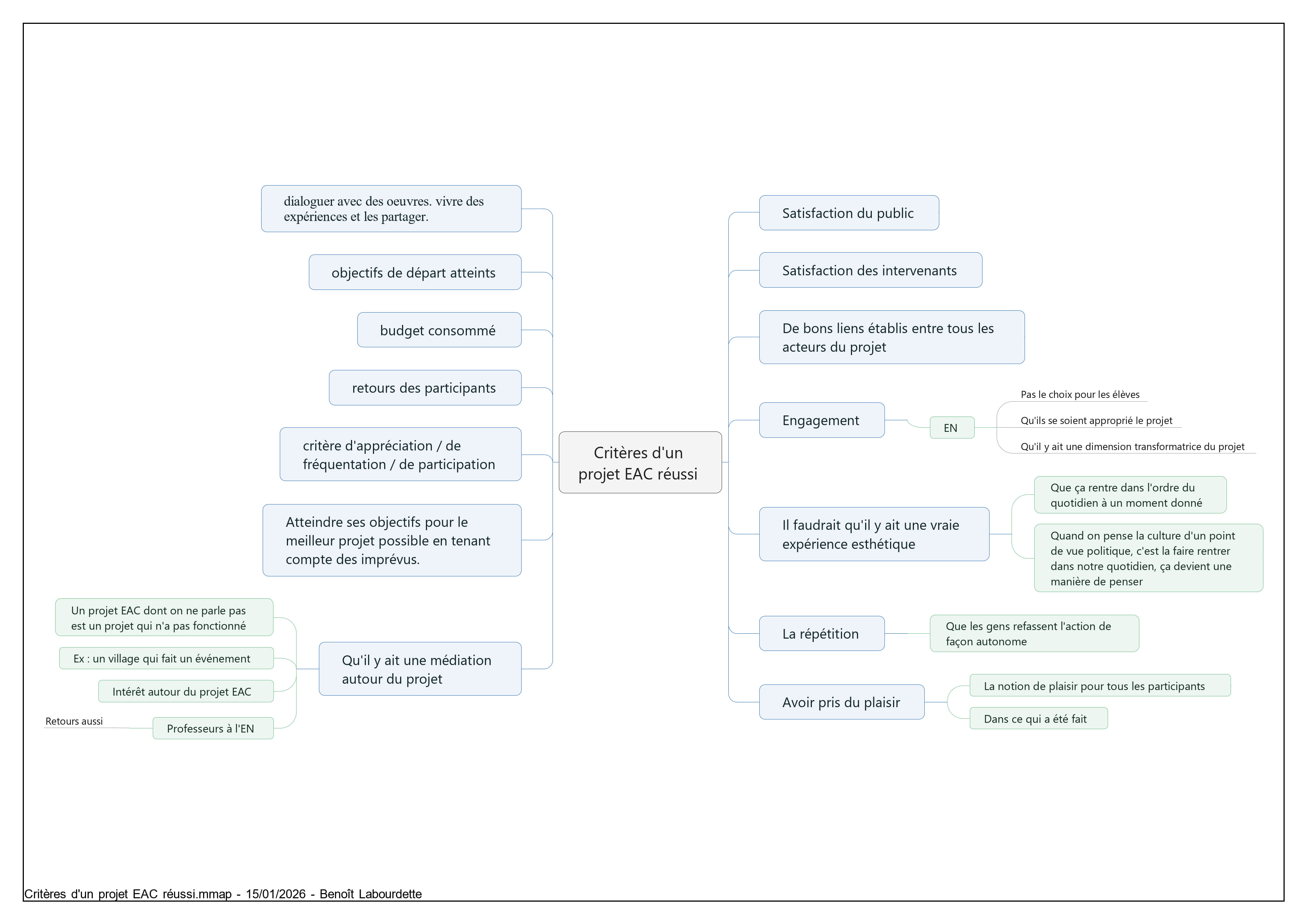
The session thus began with a collective gathering around a simple question: “In your view, what are the criteria for a successful arts and cultural education project?” This approach, inspired by brainstorming and mind-mapping techniques, allows us to start from the representations and experiential knowledge of the participants rather than imposing a conceptual framework from the outset. As the Brazilian pedagogue Paulo Freire pointed out in his Pedagogy of the Oppressed (1968), education cannot be a simple deposit of knowledge into empty containers: it must start from what people already know and develop through dialogue.
The participants’ responses were remarkably rich and formed the foundation for all the reflection that followed. Among the criteria mentioned: the satisfaction of the audience and the practitioners, the quality of the bonds established between the project’s stakeholders, the appropriation of the project by the participants despite the sometimes constrained nature of their presence (especially in school contexts), the transformative dimension of the experience, the pleasure shared by all protagonists, the ability of individuals to reproduce the action independently, and the existence of mediation around the project to talk about it and let it shine beyond the circle of direct participants.
This last remark, made by one of the participants, particularly struck me: “An ACE project that is not talked about is an ACE project that did not work.” This intuition aligns with a conviction I will develop further: the importance of documenting processes and creating the conditions for a shared memory of lived experiences.
Art as Experience: A Philosophical Foundation for ACE
To understand what it means to evaluate an arts and cultural education project, it is necessary to clarify what is meant by “art” in this context. I rely here on the thought of the American pragmatist philosopher John Dewey, whose work Art as Experience (1934) profoundly renewed the understanding of the aesthetic experience. For Dewey, art is not reducible to an object—a painting, a sculpture, a literary work—but fundamentally designates the experience lived by a person in their encounter with that object, or even with natural phenomena like a sunset.
This conception has major implications for ACE practice. It shifts attention from the produced object to the lived process, from the work to the experience of the people participating in it. The role of the visiting artist, in this perspective, is not so much to transmit a technique or to have objects produced that conform to certain aesthetic criteria, but to create the conditions for people to live an authentic artistic experience. It is, as I told the participants, “to ensure that people—citizens—can live an artistic experience.”
It is interesting to note that this philosophy of experience has irrigated many pedagogical currents of the 20th century. Célestin Freinet, founder of “Modern Education” in France, was directly influenced by Dewey’s writings on education. Later, Paulo Freire developed a pedagogy of emancipation in the favelas of Brazil, himself inspired by Freinet. And this lineage extends to bell hooks, a major figure of intersectional feminism, whose reflection on teaching as a practice of freedom and the deconstruction of systems of domination owes much to Freire. All these approaches share a conviction: true education aims for the emancipation of the person, not their conformation to predefined standards.
Cultural Rights: A Framework for Rethinking Evaluation
One concept seemed particularly fruitful for equipping the reflection on evaluation: that of cultural rights. Formalized in the 2007 Fribourg Declaration and integrated into French legislation in 2015-2016, cultural rights have taken on increasing importance in cultural policies, to the point that the Ministry of Culture now has a directorate dedicated to their promotion.
What are cultural rights? They involve considering culture not as a corpus of legitimate works to be disseminated to a public—what is traditionally called “Culture with a capital C”—but in its anthropological sense: what constitutes us as individuals, our origins, our tastes, our practices, our ways of living and thinking. Cultural rights postulate that every person has the right to see their culture recognized and respected in its legitimacy. This does not mean that all cultural practices are equal on an aesthetic or ethical level, but that respect for human dignity requires respect for what constitutes people culturally.
The stakes are political and democratic. If a person feels that their culture is respected, that it is respectable in the eyes of institutions and professionals, they can grant it legitimacy in their own eyes and thus participate fully in the life of the city. Conversely, if we signal to someone that their tastes are “worthless,” that their culture is inferior to the one we claim to bring them, we undermine their dignity and compromise any possibility of openness and mutual enrichment.
This approach allows us to distinguish between two paradigms of cultural action. On one side, “cultural democratization,” inherited from André Malraux, which aims to allow the greatest number of people access to the great works of humanity through a top-down movement. On the other, “cultural democracy,” based on cultural rights, which postulates a horizontal movement of mutual enrichment between different but equally legitimate cultures. The nuance is important: it is not saying that everything is equal, but recognizing that everyone’s gaze has value and that the intercultural encounter can be transformative in both directions.
Neuroscience in the Service of Artistic Pedagogy
To understand why respecting cultural rights is a condition for learning, it is useful to take a detour through neuroscience. Psychologist Olivier Houdé, in his book Learning to Resist (2014), developed the concept of “cognitive resistance.” Learning, he explains, is resisting one’s reflex thinking, taking the time not to think what one already thought, and creating new neural connections. This process requires energy—the brain is the organ that consumes the most energy in the body—and necessitates emotional engagement.
However, to exercise this cognitive resistance, one must feel completely reassured and confident. If one is afraid of being judged, if one feels threatened, the brain immediately goes into protection mode: reflex circuits take over, and any possibility of learning or receiving an aesthetic experience is compromised. Take the example of a group of young people arriving noisily in a theater lobby and being sharply reprimanded: this stressful situation will neurologically prevent them from receiving anything from the show they are about to see. Their cultural rights have not been respected, and the conditions for learning are not met.
This neuroscientific perspective aligns with the work of psychoanalyst Alice Miller, whose book For Your Own Good: Hidden Cruelty in Child-Rearing and the Roots of Violence (1984) helped found the concept of “ordinary educational violence.” Miller shows how violence, even symbolic, inflicted on children in the name of their own good compromises their development and can engender violent societies. This reflection invites us to examine our own educational stances and to question what, in our practices, may constitute a form of symbolic violence toward the audiences we accompany.
Evaluating One’s Own Practice: The Role of the Visiting Artist
These considerations lead us to rethink the question of evaluation in ACE. How can one evaluate the impact of an artistic experience on another person? To be honest, it is extremely difficult, if not impossible. The lived experience belongs to the person who lived it; its effects may not manifest until years later, in unpredictable ways. We can certainly measure immediate satisfaction, but this says nothing about the profound transformations that may be taking place within the participants.
On the other hand, what the visiting artist can evaluate is their own practice. Have I been attentive to people’s cultural rights? Have I created the conditions for them to feel respected and confident? Have I left room for everyone to express themselves? Have I given varied roles adapted to multiple intelligences? Have I myself been enriched by this encounter? These questions constitute criteria for self-evaluation for the professional.
This process of evaluating one’s own practice is not a solitary one. In the fields of psychology, psychiatry, and psychoanalysis, professionals have access to practice analysis groups, supervisions, and peer-to-peer intervision. These mechanisms allow for collective reflection on one’s practice, receiving feedback from colleagues who have no stake in our projects, and gaining distance from our own stances. Unfortunately, such spaces are infinitely rare in the cultural and educational fields. This is why the tools developed within the framework of cultural rights, with their methodologies for cross-analysis of practices, seem particularly precious to me.
Restoring the Process, Not Just the Result
For me, one of the central points of reflection on evaluation in ACE concerns the question of “restitution” (the sharing or presentation of the work). In many projects, there is a moment where what has been achieved is presented publicly: a film screened for parents and funders, an exhibition in the school hallway, a performance in the village hall. These moments of restitution are important because they embed the work in social space, give it visibility, and allow participants to feel recognized.
However, these moments also carry risks. The pressure of restitution can create production mandates that contradict the project’s educational objectives. The visiting artist may be tempted to “take over” the final result to make it more polished or impressive in the eyes of authorities and funders. But in doing so, they “steal” a part of the creation from the participants, who may find themselves facing an object they don’t truly recognize as their own. One of the course participants shared the opposite experience: having prioritized the autonomy of the participants (in this case, young people with severe autism), she was confronted with the disparaging gaze of other professionals regarding a result deemed less “finished.” Both pitfalls are symmetrical and illustrate the structural tension between educational objectives and production objectives.
My proposal to resolve this tension is to shift the object of the restitution: restore the process, not just the result. To do this, one must document throughout the project: take photos, keep a logbook, and assign certain participants the role of “reporters.” These traces then allow, during the restitution, to tell the story of the journey lived by the participants, with its hesitations, its blocks, and its breakthroughs. The final result then takes its place within this broader narrative and is no longer subject solely to decontextualized aesthetic judgment.
This documentation of the process also benefits the participants themselves. Often, we don’t remember the experiences we’ve lived very clearly; we don’t identify the stages of our own progress. Symbolizing this process and preserving traces of it allows people to recognize themselves in a journey that was truly theirs. It is a form of appropriation that goes beyond the simple completion of an object.
The Shared Gaze: An Exercise in Democracy
To concretely illustrate these principles, I presented to the participants a simple exercise that I regularly practice in my interventions. It involves asking everyone to take a photo with their phone on a given theme—for example, here, “the evaluation of arts and cultural education.” The instruction specifies that the photo must have an artistic intention: not a literal illustration of the concept, but an image that evokes something personal, poetic, or felt.
Once the photos are taken, it is time for the “shared gaze.” The images are projected one after another, and the rule of the game is as follows: the author of the photo is not allowed to speak while it is being looked at. It is the others who reflect what they see in the image, what they feel, and the ideas it evokes for them. This exercise reverses the usual logic of restitution, where the author justifies what they have done.
What happens then is remarkable. The gaze of others makes the author discover things in their own image that they hadn’t seen themselves, even though they are there. “I took my photo quickly, and some people see symbolism, things. I tell myself: no, this is a joke, I never put all that in my photo!” And yet, it is there. The exercise reveals several essential things: the role of the unconscious in all artistic creation, the artist’s inability to totally control the meaning of their work, the fundamental polysemy of images, and above all, the fact that reception is as important as creation—art is indeed, as Dewey said, an experience.
This exercise also constitutes a lesson in democracy. Facing the same image, people can see very different, even opposing things. There is no single correct interpretation. This diversity of gazes is not a problem to be solved, but a wealth to be cultivated. “There is not one way of thinking that is the right one. There are mutual enrichments.” The evaluation criterion then becomes: to what level did we authorize the fact of being able to enrich one another?
Anthropology as Education: A Contemporary Perspective
These reflections find an echo in the work of the British anthropologist Tim Ingold, particularly in his book Anthropology and/as Education (2018). For Ingold, education can no longer be thought of as the transmission of knowledge from a knower to a learner. He proposes conceiving it as an inquiry conducted together, an experience of shared quest and research. The pedagogue is not the one who holds the knowledge, but the one who accompanies a process of exploration whose outcome is not predetermined.
This radical vision of education has strong implications for the visiting artist. It is not about transmitting “their” technique to people who would learn “their” ways of doing things. Rather, it is about proposing an encounter whose outcome is uncertain, which may produce results very different from what was planned, but which will enrich the participants and the artist themselves. Respecting the cultural rights of participants implies accepting that the encounter with them also transforms our own artistic practice.
The Framework as That Which Authorizes
One last point deserves to be developed: the question of the framework (le cadre). In everyday language, “framing” is often associated with the idea of containing or preventing overflow. In an educational context, we sometimes think of the teacher who “polices” the room so the artist can work in peace. But this conception of the framework is, in my view, reductive.
The framework, in the perspective I defend, is above all what authorizes. It is a kind of canvas of trust, bonds, and rituals that makes people feel authorized to express themselves, to take risks, and to walk their own path of emancipation. The framework involves the place, the objects, the way people are welcomed, the instructions given, and the way they are phrased.
A psychoanalytic concept is enlightening here: that of the “third object.” In a dyadic relationship (a knower facing a learner), there is always a risk of asymmetry and domination. But if the artist brings objects—brushes, papers, scissors, cameras—and shares them, these objects become symbolic “thirds” that mediate the relationship. The participants can seize them autonomously; they no longer depend exclusively on the artist to create. The question then becomes: is there a “third” in the situation I have created, or are we in a dyadic relationship where someone tells the others what to do?
Sharing Criteria: A Condition for Evaluation
Evaluation requires shared criteria. However, in professional ACE practices, evaluation criteria are too rarely discussed beforehand between the various partners of a project. The visiting artist, the teacher, the cultural mediator, the commissioning structure, the funding authority: all may have different criteria and different expectations, and that is normal. But if these criteria are not made explicit and discussed before the project, misunderstandings are inevitable at the time of evaluation.
This is why, in the projects I support, I systematically propose a time for sharing criteria at the start. This time may seem wasted, but it is actually fundamental. Sharing criteria means sharing reasons: why are we doing this project, what does each person expect from it, what will count in evaluating its success? It is not about everyone agreeing on a single set of criteria—differences in perspective are legitimate and enriching—but about knowing what the others’ criteria are and being able to discuss them.
This approach also has a broader political function. Evaluation is essential to the sustainability of ACE funding. We must be able to talk about it, tell what happened, show the processes, and defend projects to elected officials who do not always understand what all this is for. The visibility of what happens in arts and cultural education projects, which can be magnificent, is a major democratic issue.
Evaluation as a Tool for Progress
At the end of this journey, I would like to return to what constitutes, in my eyes, the specificity of evaluation in arts and cultural education. Art, fundamentally, cannot be evaluated, or at least not by the usual criteria of measurement and hierarchy. Art is an intention, a creation, a risk-taking, an experience that exceeds us. Evaluating an ACE project is therefore not about grading the aesthetic quality of the productions achieved.
On the other hand, we can evaluate the conditions we created for the artistic experience to be possible: respect for the cultural rights of participants, the quality of bonds and trust, the presence of third objects favoring autonomy, attention to the process and its documentation, and the space left for the gaze of the other and mutual enrichment. These criteria do not concern the result, but the process, and it is indeed the process that constitutes the heart of education.
Evaluation conceived in this way is not a judgment that sanctions, but a tool for reflexivity and progress. It allows professionals to step back from their practices, to identify what worked and what could be improved, and to share their experiences with their peers. It also helps make visible and understandable what is at stake in ACE projects—for the participants, the partners, the funders, and society as a whole. In this sense, evaluation participates in the democratization of arts and cultural education itself.
Bibliographic References
- Dewey John, Art as Experience, 1934.
- Freire Paulo, Pedagogy of the Oppressed, 1968.
- Houdé Olivier, Apprendre à résister, Le Pommier, 2014.
- Ingold Tim, Anthropology and/as Education, Routledge, 2018.
- Meyer-Bisch Patrice (dir.), Fribourg Declaration on Cultural Rights, 2007.
- Miller Alice, For Your Own Good: Hidden Cruelty in Child-Rearing and the Roots of Violence, 1984.
- Saqué Salomé, Sois jeune et tais-toi. Réponse à ceux qui critiquent la jeunesse, Payot, 2023.

Drawing on Benoît Labourdette’s 30 years of experience in the field of cultural innovation and his research and methodological work, the Benoît Labourdette production agency supports cultural policies in their need for innovation, better encounters with populations, use of digital tools and cooperation, definition of mediation strategies, and support for artistic teams, technicians and elected representatives. Our method is always based on collective intelligence, cooperation and empowerment of people and structures. We work with cities and other local authorities, national networks, institutions and associations.
-

Creating to think
A French-Finnish meeting at L’Alhambra in Marseille on 4 May 2026, as part of the Erasmus+ Visual Thinkers project.
On 4 May 2026, I facilitated a professional meeting at L’Alhambra in Marseille, organised by the Image Clé association as part of the European (…) -

The Book Archipelago
A proposal to elected representatives: making plural bookshops the backbone of territorial cultural policies.
Faced with the tensions running through the bookshop sector today, it is time to put an end to the sanctuary myth. Rather than seeking an (…) -

The photography workshop: creating, showing, looking together
Reflections on a hands-on workshop facilitated by Benoît Labourdette at the professional conference “Cinema, images and young people’s mental health”, held on 14 April 2026 in Romainville, France.
A workshop in nine small groups, fifteen minutes to produce a photograph, then a moment of collective viewing in which the authors remain silent (…) -

« Mental Health and Cinema »
Synthesis of the day “Young people, their images, their spaces: new paradigms” (14 April 2026)
Synthesis of a day of professional gatherings at the Le Trianon cinema in Romainville, bringing together the perspectives of professionals from (…) -

Mental health, young people, images: what are we talking about?
Text of Benoît Labourdette’s opening talk at the professional meetings held on 14 April 2026.
Before entering into projects, we need to pin down the words. Mental health, young people, images: three notions we often use together without (…) -

Transmitting cultural rights: a question of coherence
What facilitation methods reveal about our relationship with people.
How can we talk about cultural democracy within an authoritarian framework? How can we defend respect for each person’s culture while imposing a (…) -

Mental Health and Cinema - Experiencing the World Through Images
Two professional conferences in Romainville (April 14 and 15, 2026).
On April 14 and 15, 2026, ACRIF, as part of its coordination mission for Passeurs d’images in Île-de-France, is organizing two days of (…) -

Collaborative assessment of screen literacy education in Nouvelle-Aquitaine
Collective intelligence methodology, digital platform, and collaborative publication for ALCA (2026).
ALCA, Agence Livre, Cinéma et Audiovisuel en Nouvelle-Aquitaine, entrusted me with the methodological support for a collaborative assessment of (…) -

Media Literacy: Should We Judge or Guide?
Reflections based on the National Meeting of Regional Centers for Media Literacy (Rouen, March 16–17, 2026).
On 16 and 17 March 2026, Normandie Images organised in Rouen the national meeting of France’s regional image education centres (pôles régionaux (…) -

The Meaning of Mediation Methods in Arts and Cultural Education
When practice reveals what theory ignores.
Artists and professionals involved in arts education develop singular methods that most often remain implicit. I wish to lift the veil on the (…) -

Cultural Mediation as a Device for Symbolic Emancipation
Methodological Principles for a Horizontal Approach to Collective Creation.
Lived experience radically transforms our relationship to thought. Cultural mediation does not consist of transmitting knowledge but of creating (…) -

Evaluating Arts and Cultural Education from the Artist’s Perspective
Review of a course given at INSEAC: conceptual and methodological tools for cultural professionals.
On January 15, 2026, as part of the CNAM module EAC104 “Building tools to evaluate ACE projects: qualitative and quantitative survey methodologies (…) -

Developing Psychosocial Skills Through Artistic Practices
Methodological principles for an experiential approach.
Psychosocial skills (PSS) are now at the heart of public health, education, and child protection policies. The 2023-2027 intersectoral roadmap, (…) -

When thirty-five professionals discover their psychosocial skills through creative experience
A look back at the interprofessional seminar of January 12, 2026, in Limoges: a day where theory gave way to lived experience.
At the DRAC Nouvelle-Aquitaine, educators, teachers, caregivers, and cultural actors experienced together what it truly means to develop (…) -

Image Education and Citizenship: When Youth Professionals Rethink Their Practices
{{Reflections on the “Out-of-School Time” professional day that I co-designed with ALCA and the Gironde Departmental Council.}}
On December 2, 2025, around a hundred youth, animation, and culture professionals gathered at the MECA auditorium in Bordeaux to explore together (…) -

Art and Culture in the Service of Psychosocial Skills
Account of a founding seminar for professionals of the Judicial Protection of Youth in Limousin.
On November 27, 2025, the Limousin Regional Directorate of PJJ brought together its teams for a half-day of collective reflection on psychosocial (…) -

Youth and culture: for a radical change in posture
Giving young people the power to create, not just consume culture.
How can cultural institutions break out of their chronic failure with young people? By abandoning condescension to embrace a genuine cultural (…) -

Reinventing youth reception in cinemas
Remote training for cinema operators in Lot-et-Garonne.
How can we transform our cinemas into spaces for authentic encounters with 15-25 year-olds? This question guided an intense training session with (…) -

“Participatory creation as a laboratory for democracy?”
4th edition of the biennial festival of participatory creation - Les Rencontres de la Poudrerie - Théâtre des habitants - May 16 & 17, 2025.
Les Rencontres de la Poudrerie are a moment for reflection and co-construction, at the intersection of art forms and the practice of social life. (…) -

Pour une robustesse coopérative des projets culturels
Réflexion sur les modalités de coopération territoriale et d’évaluation.
Pour que les projets culturels puissent trouver pleinement leur sens social et devenir plus robustes face aux attaques politiques qui les jugent « (…) -

Design of a professional day on “Artistic and digital practices for young people”
Act’art, artistic and cultural action in Seine-et-Marne.
As part of its mission to promote collective intelligence by facilitating local think tanks, Act’art asked Benoît Labourdette to design, (…) -

OPC Media: “What if we changed our posture?”
How can we learn to consider the richness of teenage digital practices and avoid giving in to preconceived ideas?
How can we learn to consider the richness of teenagers’ digital practices and not give in to preconceived ideas? For Benoît Labourdette, if we (…) -

Itinéraire bis, the path of cultural rights
Action research conducted by the MPAA (Paris).
Accompaniment in the animation, production of traces and fabrication of the web platform resources of the research-action “Itinéraire bis, chemin (…) -

Helping young people and professionals to speak out: “Cultures and youth policies” national meeting
Observatory of Cultural Policies / Villeurbanne (TNP, May 11 & 12, 2023).
As part of the Rencontres nationales “Cultures et politiques de la jeunesse” (“Cultures and youth policies”), which brought the year of the French (…) -

"Culture, youth and digital: designing new modalities for cultural and educational projects
Sharing of methodological tracks and professional training.
Deconstructing preconceived ideas about digital transformation and developing projects adapted to young people.The cultural offer is sometimes (…) -

“Media College” platform for Périfééries
Creation of a digital collective intelligence tool.
To meet a need for creative, intellectual emulation and the production of ideas for one of the axes of the Saint-Denis (93) city’s bid for the (…) -

Giant digital brainstorming
Design and implementation of a digital collective intelligence tool.
Method of activating a vast contribution for the axes of a cultural project. The needIn the solidarity I had with the city of Saint-Denis’ bid (…) -

The Périfééries project’s heritage council of influence
Facilitating collective intelligence in a short space of time.
As part of Saint-Denis’s bid to become European Capital of Culture 2028, I led a collective intelligence session to collect proposals on the (…) -

Reinventing cultural projects with youth?
Proposal of questions.
While public cultural action aims to reach people in their great diversity, it is clear that it is often difficult to mobilize youth. However, (…)


-

For a Permanent Cultural Transformation Moving beyond political infantilization to rebuild our institutions.
Faced with budget cuts in arts education, cultural actors appeal to those in power. This posture of supplication reveals, in my view, a dead end. (…) -

Build antifragility for cultural projects Methodological proposal.
What methodology should be adopted to build cultural projects that have the capacity to tame uncertainty and thus become more deeply rooted in (…) -

Primary and secondary cultural practices For a cultural dialectic of public proposals.
Daily cultural practices (internal) are underestimated compared to external cultural offerings, yet the latter are secondary in people’s lives. (…) -

Presence in culture For a conscious emancipation.
I allow myself a critique of the Freudian paradigm: what if human nature were intrinsically good? And I propose the concept of “presence in (…) -

Artificial Intelligence and Educational Institution For a large language model in service of the republican project.
The announcement in September 2025 by the Ministry of National Education of an artificial intelligence intended for teachers constitutes a good (…)
